emmaus or bust

The Road to Emmaus, artwork by Daniel Bonnell

C. S. Lewis identified many of us as “ordinary privates in the huge army of the bereaved, slogging along and making the best of a bad job.”

Today is a struggle job for me. I went through my prayers this morning with monotone indifference. The reading of the Word was like a dried up fountain. I’m very close to tears and want very much to be left alone.

Very little is working out the way Sandy and I hoped (expected?) 333 days ago. I am slogging through sludge in heavy boots and an overfilled backpack. If I didn’t feel the need to preserve an iota of dignity I’d be tempted to throw my head back and scream. I’ll restrain myself.

When I left the house this morning I said barely ten words to Sandy, telling her, “Headed to the library. I love you.” How I longed for some quiet and introspection. I need to process; I need to think; I need to write.

🔹 🔹 🔹 🔹

Before heading out I grabbed the recent Plough Quarterly that arrived in yesterday’s mail and have it open before me now. The theme for the issue is, “PAIN & PASSION.” What a coincidence.

One of the opening articles features a Dominican order of Sisters who offer palliative care to dying patients in NYC. Here’s what got me: the older Sisters advise the newbies that (1) their ministry is just that; it requires they first attend to their own souls in Christ before they can love and offer mercy to their patients. And, (2), never forget that all their patients are terminal; the Sisters are there to lovingly prepare them for the next world.

Those same pieces of advice will do good for me today, if I pay heed. I can’t rise above this unless I receive the love of Jesus and trust him, first and foremost; and next I must resign to the dictum, once again, that I am not made for this world.

A page over, a pastor who lost his 22-year old to an aggressive form of lymphoma cancer wrote about his desperate search for solace against the backdrop of stupefying loss:

It was a tremendous relief to realize that we [he and his wife] are not strong people; we are plain, ordinary people. And if we need to cry, then cry. If we need to grieve, then grieve. Do it hard and deeply, and then move on.

Randall Gauger, In Search of Solace

That’s good counsel. I think I’ll cry.

🔹 🔹 🔹 🔹

I’ve spent some time this week with three people: N. T. Wright and a pair of disgruntled disciples on the road away from Jerusalem. Wright captures their mood with,

“They had been traveling up a road they thought was leading to freedom, and it turned out to be a cul-de-sac.”

N. T. Wright, The Challenge of Jesus

The thing is, the Emmaus Road disciples were having their debate in the early evening hours of Easter! They’d heard rumors about a Missing Body and certain women having visions, but instead of staying back and investigating they slogged their way home.

Jesus had already risen. The apex of redemptive history has just happened. The Blessed Hope of Mankind is alive! And they are grousing about how nothing has worked out the way it was promised.

About here is where I need to do some Soul Talk. I don’t mind that you’re here, but if you’ll excuse me: Soul, why are you downcast? Why are you in turmoil? Has Jesus not Risen?

Bring me your sorrow, and watch for the sunrise of the resurrection. Yes, truly there comes always a resurrection – a morning when hope is reborn and life finds new beginning. Wait for it as tulip bulbs anticipate the spring. The rarest blooms are enhanced by the coldness of winter…Your God is your maker. He is your defender. And He is mighty to save. Yes, He is not only mighty to save from sin, but He is mighty to save from despair, from sorrow, from disappointment, from regret, from remorse, from self-castigation, and from the hot, blinding tears of rebellion against fateful circumstances.

Francis J. Roberts, Come Away, My Beloved

These two, perhaps husband and wife (I think so), mourned the loss of hope. But, just then, a Man joined them in their walk of sorrow. Jesus was a Stranger to them but he gave both something they could carry the rest of their way home. The Resurrected One granted them their own resurrection. Did not our hearts burn within us?

I’m on the struggle bus today but I’ll be fine. My heart will live to burn again another day. Today I cry; tonight I’ll still be His. He’s resurrected my tired bones before and he’ll do it 10,000 more times before I get home. What I have is terminal; what he has is eternal.

Amen.

though there’s pain in the offering


Have you ever seen someone in pain who’s not handling it well? I know you have and I have too. It’s not pretty is it? They can become bitter. Sometimes they get angry and strike. For many, pain becomes their identity.

Last time I posted I shared from the life of Joseph. I’m tempted to do the same with this post because so much of his story fits inside this theme. In his stead I’ll share a brief glimpse into his father, Jacob.

There was a day in his life when a blood-soaked garment was brought to him by his sons. “He’s gone, Dad. Joseph’s dead, mauled by a lion.” Jacob was inconsolable.

Jacob knew pain. Think back to his wedding night. Recall the entire saga of Esau? Does his divinely dislocated hip ring any bells? Consider the twenty hard years of labor in Paddan-aram (interestingly, the verb associated with the place suggests this was where Jacob was ‘ransomed’; a necessary length of time for Old Jacob to meet New Jacob).

Because of these things, perhaps, Jacob had a fixation with death and trouble. He carried his pain with him into every season and well inside his old age. There’s another grievous pain he bore but I’ll get to that if time permits.

Any of those things would cause many a man or woman to go running for the hills. God won’t give you more than you can bear?

Please.

Say that to Jacob with a straight face.

The worst of times are not the last of times.

— John Piper

lament

Lament is one of those words that sounds too religious for us regular folk. But we cannot move forward without it. This is why so many get stuck in the dry docks of dismay.

Jacob lost 22 years of his life as the consequence of his sons’ great sins against Joseph, Tamar, and the men of Shechem. He is often seen sitting with his grief and unhealthy preoccupation with death.*

*Gen 37:35; 42:36; 42:38: 44:22, 27-29; 30-31; 45:28; 46:31

One of my regrets about life after my accident is that I didn’t take necessary time to grieve all that was taken from me. In the ensuing years I was often asked “Do you get bitter?” I replied, “No, never once.” And that was the truth.

Did I lament my loss? I did…eventually. TBH, I still lament. Something is wrong with this picture. My disability is not part of the new creation. Jesus wept at Lazarus’ tomb because it didn’t…belong. It stinks. It hurts. How long, O God?

I love how lament is described by an Anglican priest:

Lament is what happens when the promises of God collide with the reality of our lives, and we express that collision and call on God to harmonise the two.

— Revd Dr. Alastair McKay, St. Martin-in-the-field

The thing about lament, biblically understood, is that it always — always — leads to praise. To lament is to actively pursue God in the midst of your sorrow. It may be a long time coming but you eventually get there. Jacob spent 22 years locked inside his bereavement. Would he recover?

I’m a big fan of the minor key and the book of Job. My friends know how much I love a gloomy, overcast day. Barry Manilow’s saddest ballads were my favorite songs in high school and college. Don’t hate me, I’m still fragile about that.

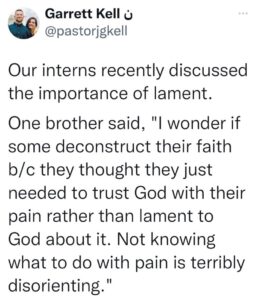
I’ve been through some stuff in my life, but I don’t ever recall a time when I’ve just wanted to pack it all in and jump ship. I scrolled through my twitter feed the other day and came across this share from a pastor I found quite enlightening:

That’s good. And painfully true.

Jacob is a case study in not dealing well with your hurt. You can’t tell me that his solemnity and despair didn’t rub off on his children. I imagine Judah or Simeon wondered aloud from time to time if they’d ever be more than a painful burr in their dad’s soul. Perhaps Reuben felt the scorn of being Leah’s son and that was all he could ever bring to the table.

But then there was a famine in the land. (Pay close attention to Gen 43:14)

It changed everything.

lessons learned

There came a day when Jacob got some news: his boy was alive! I’ve imagined how awesome it would be if I woke up tomorrow morning to see Graham at the foot of our bed! To realize it had all been a very bad dream. When I read of Jacob’s exhilaration, I feel that deep in my core.

Jacob had enjoyed Joseph for seventeen years in Hebron (Gen 37:2), and now he would get to enjoy Joseph for seventeen years in Egypt (Gen 47:28).

At 130 years of age Jacob made peace with his pain. In a long blessing over Joseph he invoked the name El Shaddai at the start and finished with Elohim at the close. Happy is the life that begins and ends with God!

Long before David called God his Faithful Shepherd, Jacob beat him to it. Jacob was the first person in Scripture to say that God “has been my shepherd all my life.” That sounds like a man at peace.

“I am about to die, BUT GOD…”

“But God.”

May this be your confession by his mercy and grace.

Allow me this one final splurge. Before you click away, I’d like to share the song whose lyric inspired the title of this post. Sandy chose this song as part of worship for Graham’s funeral. Yes, I said that. Funeral worship. We’ll see him again. Maybe not here, but when our lament has finished its course.

Amen.


I Wonder If There Were Cowbirds at the Manger

image
A female cowbird photographed through our dining room window on Christmas morn. She told me a story.


I had a new visitor Christmas morn.

While my bride battled a head cold on the sofa near the Christmas tree (one of seven displayed throughout our home), I brewed my morning coffee as the rain-soaked sky continued to gloomy-gus over our hamlet. Listening to the Keurig spit out my favorite Dark Magic blend (wish Green Mountain would choose a less nefarious name), I took my watch at the kitchen window to see the haps at the feeder. In that moment I noticed an unfamiliar addition to our backyard collection.

A genteel cowbird perched there amid raindrops, for all the world like she owned the place. Only, I’d never seen one in our yard before this.

Immediately, I went to the old bookcase (my iPad) and pulled a volume from the row of World Book encyclopedias (Google) to study what I could glean on the subject of brown-headed cowbirds.

I learned the female cowbird spends its energy on laying eggs, not building nests. And she’ll lay a lot! She’ll place her eggs in other birds’ nests (ranging from as many as 140-220 other host species), hoping her young will be favorably treated and cared for.

Just so, the Christmas blessing: God placed His Son in the borrowed ‘nest’ of a young woman who raised Jesus as her own, treasuring her Gift and releasing Him for His eternal work of redemption, desiring all to choose the Son of God.

I also discovered that many momma birds who get wise to the insertion of an alien egg will destroy it or cast it out. A female warbler might even construct a new nest on top of the original one now bearing the undesired foreigner. This reminded me that Jesus was “despised and rejected” by many (still the case) and “there was no beauty found in Him that earth-dwellers should desire Him.”1

One last τυπος (type) I uncovered from the cowbird’s relation to the message of Advent has to do with the Advent that we now long for: the return of Messiah to establish His visible Kingdom of righteousness and justice and rule over the nations of the earth.

It probably shouldn’t shock you to learn that mother cowbirds have been known to visit the nests of the birds that mistreated and rejected her young and completely destroy their dwellings. Um, I’ll just leave this right here and let you draw your own conclusions.

All this got me thinking: I wonder, amid the oxen and sheep, a donkey or two, and perhaps a spare milk-cow, there might not have been some birds flitting quietly about at the feeding-trough that Silent Night in Bethlehem.

I wonder if the Father might not have arranged to have a momma cowbird among the manger’s visitors. If the young parents of their firstborn had noticed, they might have understood more of the significance of that bundle. Perhaps, perhaps not. All I know is I saw it (again) this Christmas morn.


1 See Isaiah 53:2,3