the thirty percent

[5 minutes]

I have fought the good fight, I have finished the race, I have kept the faith. II Timothy 4:7


How important is it to you to finish well?

Biblical scholar and teacher Dr. J. Robert Clinton studied the lives of one hundred main characters in the Bible. What he discovered was hard to swallow. Fewer than 30% of them finished well.

Which people of the Bible might you add to a list of those who patterned exemplary faith? Joseph! Daniel, for sure. You have to include Ruth. Job had his moments, but he ultimately came forth as gold. Remember, it’s not about being perfect — or whether you stumble along the way (we all do!) — but rather how you finish.

There are noteworthy examples, but none more deserving than Paul. When I die, I hope with all my heart that I am able to echo what Paul confessed before he left this world:

I fought hard.

I ran a good race.

I’m ready.

“Finished” in the scripture highlighted above is τετέλεκα — an echo of the very proclamation Jesus made from the cross: It is finished. While the Savior completed his divine mission to perfection, Paul faced his own human death with Christlike finality.

Do you know what I really love about Paul’s ‘death-bed’ confession to Timothy? Ten years earlier, Paul had a shoreline meeting with some church elders at Ephesus when he declared at that time:

However, I consider my life worth nothing to me; my only aim is to finish the race and complete the task the Lord Jesus has given me—the task of testifying to the good news of God’s grace.

—Acts 20:24

A decade later, Paul sent a letter from a Roman prison to the young pastor of that same Ephesian church to say: “Mission accomplished.”

I fought the good fight.

I ran a good race.

I kept the faith for a good death.

Oh how I long to meet my Savior having the same bravado! I pray I’ll not to be a shipwreck or footnote.

In Clinton’s study only 50 of the 100 Bible characters researched had enough print about their life to determine whether or not they finished well. That means the other 50 didn’t have enough data points to know one way or the other.

Brothers and sisters, I don’t want anyone guessing about my life. I pray there is ample evidence to sift through! One day, by the grace of God, I hope a flag is planted over my bones that declares, “Here lies Scott Thomas Mitchell. He loved Jesus to the death.”

Last October one of my ministry heroes, Charles Swindoll, preached his final sermon at age 90. In a time of great shaking, scandal, heresy, and controversy in the pulpits, it is refreshing to hear of a man who faithfully ran his race and finished his course in a worthy manner.

And yet — shockingly — as the celebrated pastor was preparing for his exit, one of his own staff pastors was fired for moral misconduct a few months earlier. Two men. Two entirely different outcomes.

It’s a mercy of God that as we age our goals for end of life become more streamlined, focused. While in our younger years our dreams were all over the map, old age has a way of shaking them out and latching on to the ones that stick.

Early on in ministry I had a pastor/mentor say to me, ‘You know what my goal is? When I die, if they say ‘he loved God and he loved his wife and family’ then I’ve achieved my goal.’ At the time I thought that was incredibly lame. Years later, I get it. Such wisdom.

— an anonymous pastor

Aging Scott gets it, too.

Three verses after anticipating his own triumphant homegoing, Paul grieved about a man named Demas. Still bruised, the apostle sadly reflected over the tragic outcome of his former companion’s faith.

Howard Hendricks, a renowned seminary professor who died well in the Lord, interviewed 246 men in the clergy who had started out well but failed within two years. Here are some of the common threads he found in those 246 case studies:

  • None of the men was involved in any kind of real personal accountability.
  • Each of the men had all but ceased having a daily time of personal prayer, Bible reading, and worship.
  • More than 80 percent of the men became sexually involved with the other woman after spending significant time with her, often in counseling situations.
  • Without exception, each of the 246 had been convinced that sort of fall “would never happen to me.”

It’s not only pastors or church leaders who should be wary of finishing poorly. In a letter to a congregation in Greece, the apostle Paul offers this solemn charge: “So, whoever thinks he stands must be careful not to fall.” (1 Cor. 10:12)

Consider for a moment this alarming statement:

In American Christianity today, there are more defections than conversions. 

— The American Beliefs Study, 2022

There is plenty of evidence corroborating people leaving the institutional church, but the above annotation is taken from a study of those leaving the faith.

Jesus himself knew the sting of such numbers. As the gathering shadows fell across his popular ministry years, a raft of followers decided his way was no longer their way.

Finishing well is hard work. Paul called it a fight, a grueling race to be legged out. The world, the devil, and our greedy flesh each distract and frustrate us to no end. We drop the baton. Knock over a hurdle or two. Or three. We get downcast. We fall and lose precious ground. But we keep legging it out.

The race isn’t over. Wherever you are on the track, beloved, there’s still time to jump back in. Run for the prize. Compete for the crown. Be one of the 30%.

Keep fighting the good fight.

Stay the course.

And finish well.

Selah, and see you at the finish line, dear one.
the best of times, the worst of times: bethlehem and ramah

[5 minutes]

Happy New Year!

It is customary for many in our faith community to approach the new year with — in football lingo — a spiritual ‘fresh set of downs.’ So what’s one of the first plays we run? Right. We advance with a new Bible reading plan, right? My goal in 2025 is to tackle the New Testament along with the Psalms. Okay, enough with the football jargon.

So [opening my Bible], Matthew it is.

Matthew’s opening scenes are familiar for obvious reasons. My Advent meditations covered these passages and I quickly find myself here once again. I also spoke at a local church’s Christmas banquet using the same birth narrative as found in the first gospel. You may have read a version of it recently (“Keeping Jesus Out In Front“). I know this passage pretty well.

But, as is often the case for students of the Book, something can jump off the page that you’ve never seen before. You know what I’m talking about. That is what happened to me this morning.

Then Herod, when he saw that he had been tricked by the wise men, became furious, and he sent and killed all the male children in Bethlehem and in all that region who were two years old or under, according to the time that he had ascertained from the wise men.

Matthew 2:16

Then was fulfilled what was spoken by the prophet Jeremiah:
“A voice was heard in Ramah,
weeping and loud lamentation,
Rachel weeping for her children;
she refused to be comforted, because they are no more.”

Matthew 2:17-18

In the same carol as “glad tidings of comfort and joy” is this tragic verse of inconsolable grief and sorrow.

How do you reconcile “good news of great joy” with “weeping in Ramah” …in the same breath?

Not even ten verses earlier, Matthew goes out of his way to stack superlatives in describing the mood of the Magi when they found themselves on the right track to find Baby Jesus. The rejoiced exceedingly with great joy! The wise men were so deliriously happy they couldn’t contain themselves. High fives, back slaps, whoops and hollers commenced!

But things looked a whole lot different in Ramah and other surrounding towns.

Herod was furious. The Magi had agreed to bring him the baby king straightaway, but they changed the script on him and kept the child’s identity and location a state secret. Hotheaded Herod was beside himself.

Who is this baby???

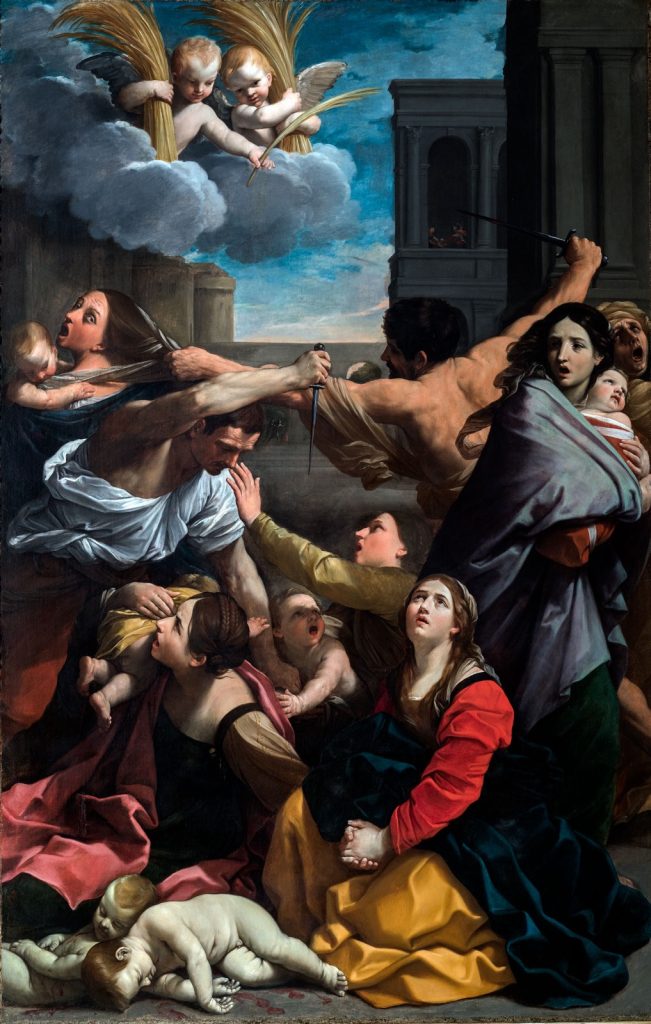
He would show them. Herod ordered a genocide of all the baby boys in the region and suddenly Judea’s Silent Night, Holy Night turned into terror. Like Egypt during the plague of darkness and death, only wails and loud weeping were heard across the land.

Okay. I didn’t like where this was going, but the Holy Spirit made me look. Here’s what I wrote in my Bible journal:

God will permit the deaths of innocents as he carries the story of redemption forward. There is weeping in Ramah though there be good news elsewhere.

Guido Reni’s Massacre of the Innocents

It was the best of times, it was the worst of times indeed. You can’t visit Bethlehem without hearing the wails of Ramah. That’s just how it is in this sad, tragic, very broken world.

Yesterday, in New Orleans, thousands were gathered on Bourbon Street to ring in the new year and enjoy the atmosphere around college football playoff game. Then, frenzy. Moments before a white pickup truck tore through a crowd of people, the streets were teeming with festive joy and frivolity. Seconds later, the sound of screams and sirens filled the night. Fifteen dead, dozens injured.

So what do we do with that paragraph I wrote? God permits the deaths of innocents, etc. How do we frame those words to people who are in shock over such a senseless act of terror? People who are likely to cancel you straight up for trying to pull the God-is-still-sovereign card.

I confess I want to keep my mouth shut. Just bury my nose in a book and don’t address it. But can we? There is the matter of timing, of course. Maybe don’t bring up Jimmy Carter’s political blunders on the day he died? There’s also the matter of courtesy. Waiting to be invited into the discussion instead of barging in and pontificating.

For the purposes of this post, I am speaking of an event that happened 2000 years ago not something that happened yesterday. The truth still remains, however. God does permit evil to bare its fangs now and then, but only in keeping with two incontrovertible rules:

  • God must win in spite of how everything looks right now.
  • the devil and his kingdom must be destroyed because it has been declared so from the beginning, and God can’t lie.

This world is broken and mercilessly mean, yes, but remember: God is broken-hearted by it; and he is the ONLY one with the power to change things.

Ramah is real. Rachel weeping for her children is our lot in this life. Evil people will do evil things and, I believe, 2025 is going to be filled with more evil and more weeping than in years past. Ramah is hard. Ramah is real.

But so is Bethlehem. “Jesus Joy” is real also.

Herod was the devil in Ramah, to be sure. But let’s not miss the bigger Story: Jesus still got born, shepherds told the news, souls got saved, the Church was born, Christ is exalted, the devil and his demons will burn in the lake of fire forever, and our King from heaven will return to dwell with us. And so shall we forever be with the Lord…in the eternal best of times. Weeping may last through the night, but the Man of Joy gets the final say.

Selah, beloved.

the book that understands me

[7.5 minute read]


For the word of God is alive and powerful. It is sharper than the sharpest two-edged sword, cutting between soul and spirit, between joint and marrow. It exposes our innermost thoughts and desires.

Hebrews 4:12

Two men. One, a former president, fashioned a Bible to his own liking; the other, a French professor, tried to do that but was ultimately pierced through by its unconquerable swordplay and aliveness.

Thomas Jefferson thought the supernatural and miraculous works of Jesus were greatly exaggerated, so he took a razor to them in his New Testament. Once he had trimmed away all but the most core and basic teachings of Jesus, he sat back and sighed, satisfied with his compact version he named The Life and Morals of Jesus of Nazareth.

The Jefferson Bible, is an 86-page dumbed-down testament of Enlightened Man. It disregards Jesus’s virgin birth, resurrection, and ascension, along with anything else that defied common sense and reason. Or so thought the 77-year old American statesman.

Across the sea, Émile Cailliet was born in Dampierre, France on December 17, 1894. He served in the French armed forces in World War I, and distinguished himself with many degrees from two universities. After coming to America, he served as a professor French literature at the University of Pennsylvania; Scripps College and Claremont Graduate School in California; and Wesleyan University in Connecticut. In 1960, he began to teach Christian philosophy at Princeton Theological Seminary, in which capacity he continued until his death in 1983.

The following is his remarkable story (in his own words) of coming to faith through the supernatural appeal of the Word of God:


I was born in a small village of France and received an education that was naturalistic to the core. This could possibly have had a great deal to do with the fact that I did not even see a Bible before I reached the age of twenty-three.


To say that this naturalistically inspired education proved of little help through front-line experiences as a lad of twenty in World War I would amount to quite an understatement. When your own buddy – at the time speaking to you of his mother – dies standing in front of you, a bullet in his chest, what use is the sophistry of naturalism? Was there a meaning to it all?


One night a bullet got me, too. An American field ambulance crew saved my life and later the use of a badly shattered arm was restored. After a nine-month stay at the hospital, I was discharged and resumed graduate work.


During my stay at the American hospital, I had married a Scotch-Irish girl whom I had met in Germany on Christmas Eve the year before the war had broken out. She was, and has always remained, a deeply evangelical person. I am ashamed to confess that she must have been hurt to the very core of her being as I made it clear that religion would be taboo in our home. Little did I realize at the time that a militant attitude often betrays an inner turmoil.


I had returned to my books, but they were no longer the same books. Neither was my motivation the same motivation. Reading in literature and philosophy, I found myself probing in depth for meaning. During long night watches in the foxholes, I had in a strange way been longing – I must say it, however queer it may sound – for a book that would understand me.


But I knew of no such book. Now I would in secret prepare one for my own private use. And so, as I went on reading for my courses I would file passages that would speak to my condition, then carefully copy them in a leatherbound pocket book I would always carry with me. The quotations, which I numbered in red ink for easier reference, would mead me as it were from fear and anguish, through a variety of intervening stages, to supreme utterances of release and jubilation.


The day came when I put the finishing touch to “the book that would understand me,” speak to my condition, and help me through life’s happenings. A beautiful, sunny day it was. I went out, sat under a tree, and opened my precious anthology. As I went on reading, however, a growing disappointment came over me. Instead of speaking to my condition, the various passages reminded me of their context, of the circumstances of my labor over their selection.


Then I knew that the whole undertaking would not work, simply because it was of my own making. It carried no strength of persuasion. In a dejected mood, I put the little book back in my pocket.


At that very moment, my wife – who, incidentally, knew nothing of the project on which I had been working – appeared at the gate of the garden, pushing the baby carriage.


It had been a hot afternoon. She had followed the main boulevard only to find it too crowded. So she had turned to a side street which she could not name because we had only recently arrived in town. The cobblestones had shaken the carriage so badly that she had pondered what to do. Whereupon, having spotted a patch of grass beyond a small archway, she had gone in with the baby for a period of rest.


It turned out that the patch of grass led to an outside stone staircase which she had climbed without quite realizing what she was doing. At the top, she had seen a long room, door wide open. So she entered.


At the further end, a white-haired gentleman worked at a desk. He had not become aware of her presence. Looking around, she noticed the carving of a cross. Thus she suddenly realized that this office was a part of a church building – of a Huguenot church edifice hidden away as they all are, even long after the danger of persecution has passed. The venerable-looking gentleman was the pastor.


She walked to his desk and heard herself say, “Have you a Bible in French?”


He smiled and handed over to her a copy, which she eagerly took from his hand; then she walked out with a mixed feeling of both joy and guilt.


As she now stood in front of me, she meant to apologize, but I was no longer listening to her.


“A Bible, you say? Where is it? Show me. I have never seen one before!”


She complied. I literally grabbed the book and rush to my study with it. I opened and “chanced” upon the Beatitudes! I read, and read, and read – now aloud with an indescribable warmth surging within. I could not find words to express my awe and wonder. And suddenly the realization dawned upon me: this was the book that would understand me!


I continued to read deeply into the night, mostly from the Gospels. And lo and behold, as I looked through them, the One of whom they spoke, the One who spoke and acted in them became alive to me.


The providential circumstances amid which the book had found me now made it clear that while it seemed absurd to speak of a book understanding a man, this could be said of the Bible because its pages were animated by the presence of the living God and the power of his mighty acts. To this God I prayed that night, and the God who answered was the same God of whom it was spoken in the book.


(Eternity magazine, July 1974).

The Book of books is alive and powerful. It doesn’t just “understand us,” it enlightens and enlivens us to know God intimately and equips us to thrive in this hard, unyielding world. As H.B. Charles, Jr. put it so well, “It is the will of God to have the Spirit of God use the Word of God to make the children of God look like the Son of God.”

May his Word accomplish its perfect work in you and me today.

Selah, beloved.