going out weeping, coming home rejoicing

[4 minutes]

They weep as they go to plant their seed,
but they sing as they return with the harvest.

Psalm 126:6

The Bible isn’t a guidebook, it is a life book. It’s not a collection of principles to live by, but life-giving truth to rest in.

With refreshing transparency, Andrée Seu Peterson confessed her once weak-kneed approach to scripture during a particularly painful season of grief. While “grousing” she read from another writer who leaned hard into the Word of God in her own similar season of trial.

In her book Won’t Let You Go Unless You Bless Me, Andrée Seu said she was more prone to “pursue minimum Christianity: saved by the blood, but entitled to grouse.” Patti McCarthy Broderick, however, believed when the Bible said ‘suffering produces character and character hope,’ it means that suffering produces character and character, hope.’*

Andrée Seu:

I, on the other hand, have interposed a baroque system of hermeneutics between the Bible and my life. I have seminary training. Unlike simple people who obey the Bible because they don’t realize how complicated it is, I find ambiguity in every verse. I don’t obey scripture, I discuss it.

She and Broderick had both heard the same statistics and psychological findings regarding the ‘natural’ course of grief and the amount of time needed to ‘process’ it. “I went with the statistics and gave myself permission to be as bad as I wanted to be. She, more simple-minded, files the following report: ‘So I chose instead to bank my life on scripture being true, and I was not going to let even well-meaning Christians talk me out of it’… 

Of Broderick, Andrée Seu said, “She took the Bible as practical…She made a conscious choice to trust in God, to take his word as truth, to see opportunity, and to wear his praises publicly on her lips. And she did not find him disappointing.”

It’s necessary to draw a distinction here between distrustful whining and trusting God even as we grieve. Some sorrows run so deep they may take years to heal. But at the heart of Psalm 126 is a promise that will never disappoint.

jerald

I still recall my friend Jerald’s beautiful exposition of this verse. Jerald served as my right hand man for several years when I was pastor in Douglasville, Georgia. I remember his teaching as if it was yesterday.

Picture it: God directs a farmer to take the precious seed, the last seed in the barn, and plant it in the dry soil of his field. It hasn’t rained for weeks.


What? Waste my seed? Why would I do that? How will my family survive?


See him as he kneels in the dust, taking the last of the seed and putting it into the dry ground. He’s risking everything on God’s coming through for his starving family. Tears fill his eyes as he surrenders to the soil, praying with uncertainty. He looks up at the sky. No clouds. He writes his sweaty brow. The seed does no good in his hands, so he presses it into the hard-packed earth.


The next week he hears thunder. He rushes outside and sees dark clouds filling the sky! Torrents of rain wash down on the farmer’s fields. The ground is suddenly bathed in precious streams of living water, as valuable to him as if he discovered gold.


He had wept when he planted the last of the seed but now he rejoices because he knows the Almighty has heard his cries and has seen his sacrifice. The farmer now laughs as he stands under the showers with arms raised to the sky…

I sat by Jerald’s hospice bed one Sunday morning when he quietly slipped off into eternity. Marie, his wife (and one of my regular readers!), joined me in singing as many verses as we could remember of Leaning On The Everlasting Arms as we kept vigil. Somewhere in the middle of the hymn, Jerald left this earthen sod.

In in his lifetime Jerald wept much because of cancer, but Marie and I were witnesses to the exact moment when her husband heard God’s gentle thunder inviting him Home. He took flight from his sick bed to where the fields of grace are always green, always growing, always lush with crops. I believe Jerald was laughing when he saw Jesus.

those who dream

Beloved, one day your soul’s deepest cries will be heard and you will be as one of those who dream about reaching the crest of the last hill after a long wilderness journey. Every thorn and desert, each and every stream of bitter water, and all the giants who towered over you and made you feel weak and unprotected, they will all be behind you, drowned in a sea of forgetfulness.

Oh, but beloved, it’s not a dream. It’s a promise for us too, not just for an ancient people who were just like us. Trust the Almighty Tear-Wiper. You will not find Him disappointing.

Those who sow in tears
shall reap with shouts of joy!

Psalm 126:5

One final word: this promise is not merely for those who cry in this life, but for those who are willing to sow their seed — trusting, believing, hoping — in the midst of their tears. They will be the ones dancing in the rain.

Selah, beloved.


*from her book He Said, “Press”: Hearing God Through Grief by Patti McCarthy Broderick
who told you?

“Who told you that you were naked? Have you eaten of the tree of which I commanded you not to eat?”

Genesis 3:11


[7 minutes]

There is a crisis of information today. No, not the lack of it, because, as we all well know, there are no limits to where we can find whatever we’re looking for whenever we need it. Alexa, how long does it take to boil an egg in the microwave? Hey Siri, what was the primary reason for the downfall of the Roman Empire?

Our appetite for knowledge is appeased through Google, ChatGPT, X, Apple News, Wikipedia, YouTube, Waze, Food Network, Zillow, and a thousand other sources as close to us as our devices. We are glutted with real-time data from every direction.

Suffering from the tyranny of FOMO, we bathe ourselves in digital light, robotically taking in whatever it feeds us — good or bad — for hours on end. Like junkies, our habit is fixed by mainlining content that is killing our souls. The Matrix is changing us from being made in God’s image to beings who slither around on our bellies like snakes.

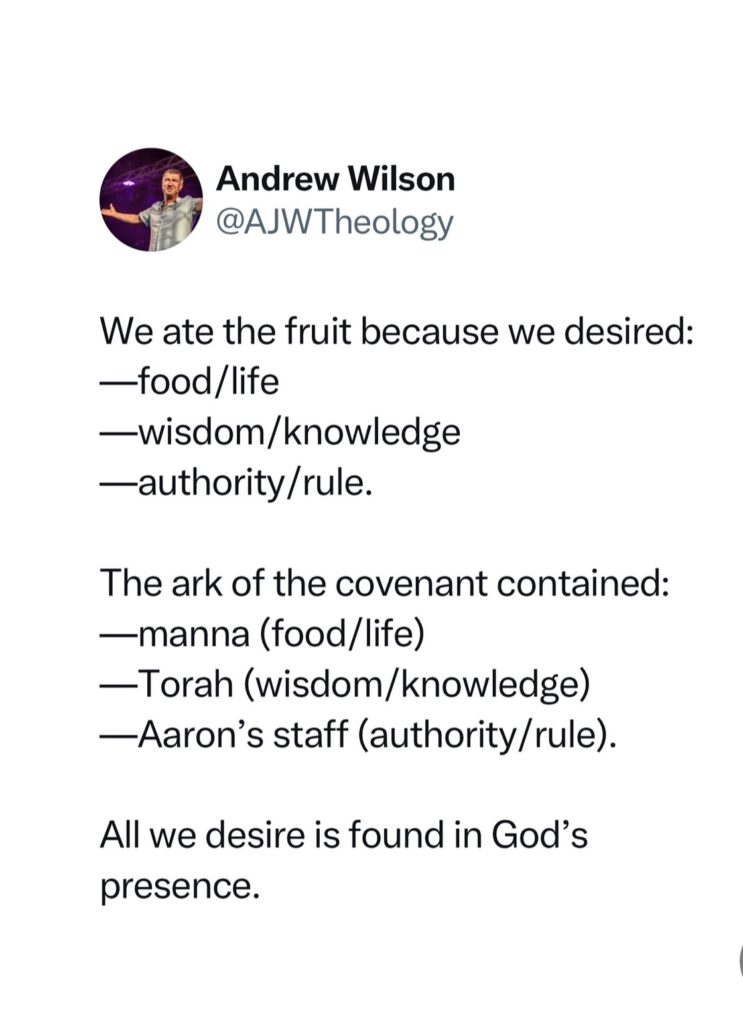
In the beginning, God was the only source of information. So when the Lord asked Adam, “Who told you?” the latter had to sheepishly admit to going off-script and getting hoodwinked by misinformation.

It all falls apart in Genesis 3. The First Man on planet earth had barely gotten his feet under him before he believed the lie and, tragically, became the lie itself.

who told you God can’t be trusted?

The sin underneath all our sins is to trust the lie of the serpent that we cannot trust the love and grace of Christ.

—Martin Luther

Thanks to the Original Couple, we have embedded inside us the default mechanism to accuse God of being spartanly unfair or cruel. It’s a constant battle for many to quell the urge to instinctively blame God for their misfortunes.

I find it telling that the first book in our Bibles — chronologically, that is — is not Genesis, but Job. Of course Adam and Eve walked the earth long before he did, but Job preceded the writer of Genesis by a long shot. If we can trust the dating of Job, and I believe we can, then it asks the oldest question of all: If God is so good then why do I hurt so badly?

Now you can see why Moses opened the canon with Genesis and the rest of the Pentateuch. Each of those first five books provides a master class for people who have a background of suffering and struggling to “not go there” when they are tempted to believe the lie that God cannot be trusted:

This is God. This is who he is. This is how he is to be worshiped. This is how he is to be trusted. Yes, bad things happen. We know this all too well! But God is not the villain in our story; he is fighting for us and faithfully planning our blessed future.”

Job fought that same urge and won. Moses had to do battle against the devil’s lie in Midian no doubt, but he overcame and led the people of Israel to leave Egypt and overcome in the wilderness. Those who didn’t make it were those who never got the taste of Egypt’s fruit out of their mouths.

One of my daily follows on X (Twitter) posted this recently and I thought it captured quite well the common struggle of mankind:

What good is the apple when one bite makes your life a living hell?

who told you God made you inferior?

In the first page of Holy writ we are told that humans are made in God’s image, in His likeness. By page two, Adam and Eve are no longer satisfied with that and looking for an upgrade.

The present culture has bullied impressionable minds to think they are not enough. Social media influencers, cultural icons, and even medical professionals have convinced an entire generation they are born wrong, look wrong, or believe wrong.

None of it is new. The satan has been using the same tactics to mar the imago dei in us since the beginning. He laughs at our gullibility. He loves to see us stripped of glory and dressed in fig leaves.

Babies are blobs of cells.

Children are an inconvenience.

Old people are a nuisance.

All men are misogynists.

Women are sex objects.

Gender is fluid.

Fathers aren’t necessary.

Families are a capitalistic construct.

We love our labels. Many of our labels serve no other purpose but to depersonalize others and erase the imago dei from their beingness. And the devil laughs.

who told you God was finished with you?

Did you think your shame defined you?

Did you think it was over for you?

Did you think you were beyond saving?

Adam and Eve were painfully aware they were now defective. The shine wore off. The original pair were like those brand new cars you drive off the lot that depreciate immediately.

This is why humans “cover” themselves with things that hide their weaknesses.

We become defensive.

We have learned how to hide our wounds to avoid the proper remedy.

We become deceptive.

We have learned to lie and, by so doing, have become the lie itself.

We become destructive.

We will burn down the whole house before admitting we are wrong and coming home.

From that point, once the die is cast, Adam and Eve no longer see the supernatural. They can’t see God, they can only hear him coming. Their souls weren’t the only thing that went dark; their eyes went dark too.

But, as it is written,
“What no eye has seen, nor ear heard,
nor the heart of man imagined,
what God has prepared for those who love him”—
these things God has revealed to us through the Spirit. For the Spirit searches everything, even the depths of God.

1 Corinthians 2:9-10

But God, in grace, made sure they knew his approach. We are told the very first words after the Fall were spoken by God:

“Where are you?”

He came seeking us. There’s grace in those words! Where are you? They imply they were somewhere they should not be but they still mattered enough for God to come looking for them. It’s the same for every human since.

You’ve messed up but you’re not irredeemable.

Your situation is not the end of the story.

We can’t hide too long without having to come out and face the music. It will catch up with us. We will eventually be outed. Better to come forward than die in the dark.

In Christ, we are not pursued like wanted criminals, but like wanted children, or like wanted lovers, because wrath is replaced by desire.

— Rachel Gilson

Don’t allow the voices and narratives of culture shape who you are. It’s fake news. Some of it has just enough truth to make it sound authentic, but it’s still a lie.

Beloved, God is not done with you. Wherever you’re hiding, whatever you’re trying to cover yourself up with to impersonate the imago dei, just stop. You may not see him, but he sees you.

I’m willing to bet you’re hearing his approach in these words. Why are you here? Who told you these lies? Come out, come back, come home. He’s calling you back to truer things than you’ll ever hear out there.

Selah, beloved.

the book that understands me

[7.5 minute read]


For the word of God is alive and powerful. It is sharper than the sharpest two-edged sword, cutting between soul and spirit, between joint and marrow. It exposes our innermost thoughts and desires.

Hebrews 4:12

Two men. One, a former president, fashioned a Bible to his own liking; the other, a French professor, tried to do that but was ultimately pierced through by its unconquerable swordplay and aliveness.

Thomas Jefferson thought the supernatural and miraculous works of Jesus were greatly exaggerated, so he took a razor to them in his New Testament. Once he had trimmed away all but the most core and basic teachings of Jesus, he sat back and sighed, satisfied with his compact version he named The Life and Morals of Jesus of Nazareth.

The Jefferson Bible, is an 86-page dumbed-down testament of Enlightened Man. It disregards Jesus’s virgin birth, resurrection, and ascension, along with anything else that defied common sense and reason. Or so thought the 77-year old American statesman.

Across the sea, Émile Cailliet was born in Dampierre, France on December 17, 1894. He served in the French armed forces in World War I, and distinguished himself with many degrees from two universities. After coming to America, he served as a professor French literature at the University of Pennsylvania; Scripps College and Claremont Graduate School in California; and Wesleyan University in Connecticut. In 1960, he began to teach Christian philosophy at Princeton Theological Seminary, in which capacity he continued until his death in 1983.

The following is his remarkable story (in his own words) of coming to faith through the supernatural appeal of the Word of God:


I was born in a small village of France and received an education that was naturalistic to the core. This could possibly have had a great deal to do with the fact that I did not even see a Bible before I reached the age of twenty-three.


To say that this naturalistically inspired education proved of little help through front-line experiences as a lad of twenty in World War I would amount to quite an understatement. When your own buddy – at the time speaking to you of his mother – dies standing in front of you, a bullet in his chest, what use is the sophistry of naturalism? Was there a meaning to it all?


One night a bullet got me, too. An American field ambulance crew saved my life and later the use of a badly shattered arm was restored. After a nine-month stay at the hospital, I was discharged and resumed graduate work.


During my stay at the American hospital, I had married a Scotch-Irish girl whom I had met in Germany on Christmas Eve the year before the war had broken out. She was, and has always remained, a deeply evangelical person. I am ashamed to confess that she must have been hurt to the very core of her being as I made it clear that religion would be taboo in our home. Little did I realize at the time that a militant attitude often betrays an inner turmoil.


I had returned to my books, but they were no longer the same books. Neither was my motivation the same motivation. Reading in literature and philosophy, I found myself probing in depth for meaning. During long night watches in the foxholes, I had in a strange way been longing – I must say it, however queer it may sound – for a book that would understand me.


But I knew of no such book. Now I would in secret prepare one for my own private use. And so, as I went on reading for my courses I would file passages that would speak to my condition, then carefully copy them in a leatherbound pocket book I would always carry with me. The quotations, which I numbered in red ink for easier reference, would mead me as it were from fear and anguish, through a variety of intervening stages, to supreme utterances of release and jubilation.


The day came when I put the finishing touch to “the book that would understand me,” speak to my condition, and help me through life’s happenings. A beautiful, sunny day it was. I went out, sat under a tree, and opened my precious anthology. As I went on reading, however, a growing disappointment came over me. Instead of speaking to my condition, the various passages reminded me of their context, of the circumstances of my labor over their selection.


Then I knew that the whole undertaking would not work, simply because it was of my own making. It carried no strength of persuasion. In a dejected mood, I put the little book back in my pocket.


At that very moment, my wife – who, incidentally, knew nothing of the project on which I had been working – appeared at the gate of the garden, pushing the baby carriage.


It had been a hot afternoon. She had followed the main boulevard only to find it too crowded. So she had turned to a side street which she could not name because we had only recently arrived in town. The cobblestones had shaken the carriage so badly that she had pondered what to do. Whereupon, having spotted a patch of grass beyond a small archway, she had gone in with the baby for a period of rest.


It turned out that the patch of grass led to an outside stone staircase which she had climbed without quite realizing what she was doing. At the top, she had seen a long room, door wide open. So she entered.


At the further end, a white-haired gentleman worked at a desk. He had not become aware of her presence. Looking around, she noticed the carving of a cross. Thus she suddenly realized that this office was a part of a church building – of a Huguenot church edifice hidden away as they all are, even long after the danger of persecution has passed. The venerable-looking gentleman was the pastor.


She walked to his desk and heard herself say, “Have you a Bible in French?”


He smiled and handed over to her a copy, which she eagerly took from his hand; then she walked out with a mixed feeling of both joy and guilt.


As she now stood in front of me, she meant to apologize, but I was no longer listening to her.


“A Bible, you say? Where is it? Show me. I have never seen one before!”


She complied. I literally grabbed the book and rush to my study with it. I opened and “chanced” upon the Beatitudes! I read, and read, and read – now aloud with an indescribable warmth surging within. I could not find words to express my awe and wonder. And suddenly the realization dawned upon me: this was the book that would understand me!


I continued to read deeply into the night, mostly from the Gospels. And lo and behold, as I looked through them, the One of whom they spoke, the One who spoke and acted in them became alive to me.


The providential circumstances amid which the book had found me now made it clear that while it seemed absurd to speak of a book understanding a man, this could be said of the Bible because its pages were animated by the presence of the living God and the power of his mighty acts. To this God I prayed that night, and the God who answered was the same God of whom it was spoken in the book.


(Eternity magazine, July 1974).

The Book of books is alive and powerful. It doesn’t just “understand us,” it enlightens and enlivens us to know God intimately and equips us to thrive in this hard, unyielding world. As H.B. Charles, Jr. put it so well, “It is the will of God to have the Spirit of God use the Word of God to make the children of God look like the Son of God.”

May his Word accomplish its perfect work in you and me today.

Selah, beloved.