who told you?

“Who told you that you were naked? Have you eaten of the tree of which I commanded you not to eat?”

Genesis 3:11


[7 minutes]

There is a crisis of information today. No, not the lack of it, because, as we all well know, there are no limits to where we can find whatever we’re looking for whenever we need it. Alexa, how long does it take to boil an egg in the microwave? Hey Siri, what was the primary reason for the downfall of the Roman Empire?

Our appetite for knowledge is appeased through Google, ChatGPT, X, Apple News, Wikipedia, YouTube, Waze, Food Network, Zillow, and a thousand other sources as close to us as our devices. We are glutted with real-time data from every direction.

Suffering from the tyranny of FOMO, we bathe ourselves in digital light, robotically taking in whatever it feeds us — good or bad — for hours on end. Like junkies, our habit is fixed by mainlining content that is killing our souls. The Matrix is changing us from being made in God’s image to beings who slither around on our bellies like snakes.

In the beginning, God was the only source of information. So when the Lord asked Adam, “Who told you?” the latter had to sheepishly admit to going off-script and getting hoodwinked by misinformation.

It all falls apart in Genesis 3. The First Man on planet earth had barely gotten his feet under him before he believed the lie and, tragically, became the lie itself.

who told you God can’t be trusted?

The sin underneath all our sins is to trust the lie of the serpent that we cannot trust the love and grace of Christ.

—Martin Luther

Thanks to the Original Couple, we have embedded inside us the default mechanism to accuse God of being spartanly unfair or cruel. It’s a constant battle for many to quell the urge to instinctively blame God for their misfortunes.

I find it telling that the first book in our Bibles — chronologically, that is — is not Genesis, but Job. Of course Adam and Eve walked the earth long before he did, but Job preceded the writer of Genesis by a long shot. If we can trust the dating of Job, and I believe we can, then it asks the oldest question of all: If God is so good then why do I hurt so badly?

Now you can see why Moses opened the canon with Genesis and the rest of the Pentateuch. Each of those first five books provides a master class for people who have a background of suffering and struggling to “not go there” when they are tempted to believe the lie that God cannot be trusted:

This is God. This is who he is. This is how he is to be worshiped. This is how he is to be trusted. Yes, bad things happen. We know this all too well! But God is not the villain in our story; he is fighting for us and faithfully planning our blessed future.”

Job fought that same urge and won. Moses had to do battle against the devil’s lie in Midian no doubt, but he overcame and led the people of Israel to leave Egypt and overcome in the wilderness. Those who didn’t make it were those who never got the taste of Egypt’s fruit out of their mouths.

One of my daily follows on X (Twitter) posted this recently and I thought it captured quite well the common struggle of mankind:
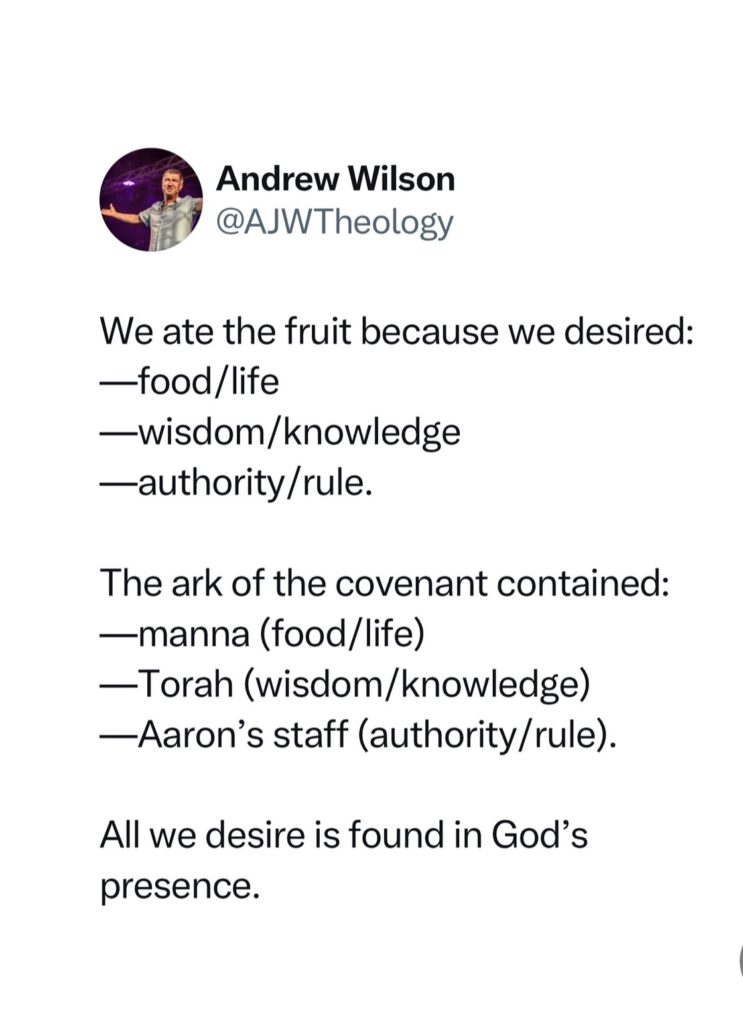
What good is the apple when one bite makes your life a living hell?

who told you God made you inferior?

In the first page of Holy writ we are told that humans are made in God’s image, in His likeness. By page two, Adam and Eve are no longer satisfied with that and looking for an upgrade.

The present culture has bullied impressionable minds to think they are not enough. Social media influencers, cultural icons, and even medical professionals have convinced an entire generation they are born wrong, look wrong, or believe wrong.

None of it is new. The satan has been using the same tactics to mar the imago dei in us since the beginning. He laughs at our gullibility. He loves to see us stripped of glory and dressed in fig leaves.

Babies are blobs of cells.

Children are an inconvenience.

Old people are a nuisance.

All men are misogynists.

Women are sex objects.

Gender is fluid.

Fathers aren’t necessary.

Families are a capitalistic construct.

We love our labels. Many of our labels serve no other purpose but to depersonalize others and erase the imago dei from their beingness. And the devil laughs.

who told you God was finished with you?

Did you think your shame defined you?

Did you think it was over for you?

Did you think you were beyond saving?

Adam and Eve were painfully aware they were now defective. The shine wore off. The original pair were like those brand new cars you drive off the lot that depreciate immediately.

This is why humans “cover” themselves with things that hide their weaknesses.

We become defensive.

We have learned how to hide our wounds to avoid the proper remedy.

We become deceptive.

We have learned to lie and, by so doing, have become the lie itself.

We become destructive.

We will burn down the whole house before admitting we are wrong and coming home.

From that point, once the die is cast, Adam and Eve no longer see the supernatural. They can’t see God, they can only hear him coming. Their souls weren’t the only thing that went dark; their eyes went dark too.

But, as it is written,
“What no eye has seen, nor ear heard,
nor the heart of man imagined,
what God has prepared for those who love him”—
these things God has revealed to us through the Spirit. For the Spirit searches everything, even the depths of God.

1 Corinthians 2:9-10

But God, in grace, made sure they knew his approach. We are told the very first words after the Fall were spoken by God:

“Where are you?”

He came seeking us. There’s grace in those words! Where are you? They imply they were somewhere they should not be but they still mattered enough for God to come looking for them. It’s the same for every human since.

You’ve messed up but you’re not irredeemable.

Your situation is not the end of the story.

We can’t hide too long without having to come out and face the music. It will catch up with us. We will eventually be outed. Better to come forward than die in the dark.

In Christ, we are not pursued like wanted criminals, but like wanted children, or like wanted lovers, because wrath is replaced by desire.

— Rachel Gilson

Don’t allow the voices and narratives of culture shape who you are. It’s fake news. Some of it has just enough truth to make it sound authentic, but it’s still a lie.

Beloved, God is not done with you. Wherever you’re hiding, whatever you’re trying to cover yourself up with to impersonate the imago dei, just stop. You may not see him, but he sees you.

I’m willing to bet you’re hearing his approach in these words. Why are you here? Who told you these lies? Come out, come back, come home. He’s calling you back to truer things than you’ll ever hear out there.

Selah, beloved.

the long game of God

istockphoto.com

[7 minute read]


I’ve begun rereading Philip Yancey’s Disappointment With God (highly recommend). His writing style has always appealed to me but his daring insights catch me out even more. Try this one on for size:

If you read Genesis in one sitting, you cannot help noticing a change in how God related to his people. At first he stayed close by, walking in the garden with them, punishing their individual sins, speaking to them directly, intervening constantly. Even in Abraham’s day he sent extraterrestrial messengers on house calls. By Jacob’s time, however, the messages were far more ambiguous: a mysterious dream about a ladder, a late-night wrestling match. And toward the end of Genesis, a man named Joseph received guidance in the most unexpected ways.

Genesis slows down when it gets to Joseph, and it shows God working mostly behind the scenes. God spoke to Joseph not through angels, but through such means as the dreams of a despotic Egyptian pharaoh…

…But shift for a moment to the perspective of God the parent. Had he deliberately “pulled back” to allow Joseph’s faith to reach a new level of maturity? And could this be why Genesis devotes more space to Joseph than to any other person? Through all his trials, Joseph learned to trust: not that God would prevent hardship, but that he would redeem even the hardship. Choking back tears, Joseph tried to explain his faith to his murderous brothers: “You intended to harm me, but God intended it for good….

— Philip Yancey, Disappointment With God, 71-72

Yancey really got me thinking about how God goes about his business…and not in the way we would expect. Of course you know this.

For example, the three matriarchs of Israel – Sarah, Rebecca, and Rachel – were each affected with some form of barrenness at one time or another. You would think that God, in inventing a new nation, would have the foresight to choose fertile young women who could pop out babies right and left on a whim to launch his people-project. Not so.

God seems to go about his business in less than flashy style, the hard way. A virgin-born baby in a frontier town. Barren matriarchs who are hardly able to eke out a child or two. The runt of the litter as king of the nation. Even in creation, one of the grandest displays of his majestic purposes, God throws out a little at a time: day one, wait, day two, I’m good, day three, that’s enough for now, and so on. Why not fling everything into being all at once in a monumental great big bang?

He scripted a Church that would stymie the gates of hell… and who did he choose as its first adapters? A handful of rough-and-tumble blue collar types; the foolish, weak, and despised. His M.O. was so frighteningly scandalous he picked the Sanhedrin’s favorite hit man to reform and apostle the growing church toward spiritual maturity.

We know God can dazzle (Matt 17:2) but he specializes in the unnerving manner (to us) of plodding and waiting and delaying. He doesn’t do things the conventional way. He’s not in a hurry and he doesn’t do flashy all that often. We want him to call down fire but he wants us to pray for our enemies. Even when he stepped out of character to curse a fig tree, he walked away from it, leaving it intact… until the next day.

He’s liable to tell us that he has big family plans for us so we get busy preparing the nursery only to have it sit empty for a quarter of a century. My ways are higher than your ways, he reminds us. He’s liable to hear that we are sick unto death then wait four days to show up. By then it’s our funeral, not our sick bed.

Jesus shied away from being coronated too soon and, on other occasions, curiously charged his healed followers to keep it between them and their priest. Turns out, he was playing the long game.

I know how disappointment with God can creep in and lead to discouragement. I’ve been there more times than I care to admit. You might be there yourself. Yancey dedicated his book “For my brother, who is still disappointed.”

A sorely disillusioned Sarah laughed over the prospect of pregnancy in her well-past-due date, and when she did so, exposed a deep well of hurt inside her. Maybe at sixty-five, she sniffed, but not hardly at ninety. God recognized it at once and spoke a sure word into her void: “Is anything impossible for the Lord…?” (Gen 18:14)

Whatever you’re going through, however difficult it seems, just keep on trusting Jesus. Sometimes we’d like it better if God stopped playing the long game and wrapped things up all nice and tidy. Quick like. Allow me to share something with you that has anchored my soul in these recent days.

“As it is, we do not yet see everything subjected to Him. But we do see Jesus…” (Hebrews 2:8-9, CSB)

Read that again. Slowly. Let your soul bathe in those words.

Here’s the thing that mollifies me today. What does the writer of Hebrews emphasize time and again about what Jesus is doing right now? He’s sitting. He’s not pacing and fidgeting; he’s not wringing his hands worrying over how to turn the tide.

Jesus is sitting down.

On a throne.

Reigning like a boss.

Right now we’re in the disquieting realm of “yes, but not yet.” We just had no idea how long not yet was going to last. But right now Jesus is ruling and reigning and interceding. Imagine: the King of the Universe has our names on his heart day in and day out and is working behind the scenes causing chief cupbearers to suddenly remember, giving dreams to Pharaohs, putting you on a different platform, orchestrating famines in other places to bring hungry families to your doorstep, and reconciling and subjecting all things – and persons – to himself. He’s not just “sitting around,” mind you, he’s quite busy making all things new.

The present seems pretty messed up, if we’re being honest. But if we can manage to squint through the fog and gloom of the present “as it is,” and adjust our focus, we’ll see it all coming together — in Christ Jesus — just as God promised long ago.

Don’t lose hope, dear one, long game notwithstanding; I won’t either. See Jesus and, in the comforting words of Julian of Norwich, “All shall be well, and all shall be well, and all manner of thing shall be well.”

Selah, beloved.

emmaus or bust

The Road to Emmaus, artwork by Daniel Bonnell

C. S. Lewis identified many of us as “ordinary privates in the huge army of the bereaved, slogging along and making the best of a bad job.”

Today is a struggle job for me. I went through my prayers this morning with monotone indifference. The reading of the Word was like a dried up fountain. I’m very close to tears and want very much to be left alone.

Very little is working out the way Sandy and I hoped (expected?) 333 days ago. I am slogging through sludge in heavy boots and an overfilled backpack. If I didn’t feel the need to preserve an iota of dignity I’d be tempted to throw my head back and scream. I’ll restrain myself.

When I left the house this morning I said barely ten words to Sandy, telling her, “Headed to the library. I love you.” How I longed for some quiet and introspection. I need to process; I need to think; I need to write.

🔹 🔹 🔹 🔹

Before heading out I grabbed the recent Plough Quarterly that arrived in yesterday’s mail and have it open before me now. The theme for the issue is, “PAIN & PASSION.” What a coincidence.

One of the opening articles features a Dominican order of Sisters who offer palliative care to dying patients in NYC. Here’s what got me: the older Sisters advise the newbies that (1) their ministry is just that; it requires they first attend to their own souls in Christ before they can love and offer mercy to their patients. And, (2), never forget that all their patients are terminal; the Sisters are there to lovingly prepare them for the next world.

Those same pieces of advice will do good for me today, if I pay heed. I can’t rise above this unless I receive the love of Jesus and trust him, first and foremost; and next I must resign to the dictum, once again, that I am not made for this world.

A page over, a pastor who lost his 22-year old to an aggressive form of lymphoma cancer wrote about his desperate search for solace against the backdrop of stupefying loss:

It was a tremendous relief to realize that we [he and his wife] are not strong people; we are plain, ordinary people. And if we need to cry, then cry. If we need to grieve, then grieve. Do it hard and deeply, and then move on.

Randall Gauger, In Search of Solace

That’s good counsel. I think I’ll cry.

🔹 🔹 🔹 🔹

I’ve spent some time this week with three people: N. T. Wright and a pair of disgruntled disciples on the road away from Jerusalem. Wright captures their mood with,

“They had been traveling up a road they thought was leading to freedom, and it turned out to be a cul-de-sac.”

N. T. Wright, The Challenge of Jesus

The thing is, the Emmaus Road disciples were having their debate in the early evening hours of Easter! They’d heard rumors about a Missing Body and certain women having visions, but instead of staying back and investigating they slogged their way home.

Jesus had already risen. The apex of redemptive history has just happened. The Blessed Hope of Mankind is alive! And they are grousing about how nothing has worked out the way it was promised.

About here is where I need to do some Soul Talk. I don’t mind that you’re here, but if you’ll excuse me: Soul, why are you downcast? Why are you in turmoil? Has Jesus not Risen?

Bring me your sorrow, and watch for the sunrise of the resurrection. Yes, truly there comes always a resurrection – a morning when hope is reborn and life finds new beginning. Wait for it as tulip bulbs anticipate the spring. The rarest blooms are enhanced by the coldness of winter…Your God is your maker. He is your defender. And He is mighty to save. Yes, He is not only mighty to save from sin, but He is mighty to save from despair, from sorrow, from disappointment, from regret, from remorse, from self-castigation, and from the hot, blinding tears of rebellion against fateful circumstances.

Francis J. Roberts, Come Away, My Beloved

These two, perhaps husband and wife (I think so), mourned the loss of hope. But, just then, a Man joined them in their walk of sorrow. Jesus was a Stranger to them but he gave both something they could carry the rest of their way home. The Resurrected One granted them their own resurrection. Did not our hearts burn within us?

I’m on the struggle bus today but I’ll be fine. My heart will live to burn again another day. Today I cry; tonight I’ll still be His. He’s resurrected my tired bones before and he’ll do it 10,000 more times before I get home. What I have is terminal; what he has is eternal.

Amen.