
though there’s pain in the offering


Have you ever seen someone in pain who’s not handling it well? I know you have and I have too. It’s not pretty is it? They can become bitter. Sometimes they get angry and strike. For many, pain becomes their identity.

Last time I posted I shared from the life of Joseph. I’m tempted to do the same with this post because so much of his story fits inside this theme. In his stead I’ll share a brief glimpse into his father, Jacob.

There was a day in his life when a blood-soaked garment was brought to him by his sons. “He’s gone, Dad. Joseph’s dead, mauled by a lion.” Jacob was inconsolable.

Jacob knew pain. Think back to his wedding night. Recall the entire saga of Esau? Does his divinely dislocated hip ring any bells? Consider the twenty hard years of labor in Paddan-aram (interestingly, the verb associated with the place suggests this was where Jacob was ‘ransomed’; a necessary length of time for Old Jacob to meet New Jacob).

Because of these things, perhaps, Jacob had a fixation with death and trouble. He carried his pain with him into every season and well inside his old age. There’s another grievous pain he bore but I’ll get to that if time permits.

Any of those things would cause many a man or woman to go running for the hills. God won’t give you more than you can bear?

Please.

Say that to Jacob with a straight face.

The worst of times are not the last of times.

— John Piper

lament

Lament is one of those words that sounds too religious for us regular folk. But we cannot move forward without it. This is why so many get stuck in the dry docks of dismay.

Jacob lost 22 years of his life as the consequence of his sons’ great sins against Joseph, Tamar, and the men of Shechem. He is often seen sitting with his grief and unhealthy preoccupation with death.*

*Gen 37:35; 42:36; 42:38: 44:22, 27-29; 30-31; 45:28; 46:31

One of my regrets about life after my accident is that I didn’t take necessary time to grieve all that was taken from me. In the ensuing years I was often asked “Do you get bitter?” I replied, “No, never once.” And that was the truth.

Did I lament my loss? I did…eventually. TBH, I still lament. Something is wrong with this picture. My disability is not part of the new creation. Jesus wept at Lazarus’ tomb because it didn’t…belong. It stinks. It hurts. How long, O God?

I love how lament is described by an Anglican priest:

Lament is what happens when the promises of God collide with the reality of our lives, and we express that collision and call on God to harmonise the two.

— Revd Dr. Alastair McKay, St. Martin-in-the-field

The thing about lament, biblically understood, is that it always — always — leads to praise. To lament is to actively pursue God in the midst of your sorrow. It may be a long time coming but you eventually get there. Jacob spent 22 years locked inside his bereavement. Would he recover?

I’m a big fan of the minor key and the book of Job. My friends know how much I love a gloomy, overcast day. Barry Manilow’s saddest ballads were my favorite songs in high school and college. Don’t hate me, I’m still fragile about that.

I’ve been through some stuff in my life, but I don’t ever recall a time when I’ve just wanted to pack it all in and jump ship. I scrolled through my twitter feed the other day and came across this share from a pastor I found quite enlightening:
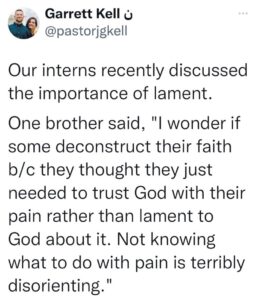
That’s good. And painfully true.

Jacob is a case study in not dealing well with your hurt. You can’t tell me that his solemnity and despair didn’t rub off on his children. I imagine Judah or Simeon wondered aloud from time to time if they’d ever be more than a painful burr in their dad’s soul. Perhaps Reuben felt the scorn of being Leah’s son and that was all he could ever bring to the table.

But then there was a famine in the land. (Pay close attention to Gen 43:14)

It changed everything.

lessons learned

There came a day when Jacob got some news: his boy was alive! I’ve imagined how awesome it would be if I woke up tomorrow morning to see Graham at the foot of our bed! To realize it had all been a very bad dream. When I read of Jacob’s exhilaration, I feel that deep in my core.

Jacob had enjoyed Joseph for seventeen years in Hebron (Gen 37:2), and now he would get to enjoy Joseph for seventeen years in Egypt (Gen 47:28).

At 130 years of age Jacob made peace with his pain. In a long blessing over Joseph he invoked the name El Shaddai at the start and finished with Elohim at the close. Happy is the life that begins and ends with God!

Long before David called God his Faithful Shepherd, Jacob beat him to it. Jacob was the first person in Scripture to say that God “has been my shepherd all my life.” That sounds like a man at peace.

“I am about to die, BUT GOD…”

“But God.”

May this be your confession by his mercy and grace.

Allow me this one final splurge. Before you click away, I’d like to share the song whose lyric inspired the title of this post. Sandy chose this song as part of worship for Graham’s funeral. Yes, I said that. Funeral worship. We’ll see him again. Maybe not here, but when our lament has finished its course.

Amen.



quiverfull

NOTE (6/5/23): In lieu of a certain documentary recently released regarding Bill Gothard and the IBLP’s various teachings — such as ‘quiverfull’ — I feel compelled to add this post is in no way influenced by his teachings!

I was reading an ‘anti-abortion’ scripture passage, when the Holy Spirit jostled my heart. A sudden parting of a curtain allowed me a peek inside a gospel mystery. In a quick instant my spiritual astigmatism vanished and I understood why God won’t march with the pro-abortion crowd.

Behold, children are a heritage from the LORD,
the fruit of the womb a reward.

Like arrows in the hand of a warrior
are the children of one’s youth.

Blessed is the man
who fills his quiver with them!

Psalm 127:3-5, ESV

If children are a gift from God, why stop at one? Why choose abortion? If you are able, have as many as you can! Double, triple, quadruple your gladness.

I mentioned the Holy Spirit entering the moment. His heart revealed the great gospel mystery in this. If children are among an earthly parent’s greatest pleasures, doesn’t it also say something about our Father and his heavenly family?

God, too, wants a “quiverfull” of kids! He wants his house teeming with children! Our Heavenly Father is a great big softie when it comes to parenthood. He just keeps adopting and adopting…and adopting…

He’s never birthed a mistake. Not one of his has ever been an inconvenience to him.

That’s all well and good, you say, but what do we make of this scripture?

Jesus traveled through cities and villages, teaching and making his way to Jerusalem. Someone said to him, “Lord, will only a few be saved?”

Luke 13:23, Common English Bible

We might expect Jesus to say something like, “Are you crazy? A few? Hardly a few, my good man.”

That’s not what he says, though.

Make every effort to enter through the narrow gate. Many, I tell you, will try to enter and won’t be able to.

Luke 13:24, CEB

So which is it? Does God want his house to be filled or does he want to limit who gets in? Well, based on Jesus’s teaching, both are true.

I’ve studied and puzzled and even lamented over this teaching for a long time. My conclusion is that there are many who believe in themselves — or religion — for their salvation.

By contrast only a comparatively few who, by submitting to the demands of justification — repentance and faith — can live with absolute, peace-filled assurance they are already and forevermore living in his house. That’s the difference between being in God’s family and eternal self-abortion.

Don’t forget the primary audience are Jews who are heavily influenced by their religion of works-righteousness. Consequently, they will be turned away at the door because they refused the gate (Jesus).

As for the “few who will be saved?” I’m looking at you Nicodemus. I’m also looking at you, Joseph of Arimathea. And you, Brothers James and Jude.

Don’t you know it took a lot of effort on their part to remain true to Jesus in spite of their affiliation with the sect of the Pharisees or as reluctant skeptics? Still, the Bible appears to give evidence to their true faith. They’re in God’s quiver.

There’s another guy in the Bible who testified that he made the grade among the religious folk, but had he not turned miraculously to Jesus, he would never have made the cut. I speak, of course, of Saul of Tarsus.

Do we really need to be reminded of the great effort Paul had to endure to be a follower of Jesus? He’s for sure in God’s great gospel quiver.

The eternal kingdom will look nothing like an old west Montanan territory with only a sprinkling of settlers spread out for miles and miles. Heavens, no. Our forever family will be a great big loud bunch of crazy shouting, dancing, and running kids. God wants it that way; he wants his house bulging at the seams.

I’ve shared a terrifying dream I had about Graham with some of you. About two or three nights after he passed away, I had a nightmare of him burning in hell. It was quite vivid; I could even hear him screaming from the abyss.

Then I remembered, or, more accurately, God reminded me he doesn’t inspire nightmares to provoke us to fear, the devil does. The accuser wanted me to think my son is lost forever.

The devil is a liar. While he wants our children dead, God is very pro-life. It’s not a political talking point to him, it is genuine. The Heavenly Father delights in bringing many sons and daughters into glory.

The devil wants you thinking you can do life on your own terms; God wants you to stop running.

The devil wants you falling from grace; God wants you falling into his arms.

The devil wants you to be a rebel; God wants you to know his rest.

The devil loves abortion; God is all about the quiverfull.

a gentle word

I want to open with a story, but it’s not mine to tell. It is an intensely personal story for Sandy and I needed to ask her permission before sharing it. She felt it was right and agreed. I’m grateful she did.

One word from your lips will be sweeter to us and more full of music than the harps of angels.

—Charles Spurgeon—

first, a story

During a particularly hard ministry season, Sandy got in her car and drove. She knew where she needed to go but didn’t want to. He’ll just tell me how wrong I am. He’ll quote scripture at me. He’ll tell me to have more faith, she fumed.

I don’t need a Bible verse, I need God to give me a break.

Her car seemed to know where to take her. Next thing my wife knew, she was in the driveway of the very address she didn’t want to see.

Sandy got out of her car and went to the front door and rang the bell. She couldn’t believe she was doing this, but when you’re at the bottom, you’ll risk anything.

The sweet couple who greeted her could see this wasn’t a social call. Sandy bravely fought back tears but it was no use. Tears welled and glistened in her eyes.

“I didn’t want to come,” she told them. “I didn’t know what else to do. I don’t feel I had anywhere else to go.”

Her heart ruptured. Every bottled up emotion was uncorked. No stone got unturned. Nothing in her life was working* and it shamed her to say it out loud to these people.

John and Patti listened quietly. Not once did they interrupt her, but let her disgorge her soul. When it was clear that she was finished, they both reached out and held her hand. There were noticeable tears in both pairs of eyes.

Then John said words that disarmed her. Most gently and tenderly he said,

There’s nothing for you to feel ashamed about, Sandy. Everything that is wrong in your life isn’t your doing. It’s all happening to you and there isn’t a single thing you can change. You have no options. You’re trapped.

John (and Patti) is a pastor, counselor, and friend. They are safe people. Never once did they offer tired rhetoric or warmed-over platitudes. Romans 8:28 didn’t make an appearance (though no less true). Their words said to Sandy’s broken heart, “We see you. We hear you. We feel your sorrow.”

That’s why God sent her there. He had something he wanted her to hear, and the faithful couple who knows us and loves us well were the perfect pair to tell Sandy what was on God’s heart.


a gentle reminder

There are times, as with Sandy, we feel God has abandoned us even if we’re not guilty of sin (see Job). We are “hard pressed on every side” from grievous pressures that don’t care one whit about our capacity to hold our own against them.

Other times, of course, we are the cause of our own pain and need to know God still loves us.

I recently finished both letters to the Corinthians and saw something near the end I’d not noticed before, and I’m very excited to tell you what I found. It’s a very gospel thing.

The Corinthians were a flawed bunch, yes? They were a puffed-up gaggle of rebels, idolaters, and rank adulterers. One could say the city of Corinth was a sewer plant and the church fanned the fumes.

The first letter got written because Paul got word of their antics and needed to address them. There was also a “painful visit” in there. And then he penned a “severe letter” that is lost. We’ll never know what he said in that one.

So I get over to the 7th chapter and am struck dumb by Paul’s heart in spite of all the tough talk. His heart is veritably bursting when he says this:

“We are comforted (and)…refreshed by you.”

2 Corinthians 7:13

And this:

“Our boasting (of you) has proved true.”

2 Corinthians 7:14

Behold, marvel at this curiously gentle stroking:

“I am acting with great boldness toward you; I have great pride in you; I am filled with comfort. In all our affliction, I am overflowing with joy.”

2 Corinthians 7:4

How extraordinary! To have these emotions and encouraging words for the people at Corinth in spite of how he addressed them in the previous chapter(s) is…well, astounding!

This speaks to my heart about the love of Jesus. Yes, he sees the filth and idolatry and unwholesomeness of our souls (and bodies), and yet his heart is “wide open” to us and speaks gentle words in the middle of his (sometimes) tough love.

He doesn’t over-emphasize the bad to the neglect of the good. You are loved, never forget that.

how does Jesus feel about me?

I would like for you to hear your Savior say this to you right now:

“ I rejoice because I have complete confidence in you.”

2 Corinthians 7:16

Okay, I know that’s what Paul said to the saints in that particular church. I don’t have trouble receiving that because I know Paul was “Christ” to them. He ministered from the same heart as Jesus.

Yes, they vacillated and backslid and married wrong and worshiped wrong and treated one another wrongly. And they would fail and fall again,

but the ones who still clung to Christ, even in their weakness and maddeningly misdirected affections, were gently and warmly loved by the Christ who saved them. He never let them go. His heart remained wide open to them.

Beloved, the same gospel goes for you, too!

The Corinthian believers (though not all) repented. For all their unruliness and out-of-jointedness, still, at the end of the day, they walked in repentance.

If you’re feeling the “severe letter” in your life is justified, don’t think you’re being written off by Jesus. Look to him, not your shame. For the unrepentant he’s writing other words not meant for you. Here’s what he’s gently saying to you:

And Jesus [says] to [you], As for myself, neither do I condemn you. Be proceeding and no longer go on sinning.

John 8:11, Wuest Translation, slightly altered by me

If you’re feeling the crushing weight of life “just because” (as in Sandy’s case), I’m praying for a merciful end to your sorrows.

The Holy Spirit’s eloquence gets muddled through my messengering at times, but I do hope you catch the gentleness of his voice. I pray the broken-hearted hear the Savior’s “I see you. I hear you. I feel your sorrow. Don’t be ashamed. I am for you.”

Selah, beloved.


*For Sandy to drop her hands and lose the fight is against everything that is in her. In this particular season, she was bearing the crushing weight of ‘losing’ her son, being responsible to her ministries at the church, fighting for my health, supporting me in my “daily pressure of anxiety” for our church, and holding down a hard-labor, high demanding job for health insurance.

[tipjarwp mode=”button” link_text=”Click here to buy me a coffee ☕️ Thank you!” open_style=”in_place”]