a gentle word

I want to open with a story, but it’s not mine to tell. It is an intensely personal story for Sandy and I needed to ask her permission before sharing it. She felt it was right and agreed. I’m grateful she did.

One word from your lips will be sweeter to us and more full of music than the harps of angels.

—Charles Spurgeon—

first, a story

During a particularly hard ministry season, Sandy got in her car and drove. She knew where she needed to go but didn’t want to. He’ll just tell me how wrong I am. He’ll quote scripture at me. He’ll tell me to have more faith, she fumed.

I don’t need a Bible verse, I need God to give me a break.

Her car seemed to know where to take her. Next thing my wife knew, she was in the driveway of the very address she didn’t want to see.

Sandy got out of her car and went to the front door and rang the bell. She couldn’t believe she was doing this, but when you’re at the bottom, you’ll risk anything.

The sweet couple who greeted her could see this wasn’t a social call. Sandy bravely fought back tears but it was no use. Tears welled and glistened in her eyes.

“I didn’t want to come,” she told them. “I didn’t know what else to do. I don’t feel I had anywhere else to go.”

Her heart ruptured. Every bottled up emotion was uncorked. No stone got unturned. Nothing in her life was working* and it shamed her to say it out loud to these people.

John and Patti listened quietly. Not once did they interrupt her, but let her disgorge her soul. When it was clear that she was finished, they both reached out and held her hand. There were noticeable tears in both pairs of eyes.

Then John said words that disarmed her. Most gently and tenderly he said,

There’s nothing for you to feel ashamed about, Sandy. Everything that is wrong in your life isn’t your doing. It’s all happening to you and there isn’t a single thing you can change. You have no options. You’re trapped.

John (and Patti) is a pastor, counselor, and friend. They are safe people. Never once did they offer tired rhetoric or warmed-over platitudes. Romans 8:28 didn’t make an appearance (though no less true). Their words said to Sandy’s broken heart, “We see you. We hear you. We feel your sorrow.”

That’s why God sent her there. He had something he wanted her to hear, and the faithful couple who knows us and loves us well were the perfect pair to tell Sandy what was on God’s heart.


a gentle reminder

There are times, as with Sandy, we feel God has abandoned us even if we’re not guilty of sin (see Job). We are “hard pressed on every side” from grievous pressures that don’t care one whit about our capacity to hold our own against them.

Other times, of course, we are the cause of our own pain and need to know God still loves us.

I recently finished both letters to the Corinthians and saw something near the end I’d not noticed before, and I’m very excited to tell you what I found. It’s a very gospel thing.

The Corinthians were a flawed bunch, yes? They were a puffed-up gaggle of rebels, idolaters, and rank adulterers. One could say the city of Corinth was a sewer plant and the church fanned the fumes.

The first letter got written because Paul got word of their antics and needed to address them. There was also a “painful visit” in there. And then he penned a “severe letter” that is lost. We’ll never know what he said in that one.

So I get over to the 7th chapter and am struck dumb by Paul’s heart in spite of all the tough talk. His heart is veritably bursting when he says this:

“We are comforted (and)…refreshed by you.”

2 Corinthians 7:13

And this:

“Our boasting (of you) has proved true.”

2 Corinthians 7:14

Behold, marvel at this curiously gentle stroking:

“I am acting with great boldness toward you; I have great pride in you; I am filled with comfort. In all our affliction, I am overflowing with joy.”

2 Corinthians 7:4

How extraordinary! To have these emotions and encouraging words for the people at Corinth in spite of how he addressed them in the previous chapter(s) is…well, astounding!

This speaks to my heart about the love of Jesus. Yes, he sees the filth and idolatry and unwholesomeness of our souls (and bodies), and yet his heart is “wide open” to us and speaks gentle words in the middle of his (sometimes) tough love.

He doesn’t over-emphasize the bad to the neglect of the good. You are loved, never forget that.

how does Jesus feel about me?

I would like for you to hear your Savior say this to you right now:

“ I rejoice because I have complete confidence in you.”

2 Corinthians 7:16

Okay, I know that’s what Paul said to the saints in that particular church. I don’t have trouble receiving that because I know Paul was “Christ” to them. He ministered from the same heart as Jesus.

Yes, they vacillated and backslid and married wrong and worshiped wrong and treated one another wrongly. And they would fail and fall again,

but the ones who still clung to Christ, even in their weakness and maddeningly misdirected affections, were gently and warmly loved by the Christ who saved them. He never let them go. His heart remained wide open to them.

Beloved, the same gospel goes for you, too!

The Corinthian believers (though not all) repented. For all their unruliness and out-of-jointedness, still, at the end of the day, they walked in repentance.

If you’re feeling the “severe letter” in your life is justified, don’t think you’re being written off by Jesus. Look to him, not your shame. For the unrepentant he’s writing other words not meant for you. Here’s what he’s gently saying to you:

And Jesus [says] to [you], As for myself, neither do I condemn you. Be proceeding and no longer go on sinning.

John 8:11, Wuest Translation, slightly altered by me

If you’re feeling the crushing weight of life “just because” (as in Sandy’s case), I’m praying for a merciful end to your sorrows.

The Holy Spirit’s eloquence gets muddled through my messengering at times, but I do hope you catch the gentleness of his voice. I pray the broken-hearted hear the Savior’s “I see you. I hear you. I feel your sorrow. Don’t be ashamed. I am for you.”

Selah, beloved.


*For Sandy to drop her hands and lose the fight is against everything that is in her. In this particular season, she was bearing the crushing weight of ‘losing’ her son, being responsible to her ministries at the church, fighting for my health, supporting me in my “daily pressure of anxiety” for our church, and holding down a hard-labor, high demanding job for health insurance.

[tipjarwp mode=”button” link_text=”Click here to buy me a coffee ☕️ Thank you!” open_style=”in_place”]


here i am, Lord, standing on the bottom step

I come to worship you, Lord. I desperately need it, but I’m having a hard time getting my head in a right place.

“Nothing in my hands I bring”?

Hardly. I come with wounds and weariness. There are stains on my soul. Battle stains. ‘I am for peace, but when I speak, they are for war’

…have mercy, O Christ…I am so, so tired…


Years ago I read a mostly forgettable book but for one sentence. That single line so resonated with me I can still quote it twenty years later. The author said, “Whatever the enemy wants to do to you he uses people to do it.”

Paul mentioned something to the Ephesians about the devil and his “fiery darts.” That’s real. If you’ve ever been in any kind of spiritual warfare you know it’s real.

Sometimes it’s an unkind text. Perhaps you caught an eye roll from your husband or a hurtful facial expression from your fellow staff member. Maybe you walked into a café and spotted your friend at a table with your least favorite person.

There was a time I had to take a strong stand as a pastor, and some of my dearest friends questioned my position. I had made enemies in the church and now even my friends were turning against me. Sandy and I were utterly bereft. I called my spiritual mentor and cried through the entire conversation. It was easily one of the lowest points of my life.

This was during a time our son was not doing well at all, constantly rebelling and deepening our sorrow. It was all too much. The devil was setting up bulwarks and laying siege to our home and Sandy and I felt completely cut off and alone.

Fiery darts, man. One day you’re going along happy as you please when a stranger cusses you out for trying to change lanes. Sometimes those fiery darts come in the form of words flung from people you are supposed to trust. Those are the hardest.

Sandy and I can easily put ourselves in the sandals of this pilgrim who has just come through a war zone. He stands on the bottom step of the temple, knees feeble, arms hanging. The man is spent. And he desperately needs a kind word from God.

In those seasons, of which we are in one now, the only comfort we have is the word of God.

Here we are, Lord, standing on the bottom step.

too stressed to bless

Psalm 120 is the first of fifteen worship songs created for pilgrims on their way to Jerusalem to celebrate a national feast day. The subscript in your Bible might read “ascent” since Jerusalem was “up” to the travelers; others call them “step” psalms to indicate the fifteen steps taking the pilgrims up into the Temple.

So this psalm is the very first step. Problem is, our soloist is already tired before he even begins. The journey starts out rough. This worshiper is struggling to get to church and now he’s wondering if he should even go. Maybe just turn this caravan around. Check out.

In my distress I called to the LORD…

Psalm 120:1

“Distress.” The word he uses in the opening verse means ‘rival wife.’ It’s possible he wants us to think about Hannah in 1 Samuel 1:6-7 where we find the same word. Read the highlighted text if you aren’t familiar with her story. The insults she got from her rival wife Peninnah were taunting her all the way to the tabernacle.

By the time she arrived, she was too stressed to bless the Lord. She went anyway. Hannah yearned for a kind word from God.

In some forms the word means ‘pebble’ and you can see how well that ties in. Ever tried to walk anywhere with a stone in your shoe?

What was so distressing? Why the furrowed brow, mate?

The very next verse tells us:

Deliver me, O LORD,

from lying lips,

from a deceitful tongue.

Psalm 120:2

Like Hannah, this weary worshipper was harassed by people who did not share his heart. They were unsafe. The taunts he received were an amalgam of bald-faced lies and honeyed words that hid a sharpened knife.

Our pilgrim in this story pulled into the church parking lot feeling like he’d been through a war zone. I’m pretty sure he wanted to put his feet in reverse and go home. Or maybe he realized he was home, the safest spot on earth.

“Woe is me!” he cries from the first step.


meshechites among us

Woe to me, that I sojourn in Meshech,

that I dwell among the tents of Kedar!

Psalm 120:5

Eugene Peterson sets the stage:

Meshech and Kedar were barbarian tribes with a reputation for wildness. They were neighbors to the biblical Hebrews. The person who prayed Psalm 120 was praying in the company of people who were on their way to worship God in Jerusalem but feeling immersed in enmity, lying lips, and a deceitful tongue. He is committed to a way of peace, God‘s peace, but he feels hostility all around him. ‘I am for peace,’ he says, ‘but when I speak, they are for war.’

—Eugene Peterson, Practice Resurrection, 135

Some people are always spoiling for a fight. They quite enjoy starting fires. Their demeanor is mostly antagonistic, but if you happen to catch them on a good day, count your blessings.

Our pilgrim worshipper had come through a string of bad days. Like a certain apostle, he was “troubled on every side…distressed…persecuted…knocked down.” There seemed to be no end to the assaults. Enmity was everywhere.


a closing word

Sometimes the enmity never lets up. You pray, plead, beg, cry, and practically crawl for resolution, but no help comes. Unfortunately, this psalm doesn’t end on a high note. However, we mustn’t forget a very important truth: the very next step offers a better view of things.

I hear you: Lord, hurry up and get me on the next step!

Sandy and I are right there with you.

If perchance you read on you’ll find the worshipper ascending to a new step. In fact, go ahead and read the next psalm now; we could all use some of its encouragement.

I’ll give you the highlights, the better vantage points from the next step:

  • My Source is true, theirs is a lie
  • My strength and hope comes from God
  • He’s wide awake; he sees what’s happening
  • He’s right beside me, protecting me

The last thing I’ll say is this. Our weary traveler is not alone. Yes, of course God is with him. But he’s also in a company of fellow travelers.

They’ve heard the taunts too. They’ve also been blindsided. They are people of faith of whom can be said, ”They understand. They’ve been there also. They have scars too.” Know they are standing with you on the first step, linking arms, holding you up.

No matter how bad I am feeling, how lost or lonely or frightened, when I see the faces of the people at my church, and hear their tawny voices, I can always find my way home.

—Ann Lamott

Selah, beloved.

[tipjarwp mode=”button” link_text=”Click here to buy me a coffee ☕️ Thank you!” open_style=”in_place”]

weak-shaming

I can’t walk.

It’s not a temporary condition. It doesn’t only afflict me on certain days. It’s lifelong. If my overhead lift in the bedroom loses power I have to wait for it to recharge just so I can perform the simple task of getting into bed. If the ramp on my van quits working I’m stuck inside until somebody comes by to help (hopefully someone who understands basic mechanics).

There are days my paralysis gets the best of me. A good cry usually gets me back to center. The Good Lord knows and I feel seen.

I’m weak. It’s my lot in life. Don’t cry for me, Argentina, it’s all good. One of the reasons I know so is because there’s a verse in the Bible about me.

Look at your situation when you were called, brothers and sisters! By ordinary human standards not many were wise, not many were powerful, not many were from the upper class. But God chose what the world considers foolish to shame the wise. God chose what the world considers weak to shame the strong.1

Don’t let my pastor hear this, but while he was preaching this morning I dug into the text he was expositing (Gospel of Mark, chapter 2, verse 13, yes I was listening) from my Bible app. I came across this beautiful nugget of a story from The Preacher’s Commentary:

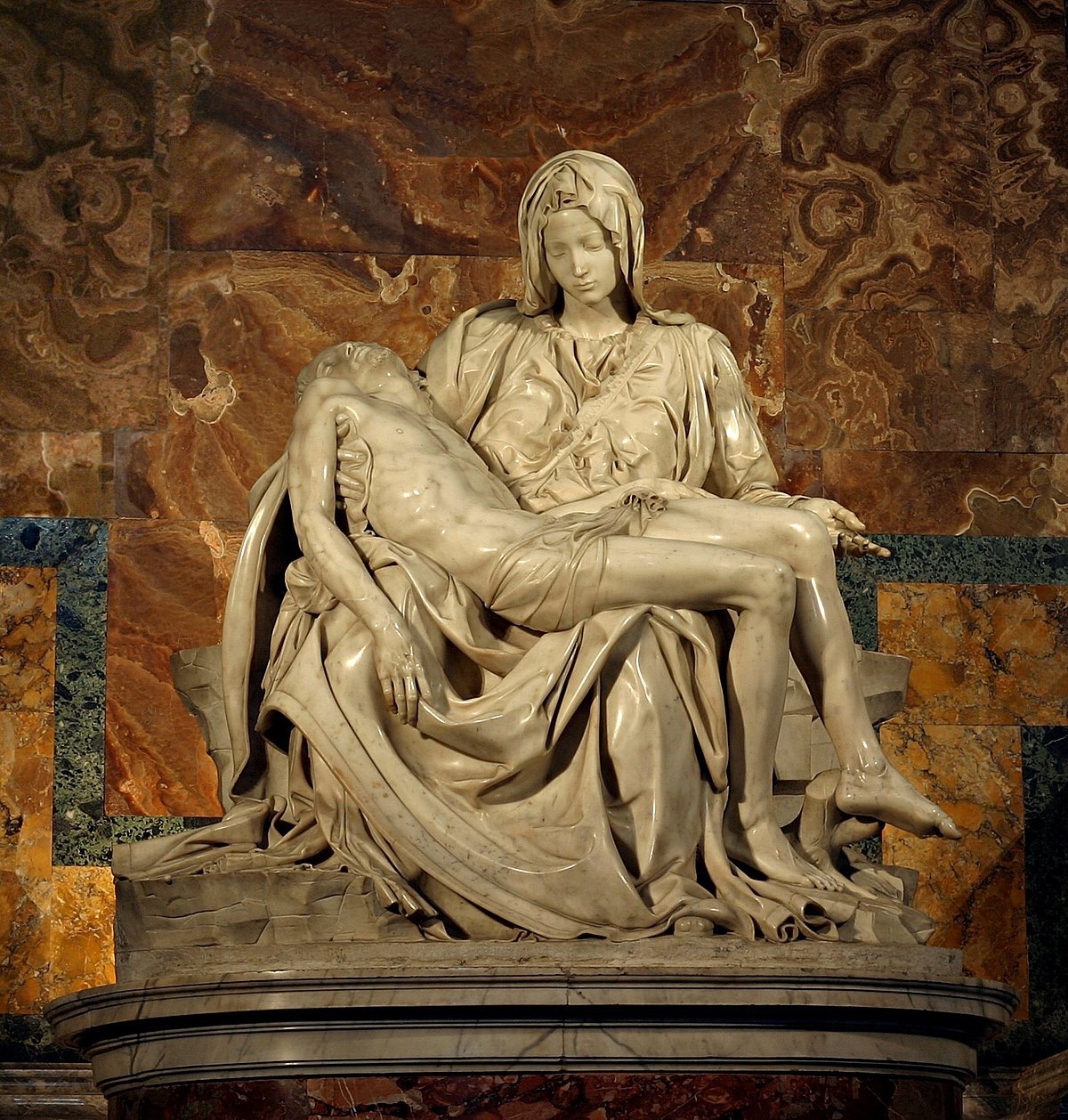
“To see Michelangelo’s Pietà—the sculpture depicting Mary holding her son, Jesus, after He was taken down from the Cross—is an overwhelming experience. Yet, the legend behind the stone is an inspiration in itself. Early in his career, Michelangelo was too poor to buy the marble for his sculpting. He had to pick his way through the rejected or ruined stones of other sculptors. As he eyed the marble, he said that he could see the figure inside waiting to be released by his chisel. Dragging it home, he freed the figures of Mary and Jesus that he envisioned and thus produced one of the miracles of artistic creation—from a reject.”2

Paul, the apostle, knew something about weakness. But he also knew something about God‘s workmanship. He said we rejects and castoffs are really God’s “masterpiece,” his artwork…his poem.3

Here’s N. T. Wright to add some flavor:

Those who are grasped by grace in the gospel and who bear witness to that in their loyal belief in the one God, focused on Jesus, are not merely beneficiaries, recipients of God’s mercy; they are also agents. They are poems in which God is addressing his world, and, as poems are designed to do, they break open existing ways of looking at things and spark the mind to imagine a different way to be human.


“A different way to be human.”

My, my, my. Sign me up because the world’s way of being fully human is turning into an inbred mess! There’s no rhyme or reason to humankind left to itself.

Are you feeling pretty weak about yourself today? Yeah, I bet you are. Losing the same battles over and over again, bumbling and fumbling and stumbling your way through life. Overlooked, unappreciated, dismissed. You’re mild-mannered Clark Kent in a superhero world. Nobody sees who you are on your way to becoming.

Newsflash, God specializes in weak-shaming.

First, he goes into the junkpile and finds the most unlikely materials and says, “I’m going to make something beautiful.” Next, he takes his chisel and chips away all the hard edges and smooths and grinds out all the rough spots. It takes some doing, but he gets us there.

All the patrons of the ages will see it and know they’re witnessing a miracle. They are hushed by the pure poetry of sight in graceful curves and righteous detail. The glory of the Artist shines through and they can’t be in the same room with all that glory; they know they don’t belong there. They bow and take their exit.

If I could tell you that you are one of the lyrics in God’s Epic Poem or a statue in his gallery you’d be happy as a pig in mud. Well, you are, right along with all us other weak sauce saints. Right now its all rough draft, but I know the publishing date is set and the unveiling is scheduled and your scars and embarrassments and deficiencies will make sense on That Day. There’s rhyme and reason for it all. Just you wait and see.

I can’t wait.

———————————————————————

1 1 Corinthians 1:26-27, Common English Bible

2 The Preacher’s Commentary, Dr. Stuart Briscoe, New Testament, Mark 2, Ministry of Hope

3 The Greek word for workmanship in Ephesians 2:10 is poiema.

Timothy Keller asks “Do you know what it means that you are God’s workmanship? What is art? Art is beautiful, art is valuable, and art is an expression of the inner being of the maker, of the artist. Imagine what that means. You’re beautiful, you’re valuable, and you’re an expression of the very inner being of the Artist, the divine Artist, God Himself. You see, when Jesus gave Himself on the Cross, He didn’t say, “I’m going to die just so you know I love you.” He said, “I’m going to die, I’m going to bleed, for your splendor. I’m going to re-create you into something beautiful. I will turn you into something splendid, magnificent. I’m the Artist; you’re the art. I’m the Painter; you’re the canvas. I’m the Sculptor; you’re the marble. You don’t look like much there in the quarry, but I can see. Oh, I can see!” Jesus is an Artist!” And you beloved are His crowning achievement, His masterpiece! (Precept Austin)