
the noonday devil

©️ Pasturescott

I am struck by this sledgehammer of words that careened off the page in the direction of my heart:

“The noonday devil of the Christian life is the temptation to lose the inner self while preserving the shell of edifying behavior.”

—Brennan Manning, The Ragamuffin Gospel, 135

Thank you, Father; I rather needed that.

So much so I find myself praying Manning’s closing chapter prayer aloud (and might again a time or two before it’s over):

Lord Jesus, we are silly sheep who have dared to stand before You and try to bribe You with our preposterous portfolios. Suddenly we have come to our senses. We are sorry and ask You to forgive us. Give us the grace to admit we are ragamuffins, to embrace our brokenness, to celebrate Your mercy when we are at our weakest, to rely on Your mercy no matter what we may do. Dear Jesus, gift us to stop grandstanding and trying to get attention, to do the truth quietly without display, to let the dishonesties in our lives fade away, to accept our limitations, to cling to the gospel of grace, and to delight in Your love. Amen.

—Brennan Manning, The Ragamuffin Gospel, p144

Amen, indeed.

It’s easy to point fingers at the collective church and say, “The problem with the American Church today is…” and leave ourselves entirely non-mea-culpa. We would do well to remember a Chesterton take on the subject:

When the The Times of London posed this question to several prominent authors: “What’s wrong with the world today?” well-known author and philosopher G.K. Chesterton is said to have responded with a one-sentence essay:

_Dear Sir,
__I am.
_Yours sincerely, G.K. Chesterton

The noonday devil tempts us to pretend we are an Instagram version of ourselves. And be okay with it.

I’ve learned much at the feet of David Pawson, now with the Lord. At one point in his ministry, rumors had been spread about the Bible teacher and speaking engagements were summarily cancelled.

Pawson was up in arms over the whole ordeal and complained vigorously to his wife. She told him to go the the Lord. He did. The Holy Spirit’s say in the matter was: “David, the worst they can say about you is not as bad as the truth.” He laughed. But the point was taken, with God adding, “I know the worst, but I still love you and will use you.”

That truth stuck with Pawson the remainder of his years. He even titled his autobiography, “Not As Bad As The Truth.”

As I once heard said, if our bosom sins were written on our forehead for all to see, most of us would be inclined to wear broad-brimmed hats everywhere we go.

Mr. Moody of Chicago once heralded,

“What we want is to be real. Let us not appear to be more than we are. Don’t let us put on any cant, any assumed humility, but let us be real; that is the delight of God. God wants us to be real men and women, and if we profess to be what we are not, God knows all about us. God hates sham.”

—Dwight Lyman Moody

Did you catch that? “…but let us be real; that is the delight of God.” It would seem the Father is waiting for us to shed the act and embrace the truth. For our own good.

In this selfie culture fascinated with filters, it might just be a sign of maturity to put ourselves out there completely unadorned by the deceptive magic of sham and confess to our ‘followers,’ “This is me. I am dark but lovely. I’m out here tending to vineyards but I’ve been neglecting my own.”

Why must we either surreptitiously rumor ourselves as the hero of our stories or manipulate public acclaim by using the tool of fake humility? Neither is the truth. Somewhere in the middle is true and honest. “Jesus is the hero of my story and I am his humble servant.” And mean it.

Back to Manning. One of the things I love about him is how he completely got over trying to impress (or as close to it as anyone I know). There is such a down-to-earth honesty in his oeuvre, as if he had been there, done that, and was so sick and tired of the whole nasty business of mask-wearing.

Are we prepared to live in community (and before the world) with this premium grade honesty?

Rich Villodas rightly observed, “Evangelical Christianity is often characterized by a deep desire to have ‘Christianity’ pervade our culture but not have Christ permeate our being.”

It may seem an odd thing, but I believe the world would sit up and take notice of this brand of being the church when we the saved are more known as image-bearers of Christ and to an infinitely less degree, image-protectors of self.

It’s high time we exorcised some demons. You know the kind: those “all-dressed-up-in-church-clothes“ demons who offer us phony piety at a discount price. I’m beginning to think they’re among the ones who come out only by prayer and fasting.

Just so you know, whatever you think of me, I can assure you it’s not as bad (or nearly as good?) as the truth. But this I know: God loves me in spite of it and it does me no good to pretend. How many would be spared a devastating fall from grace if they had preemptively confessed their sin to another?

Anyway, that’s what’s on my mind today.

Selah, beloved. (And you are.)

[tipjarwp mode=”button” link_text=”Click here to buy me a coffee ☕️ Thank you!” open_style=”in_place”]

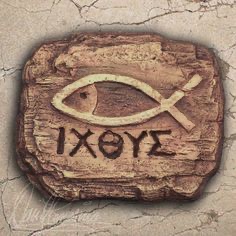
embrace the x

©️ Pasturescott

“X-mas” was close to a cuss word in the church circles in which I grew up. Borderline sacrilege. People who wished you a “Merry Xmas” weren’t truly Christian; that’s just the way it was.

We saw the ‘X’ as a scheme to rid Christ from the very holiday that celebrated His birth! While there’s still a part of me that thinks it’s true for some, I have recently come to an understanding that there’s something more honorable in play.

The early Church loved the ‘X’ (chi) in ιχθυς (ichthus) or Christ (Χριστός) as it was their shorthand for the Savior.

What in the world is ‘ichthus’?

You’re not going to find it in your Greek New Testament. Ichthus was a ‘code’ word invented by the first-century church to silently confess who they were to one another – at the risk of their lives.

The Greek letters in ichthus make an acrostic:

I (Iesous)

Chi, or X (Christos)

Theta (Theou)

Upsilon (Uios)

Sigma (Sotor)

The letters together spell ‘ichthus’ (ιχθύς) and the five Greek words they represent make this striking declaration:

“Jesus Christ, Son of God, Savior”

Sometimes, when the situation demanded, they shortened it with an ‘X’ or a two-stroke fish outline.

I’m not a ‘fish symbol on the car’ kind of guy but I can certainly truck with the idea behind them. Those emblems, whether on a business sign or the bumper of an automobile, are designed to tell passersby We worship Jesus Christ, (who is) the Son of God, (our) Savior.

So what about the ‘X’?

The chi (or ‘X’) is just what you might expect. It has connotations of the cross and was surreptitiously drawn as a sign passed between believers.

Back in those days Christianity was seen as a rogue religion, outlawed by the Roman imperial government. If you were a follower of Christ, there was always the danger of being outed, so Christians (Xians), people of ιχθυς, would use a quick sign (a two-stroke outline of a fish or an ‘X’) to assure another they were safe in their company.

Embrace the ‘Χ’ this Xmas. You can be assured you’re tracing a long history of committed, devoted worshippers of the Christ!

Still uncomfortable?

I understand. I still wince a little when I see it spelled that way. Think of it in another way:

  • X marks a treasure, and Jesus is certainly the inexhaustible supply of God, our Portion and Prize for eternity
  • X marks where you are on a map – that’s what Emmanuel is all about. Imagine yourself ‘here’ and then place an ‘X’ over that spot. He is with you!

Hopefully this Christmas post helps you see what the enemy wants to scandalize, God sanctifies. When I see ‘Xmas’ from here on, I’ll breathe a little easier knowing it really is about Christ…whether the world knows it or not.

Merry Xmas, beloved!

[tipjarwp mode=”button” link_text=”Click here to buy me a coffee ☕️ Thank you!” open_style=”in_place”]

just another miraculous birth?

“How will this be, since I am a virgin?”

— Mary, Luke 1:34

FreeBibleImages.com

If you know me at all, you know how much I love the writings of the late Eugene Peterson. The man has pastored my soul for decades. In one of his perhaps lesser known works, Christ Plays in Ten Thousand Places, he reminds us the birth of Messiah wasn’t the only miraculous birth in scripture, but it was the only one of its kind.

The eminent pastor turns our attention to pre-Advent scripture to briefly recount five miraculous births God was “critically and intimately involved in…”:

  • Abraham and Sarah (Isaac)
  • Manoah and unnamed wife (Samson)
  • Boaz and Ruth (Obed)
  • Elkanah and Hannah (Samuel)
  • Zechariah and Elizabeth (John)

And here is how he worshipfully distinguishes the heart-staggering birth of King Jesus from those earlier birth events:

The work of God in the conception and birth of Jesus through Mary is continuous with these five previous “impossible” births, but it is also different…

How so? we wonder.

In the mothers ranging from Sarah to Elizabeth, a barren womb was the impossible condition to overcome; these women very much wanted a child. But in Mary the “impossible” condition is virginity: here there is no yearning for or expectation of a child.

Christ Plays In Ten Thousand Places, 55-6

Peterson quotes Raymond Brown (The Birth of the Messiah, p314), who opens to us the compelling thought of this being the first and only birth through agency of a human womb in which God took the initiative.

It was all God’s idea!

In Mary’s case, she was a virgin who had no thought of bearing a child at that time. It was unthinkable to her. Maybe someday but not at this stage of her life, and certainly not as an unmarried woman!

Her pregnancy was ALL God’s idea! He wasn’t answering the cry of a barren couple, he was answering

Himself,

His own heart,

His own yearning.

This is the heart of Advent. This is the miracle and mystery of Christmas hope. Here is the gospel: God from the start has sought you, not the other way around. You weren’t even aware of your longing but that God was already at work filling your womb, your inner cry, with his life.

When Mary visited her cousin to tell her the news of her divine pregnancy, Elizabeth called her “Blessed!”

Allow me to put an ❗️on this post by pulling from another author I greatly admire. Picking up on Elizabeth’s same exuberant emotion, Brennan Manning applies it to all of us who are caught in the thrall of Christmas grace:

You are blessed! God’s desire is for you. And Jesus is the incarnation of God’s furious longing. He is your supreme Lover. It’s true. You are blessed. Your soul’s winter is over. The snows are over and gone. Flowers are blooming inside of you. The season of joyful songs has come. To you. You are blessed! The love of God is folly. No one is excluded. All (really!) are called to the banquet table. Come, and be filled. You are blessed! You can pray like a child, and enjoy God. You are blessed! Heal, and be healed…Amen. Amen. Amen.

Brennan Manning, The Furious Longing of God

Selah, blessed and beloved!

[tipjarwp mode=”button” link_text=”Click here to buy me a coffee ☕️ Thank you!” open_style=”in_place”]