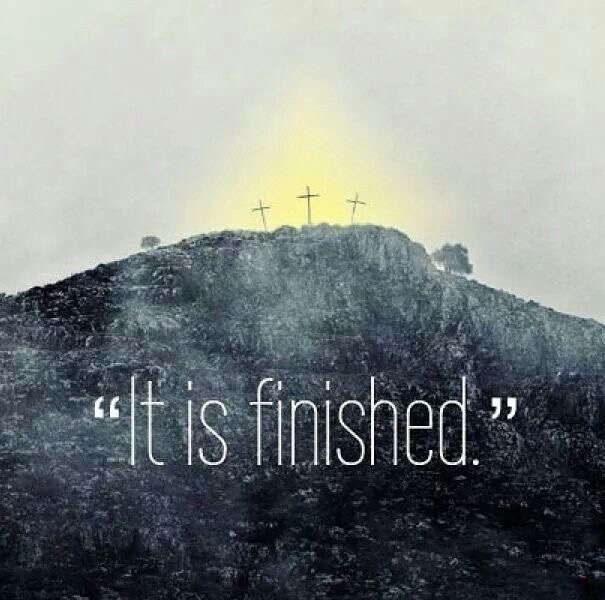
As I write it’s roughly 3:00 in the afternoon of Good Friday. We know this to be the time the most important words ever inserted into the human narrative were spoken by our Savior-King from a Roman cross:
Speaking of reversal – which is the heart of this post – I want to illustrate ALL THAT JESUS DID by going back in time and to another dispensation (I use the word guardedly as I am not a classic dispensationalist) to elicit an Old Testament example of how things stood under Law for centuries…and how Jesus reversed it in a weekend.
But first.
I loved preaching from the OT scriptures, and still do. I fear, however, that I preached much of it for many years without highlighting the Great Reversal that Jesus came to accomplish. I recall the many times I preached youth revivals laying the guilt on pretty thick with fiery expositions from the prophets but minus the encouragement that Jesus came to fulfill ALL the Law and has given us His new heart, a new living spirit, plus His Holy Spirit, His righteousness and the will and desire to walk in His ways (see Jeremiah 31:31,33 and Ezekiel 36:26,27).
May I never preach again without always bringing it back to the Gospel. Enough of leaving listeners with the impression they must do more, try more, sacrifice and give more to earn divine favor apart from the promises and benefits of the New Covenant. The earning is over. He reversed all that.
For instance, if you read about Abraham’s sacrifice of Isaac and your only takeaway is that God demands we sacrifice our very best in order to merit righteousness, you’ve (and I’ve) missed it.
The point of this story was wholly prophetic. God called Abraham, the father of saving faith for all, to sacrifice his son – nothing new for someone who spent decades in a pagan religious system that often demanded child sacrifice. When God interrupted his worship service, He was foretelling a time when the people would no longer have to sacrifice daily and yearly for divine cleansing but that He would become the sacrifice that ends ours!
That’s the chief point of that story: a Day is coming when God will provide an end-all Sacrifice for humanity through His own Son of Promise.
Am I saying we aren’t called on to lay our best on the altar at times? Of course not – but only in context of our worshipful response to His ultimate Sacrifice (see Romans 12:1), never as manipulation to earn favor. God reversed all that!
Oh! Just a thought: isn’t it telling when the author of Hebrews cites Abraham in his Hall of Faith, he doesn’t even mention the Genesis 22 story? It’s as if he’s saying that story is prophetic about Messiah Jesus – right down to the place (Moriah, the place of Jesus’ execution) and the MALE LAMB caught (Hebrew word meaning ‘stretched out’) in a wooden thicket!
But the story that I present as Exhibit A is the Law that states no Moabites are permitted in the assembly of the people when they present themselves to the Lord (see Deuteronomy 23:1-4). In the same passage we find those with deformities and disabilities are also excluded.
Wait. The disabled too? I mean, the Ammonites I get. The Moabites I have no problem understanding, given the reason. But me too?
You mean, God, if I’d been alive back then I’d be stopped at the gate and forbidden entry?
- Remember: when you’re reading the Old Testament and you come across a scripture that leaves you scratching your head and wondering about a Graceless God, what is He thinking, how can He be so cruel, etc., don’t forget to read it through the lens of the Great Reversal that is coming in the Paschal Lamb of God.
- Also: I’m a big believer in the truth that we can never be absolutely amazed and blown away by grace until we are introduced to the absolute perfection and holiness of God. The Old Testament lays the groundwork for the Holiness of the Almighty – to prepare us for the Great Reversal. Not that He will lessen His standard of righteousness – oh no, never that! – but that He will take our treatment, wrath, reputation and curse on Himself…and give us His righteousness in return!
Speaking of the Moabites and the Great Reversal, I leave you with this fascinating illustration of the New Covenant’s stunning reversal by John Phillips in his Commentary of Hebrews regarding that Deuteronomy 23 passage. I think it might just get you down on your face in worship for ALL JESUS DID in our redemption. I sure hope it does.
Selah, my once-Moabite friend.
Imagine with me a Moabite of old gazing down upon the Tabernacle of Israel from some lofty hillside. This Moabite is attracted to what he sees so he descends the hill and makes his way toward the Tabernacle.
He walks around this high wall of dazzling linen until he comes to a gate and at the gate, he sees a man.
“May I go in there?” he asks, pointing to the gate where all the bustle of activity in the Tabernacle’s outer court can be seen.
“Who are You?” demands the man suspiciously.
“I’m from Moab,” the stranger replies.
“Well, I’m very sorry, but you can’t go in there. You see, it’s not for you. The Law of Moses has barred the Moabite from any part in the worship of Israel until his tenth generation.”
The Moabite looks so sad and said, “Well, what would I have to do to go in there?”
“You would have to be born again,” the gatekeeper replies. “You would have to be born an Israelite, of the tribe of Judah, or of the tribe of Benjamin or Dan.”
“Oh, I wish I had been born an Israelite,” the Moabite says and as he looks again, he sees one of the priests, having offered a sacrifice at the brazen altar and the priest cleansed himself at the brazen laver and then the Moabite sees the priest enter the Tabernacle’s interior. “What’s in there?” asks the Moabite. “Inside the main building, I mean.”
“Oh,” the gatekeeper says, “That’s the Tabernacle itself. Inside it contains a lampstand, a table, and an altar of gold. The man you saw was a priest. He will trim the lamp, eat of the bread upon the table and burn incense to the living god upon the golden altar.”
“Ah,” sighs the Moabite, “I wish I were an Israelite so that I could do that. I would so love to worship God in there and help to trim the lamp and offer Him incense and eat bread at that table.”
“Oh, no, the gatekeeper hastens to say, “even I could not do that. To worship in the holy place one must not only be born an Israelite, one must be born of the tribe of Levi and of the family of Aaron.”
The man from Moab sighs again, “I wish that I had been born of Israel of the tribe of Levi of the family of Aaron,” and then, as he gazes wistfully at the closed Tabernacle door, he says, “What else is in there?”
“Oh, there’s a veil. It’s a beautiful veil I’m told and it divides the Tabernacle in two. Beyond the veil is what we call ‘the Most Holy Place’… ‘the Holy of Holies.’”
“What’s in the Holy of Holies?” the Moabite asks.
“Well, there’s the sacred chest in there and it’s called the Ark of the Covenant. It contains holy memorials of our past. Its top is gold and we call that the mercy seat because God sits there between the golden cherubim. Do you see that pillar of cloud hovering over the Tabernacle? That’s the Shekinah glory cloud. It rests on the mercy,” said the gatekeeper.
Again, a look of longing comes over the face of the Moabite man. “Oh,” he said, “if only I were a priest! How I would love to go into the Holy of Holies and gaze upon the glory of God and worship Him there in the beauty of His holiness!”
“Oh no!” said the man at the gate. “You couldn’t do that even if you were a priest! Only the high priest can enter the Most Holy Place. Only he can go in there. Nobody else!”
The heart of the man from Moab yearns once more. “Oh,” he cried, “If only I had been born an Israelite, of the tribe of Levi, of the family of Aaron. If only I had been born a high priest! I would go in there every day! I would go in there three times a day! I would worship continually in the Holy of Holies!”
The gatekeeper looked at the man from Moab again and once more shook his head. “Oh now,” he said, “you couldn’t do that! Even the high priest of Israel can go in there only once a year, and then only after the most elaborate preparations and even then only for a little while.”
Sadly, the Moabite turned away. He had no hope in all the world of ever entering there!
“. . . Therefore, brothers, since we have confidence to enter the holy places by the blood of Jesus, by the new and living way that he opened for us through the curtain, that is, through his flesh, and since we have a great priest over the house of God, let us draw near with a true heart in full assurance of faith
(Hebrews 10:19-22).” Here it is, a tremendous word of welcome, extended to Jew and Gentile alike, to come on in and worship, not in the holiest place of the human tabernacle, but into the Holy of Holies in heaven itself “by the blood of Jesus.”