You love justice and hate evil. Therefore God, your God, has anointed you, pouring out the oil of joy on you more than on anyone else. Myrrh, aloes, and cassia perfume your robes. In ivory palaces the music of strings entertains you.
Psalm 45:7-8, NLT
I enjoy laughing. I’m told I have a pretty good laugh and I’ll take it. My male and female friends are some of the funniest people I’ve ever met and they also happen to love Jesus more than anybody I know. Sandy, the life of my party every day, is a hoot to live with; she has lightened my mood so many times I’ve lost count. I love laughing with her.
A couple I pastored years ago enjoyed the way I presented Jesus as being as real – with real emotions – as you and I. They gifted me with a print of the “Laughing Jesus” and it’s still one of my favorite depictions of the Savior rendered by any artist.
Jesus, Man of Joy
Jesus would be the life of any party. Based on the scripture above, he has more joy than the happiest person in the room. He is delighted (“stringed instruments make you glad” v8) when he hears good music. I think he’d sidle up to the house deejay and suggest a tune and everybody at the party would enthusiastically approve.
There have been many gloomy kings, sad kings, bad kings, and even some mad kings, but few glad kings. David came as close as any with his hymnbook and his harps, but many of David’s great songs are drenched with tears. Jesus will be a happy King—anointed with the oil of gladness above His fellows! His reign will fill the world with sunshine and song.
– John Phillips
Just today I was reading someone encouraging us that reading the psalms wasn’t just reading the words of David or some other Hebrew worshipper. We’re actually given the pleasure of singing along with Jesus much as he sang them with his followers. That hit me in a sweet spot. Singing alongside the Savior!
Sure, there are dirges and choruses in the minor key, but think of the volume of joyous anthems and Hebrew ditties. Picture Jesus, Man of Joy, with head thrown back, belting out hosannas and riffing on bouncy melodies and beaming as he scans the happy faces around the fire, urging them to join in with gusto.
Far be it from me to miss any party Jesus is attending. My name’s on the list for the Party of parties – the Mother of all parties – that’s coming. You know, the one Psalm 45alludes to.
There’s always party-poopers, of course. One day the Cold Water Committee™️ showed up to crash a dinner party one of the newly-minted disciples threw for Jesus. Levi invited all his buddies from his former life, raising the ire of the party police. “Why do you eat and drink with such scum?” they demanded to know.
Who the prickly pontificates called “scum” Jesus called his “friends.”
It’s gonna be a “Friends-only” Party (FOP) in the New Creation. Jesus will, no doubt, be laughing and singing as he serves us (!!!) and we will marvel at how beautiful and full of joy he is. We are going to feast and dance and laugh until the cows come home. And those kind of cows, my brothers and sisters, they never come home.
I come to worship you, Lord. I desperately need it, but I’m having a hard time getting my head in a right place.
“Nothing in my hands I bring”?
Hardly. I come with wounds and weariness. There are stains on my soul. Battle stains. ‘I am for peace, but when I speak, they are for war’
…have mercy, O Christ…I am so, so tired…
Years ago I read a mostly forgettable book but for one sentence. That single line so resonated with me I can still quote it twenty years later. The author said, “Whatever the enemy wants to do to you he uses people to do it.”
Paul mentioned something to the Ephesians about the devil and his “fiery darts.” That’s real. If you’ve ever been in any kind of spiritual warfare you know it’s real.
Sometimes it’s an unkind text. Perhaps you caught an eye roll from your husband or a hurtful facial expression from your fellow staff member. Maybe you walked into a café and spotted your friend at a table with your least favorite person.
There was a time I had to take a strong stand as a pastor, and some of my dearest friends questioned my position. I had made enemies in the church and now even my friends were turning against me. Sandy and I were utterly bereft. I called my spiritual mentor and cried through the entire conversation. It was easily one of the lowest points of my life.
This was during a time our son was not doing well at all, constantly rebelling and deepening our sorrow. It was all too much. The devil was setting up bulwarks and laying siege to our home and Sandy and I felt completely cut off and alone.
Fiery darts, man. One day you’re going along happy as you please when a stranger cusses you out for trying to change lanes. Sometimes those fiery darts come in the form of words flung from people you are supposed to trust. Those are the hardest.
Sandy and I can easily put ourselves in the sandals of this pilgrim who has just come through a war zone. He stands on the bottom step of the temple, knees feeble, arms hanging. The man is spent. And he desperately needs a kind word from God.
In those seasons, of which we are in one now, the only comfort we have is the word of God.
Here we are, Lord, standing on the bottom step.
too stressed to bless
Psalm 120 is the first of fifteen worship songs created for pilgrims on their way to Jerusalem to celebrate a national feast day. The subscript in your Bible might read “ascent” since Jerusalem was “up” to the travelers; others call them “step” psalms to indicate the fifteen steps taking the pilgrims up into the Temple.
So this psalm is the very first step. Problem is, our soloist is already tired before he even begins. The journey starts out rough. This worshiper is struggling to get to church and now he’s wondering if he should even go. Maybe just turn this caravan around. Check out.
In my distress I called to the LORD…
Psalm 120:1
“Distress.” The word he uses in the opening verse means ‘rival wife.’ It’s possible he wants us to think about Hannah in 1 Samuel 1:6-7 where we find the same word. Read the highlighted text if you aren’t familiar with her story. The insults she got from her rival wife Peninnah were taunting her all the way to the tabernacle.
By the time she arrived, she was too stressed to bless the Lord. She went anyway. Hannah yearned for a kind word from God.
In some forms the word means ‘pebble’ and you can see how well that ties in. Ever tried to walk anywhere with a stone in your shoe?
What was so distressing? Why the furrowed brow, mate?
The very next verse tells us:
Deliver me, O LORD,
from lying lips,
from a deceitful tongue.
Psalm 120:2
Like Hannah, this weary worshipper was harassed by people who did not share his heart. They were unsafe. The taunts he received were an amalgam of bald-faced lies and honeyed words that hid a sharpened knife.
Our pilgrim in this story pulled into the church parking lot feeling like he’d been through a war zone. I’m pretty sure he wanted to put his feet in reverse and go home. Or maybe he realized he was home, the safest spot on earth.
“Woe is me!” he cries from the first step.
meshechites among us
Woe to me, that I sojourn in Meshech,
that I dwell among the tents of Kedar!
Psalm 120:5
Eugene Peterson sets the stage:
Meshech and Kedar were barbarian tribes with a reputation for wildness. They were neighbors to the biblical Hebrews. The person who prayed Psalm 120 was praying in the company of people who were on their way to worship God in Jerusalem but feeling immersed in enmity, lying lips, and a deceitful tongue. He is committed to a way of peace, God‘s peace, but he feels hostility all around him. ‘I am for peace,’ he says, ‘but when I speak, they are for war.’
—Eugene Peterson, Practice Resurrection, 135
Some people are always spoiling for a fight. They quite enjoy starting fires. Their demeanor is mostly antagonistic, but if you happen to catch them on a good day, count your blessings.
Our pilgrim worshipper had come through a string of bad days. Like a certain apostle, he was “troubled on every side…distressed…persecuted…knocked down.” There seemed to be no end to the assaults. Enmity was everywhere.
a closing word
Sometimes the enmity never lets up. You pray, plead, beg, cry, and practically crawl for resolution, but no help comes. Unfortunately, this psalm doesn’t end on a high note. However, we mustn’t forget a very important truth: the very next step offers a better view of things.
I hear you: Lord, hurry up and get me on the next step!
Sandy and I are right there with you.
If perchance you read on you’ll find the worshipper ascending to a new step. In fact, go ahead and read the next psalm now; we could all use some of its encouragement.
I’ll give you the highlights, the better vantage points from the next step:
My Source is true, theirs is a lie
My strength and hope comes from God
He’s wide awake; he sees what’s happening
He’s right beside me, protecting me
The last thing I’ll say is this. Our weary traveler is not alone. Yes, of course God is with him. But he’s also in a company of fellow travelers.
They’ve heard the taunts too. They’ve also been blindsided. They are people of faith of whom can be said, ”They understand. They’ve been there also. They have scars too.” Know they are standing with you on the first step, linking arms, holding you up.
No matter how bad I am feeling, how lost or lonely or frightened, when I see the faces of the people at my church, and hear their tawny voices, I can always find my way home.
—Ann Lamott
Selah, beloved.
[tipjarwp mode=”button” link_text=”Click here to buy me a coffee ☕️ Thank you!” open_style=”in_place”]
Dickens penned one of the greatest opening lines in a novel with “It was the best of times, it was the worst of times…”
It takes a whole other level of creativity to find the best of times in the worst of times; that’s something only the Author of Life can write. I’ve been through some terrible and dark times but with each has come a major plot twist: good from bad, healing from ruin, life from death.
A particularly dark time brought me into the jaws of death in 2009. None of my doctors could locate the cause of infection that was taking my life. Every day the news got more grim; every day I fell more deeply into darkness. I won’t belabor you with the entire nasty business but I will tell you this: today I look back on that time with reverence and a deeper revelation into the healing love of God.
So when David makes wild claims like “It is good for me that I was afflicted…” I don’t wince; I say to myself, “I totally get that.”
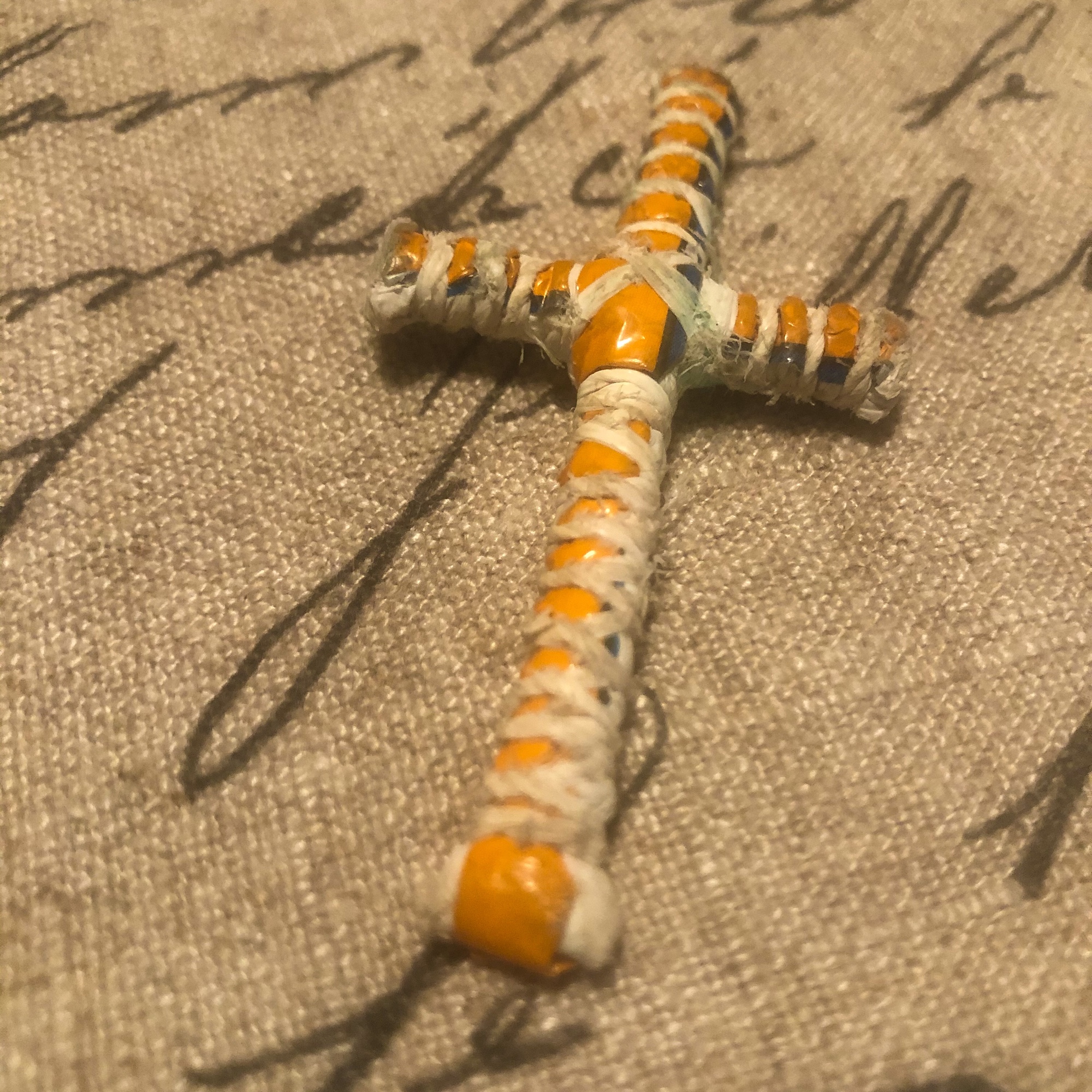
Years ago, our son made this cross out of garbage bags while in prison; there’s truly a parable in it.
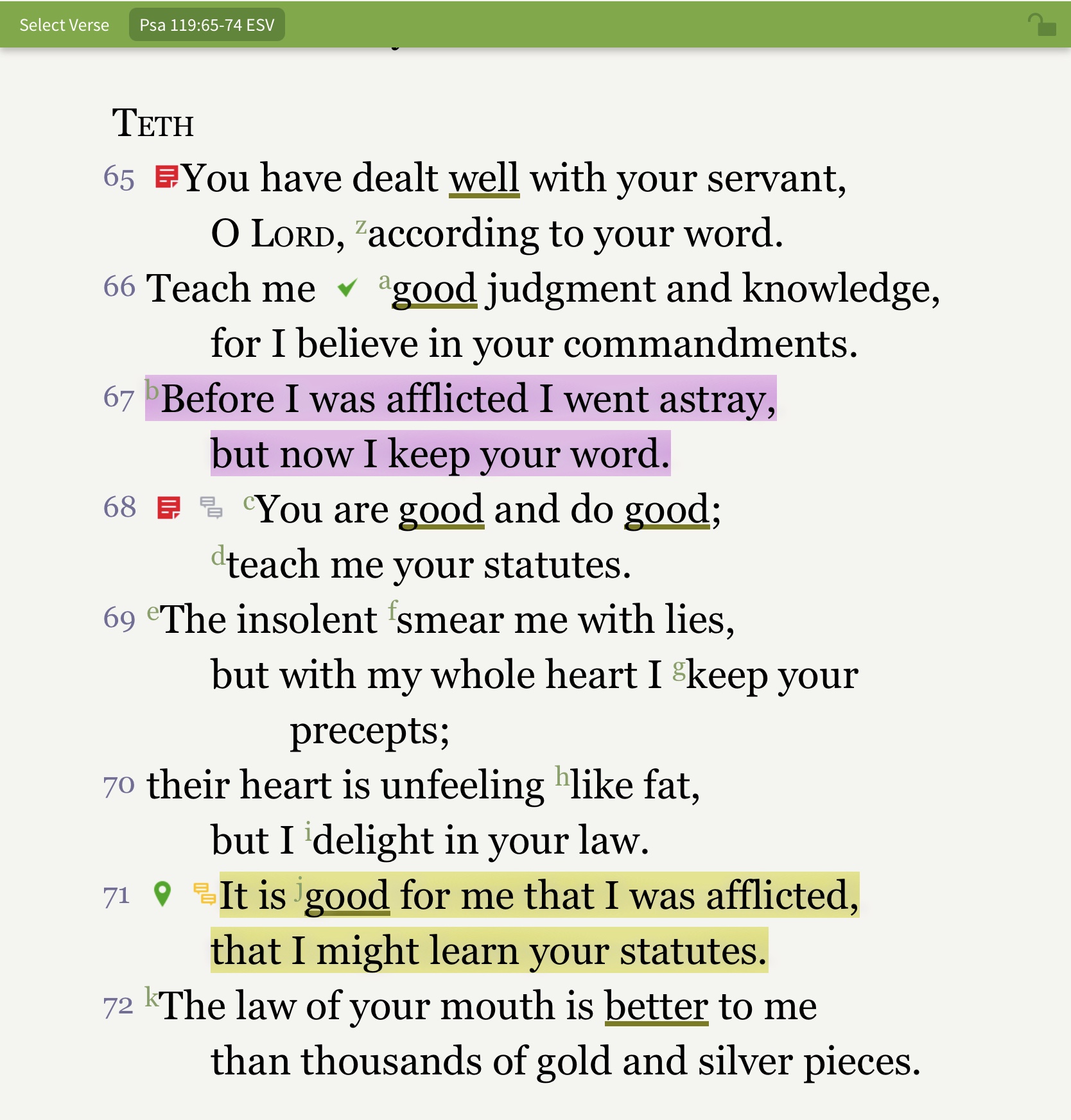
The longest chapter in the Bible is Psalm 119 and covers the entire vista of life in God from A-Z. Each section begins with a succeeding letter of the Hebrew alphabet and the accompanying verses expand on the theme. If you move your eyes down to the ninth paragraph (vs65-72) you’ll find composer David reflecting on the greatest lesson he ever learned about trials and afflictions.
The 9th letter in the poem, TETH (‘tayt’), means essentially “the hidden goodness of God.” Take a look at the image just below: some have seen in the shape of the letter a pregnant belly, others a full pot. The ‘good’ within can only be seen at delivery or when one removes the lid.
Hebrew letter “Tet”
Now take another look at the passage above and locate the underlined words. Each time it’s the Hebrew word, “Tov.”
“Tov” (“well”, “good”, “better”) is found six times, hidden in those eight verses. Its basic meaning is ‘good’ but it’s fuller definition has to do with something that is “well suited” for its purpose; something “well wrought” and “well crafted.” It’s a word found in the vocabulary of an artist.
🔹It’s a fruit of the Spirit (“goodness”)
🔹We first see it throughout the creation story (“God created….and it was good”)
🔹Satan wanted to erase all “good” from creation, plunging it all into darkness and chaos; he wanted the opposite of ‘tov’: he wanted despair and hopelessness
🔹God has preserved this aspect of creation by never removing ‘Tov’; even as Satan is busily stacking bricks to build his empire, rays of ‘tov’ spread over the earth…to the evil one’s great consternation
Satan assumed grief would be the end of us. He thought affliction and trial would cause us to curse God. He never, ever expected good to come from any of it.
The devil wanted to erase “good” for good. Big mistake. God’s good cannot be erased; this is still our Father’s world, and we can find good in our suffering.
My dad was known for having a wonderful singing voice. When called on to give a solo at church he would sometimes sing “The Love of God.” I remember hearing him give the backstory about one of the verses being found on the walls of a cell, put there by an inmate at an insane asylum:
Could we with ink the ocean fill, and were the skies of parchment made; were every stalk on earth a quill, and every man a scribe by trade: to write the love of God above would drain the ocean dry, nor could the scroll contain the whole though stretched from the sky to sky.
It’s crazy to think how we can see the love of God insidewalls of despair pressing in on us. It seems counterintuitive. How do you sing about the love of God from a hospital bed? How can you see the goodness of God at the graveside of your child or spouse?
After my accident in 1981 I spent time at Shepherd spinal center in Atlanta doing rehab. One day the staff psychologist called my parents into his office and said he didn’t think I was handling my disability well at all. He felt I was living in denial. I was (his assessment) “too happy.”
I can tell you that I am not the hero in any of my stories. It’s not about how strong or well-balanced I am. It’s all about the goodness of God.
One of the pilgrim psalms tells us God has a “thousand ways to set you free!” (Psa 130:7). When you begin to learn how much God loves to rescue us, you learn, even in the throes of great trial, to wait for him to show up. Because he will.
“The anvil, the fire, and the hammer, are the making of us…I have found that there is a sweetness in bitterness not to be found in honey; a safety with Christ in a storm which may be lost in a calm. It is good for me that I have been afflicted.” – Charles Spurgeon
“Good” affliction
It’s good for me that I was afflicted, that I might learn your statutes. (Psa 119:71)
“Good. for. me.”
“Good” has the place of emphasis. Everything else is window dressing. This passage is the Old Testament parallel to Romans 8:18-28. We know that Paul was a Hebrew scholar and in his training as a Pharisee memorized the Old Testament Scriptures. I think it’s very likely he was calling to remembrance these verses in Psalms when he was writing his Magnus opus in Romans!
So it begs the question: how can we call grief and affliction “good”?
A number of years ago, I was sitting by the graveside of my son, just talking with him about my disability and how good God has been to me throughout my affliction. It was actually on the 33rd anniversary of my accident and I just started jotting down some things. I wish I had time to share them all with you here (there’s a whole bunch more), but let’s just look at a few that tell us why trials and troubles and heartache can be called “good” in the plan of God.
▪️Faithfully enduring trials invites us into deeper intimacy with the Father
▪️It is not in suffering itself that brings glory but our voluntary, joyful acceptance of it
▪️Broken people release the aroma of Christ’s love, healing and mercy
▪️God only allows suffering when He is intent on birthing something new out of it
▪️There’s no greater evangelical “tool” than for the unsaved to encounter a broken vessel that lets the Light of Christ shine into the darkness!
▪️The afflictions of this lifetime will determine the affluence of my eternity and the pains I endure here will reciprocate to pleasures compounded daily for eternity
▪️Until faith has been tested in fire it cannot be trusted in life
▪️God is more focused on my character than my comfort – but not at the expense of His being my Comforter!
▪️Joyfully embracing brokenness leads to patience, gratitude and infectious hope
I pray you find the best of things in the worst of times. May the hidden goodness of God change your story and leave you… stunned.