
though there’s pain in the offering


Have you ever seen someone in pain who’s not handling it well? I know you have and I have too. It’s not pretty is it? They can become bitter. Sometimes they get angry and strike. For many, pain becomes their identity.

Last time I posted I shared from the life of Joseph. I’m tempted to do the same with this post because so much of his story fits inside this theme. In his stead I’ll share a brief glimpse into his father, Jacob.

There was a day in his life when a blood-soaked garment was brought to him by his sons. “He’s gone, Dad. Joseph’s dead, mauled by a lion.” Jacob was inconsolable.

Jacob knew pain. Think back to his wedding night. Recall the entire saga of Esau? Does his divinely dislocated hip ring any bells? Consider the twenty hard years of labor in Paddan-aram (interestingly, the verb associated with the place suggests this was where Jacob was ‘ransomed’; a necessary length of time for Old Jacob to meet New Jacob).

Because of these things, perhaps, Jacob had a fixation with death and trouble. He carried his pain with him into every season and well inside his old age. There’s another grievous pain he bore but I’ll get to that if time permits.

Any of those things would cause many a man or woman to go running for the hills. God won’t give you more than you can bear?

Please.

Say that to Jacob with a straight face.

The worst of times are not the last of times.

— John Piper

lament

Lament is one of those words that sounds too religious for us regular folk. But we cannot move forward without it. This is why so many get stuck in the dry docks of dismay.

Jacob lost 22 years of his life as the consequence of his sons’ great sins against Joseph, Tamar, and the men of Shechem. He is often seen sitting with his grief and unhealthy preoccupation with death.*

*Gen 37:35; 42:36; 42:38: 44:22, 27-29; 30-31; 45:28; 46:31

One of my regrets about life after my accident is that I didn’t take necessary time to grieve all that was taken from me. In the ensuing years I was often asked “Do you get bitter?” I replied, “No, never once.” And that was the truth.

Did I lament my loss? I did…eventually. TBH, I still lament. Something is wrong with this picture. My disability is not part of the new creation. Jesus wept at Lazarus’ tomb because it didn’t…belong. It stinks. It hurts. How long, O God?

I love how lament is described by an Anglican priest:

Lament is what happens when the promises of God collide with the reality of our lives, and we express that collision and call on God to harmonise the two.

— Revd Dr. Alastair McKay, St. Martin-in-the-field

The thing about lament, biblically understood, is that it always — always — leads to praise. To lament is to actively pursue God in the midst of your sorrow. It may be a long time coming but you eventually get there. Jacob spent 22 years locked inside his bereavement. Would he recover?

I’m a big fan of the minor key and the book of Job. My friends know how much I love a gloomy, overcast day. Barry Manilow’s saddest ballads were my favorite songs in high school and college. Don’t hate me, I’m still fragile about that.

I’ve been through some stuff in my life, but I don’t ever recall a time when I’ve just wanted to pack it all in and jump ship. I scrolled through my twitter feed the other day and came across this share from a pastor I found quite enlightening:
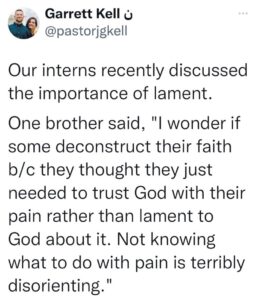
That’s good. And painfully true.

Jacob is a case study in not dealing well with your hurt. You can’t tell me that his solemnity and despair didn’t rub off on his children. I imagine Judah or Simeon wondered aloud from time to time if they’d ever be more than a painful burr in their dad’s soul. Perhaps Reuben felt the scorn of being Leah’s son and that was all he could ever bring to the table.

But then there was a famine in the land. (Pay close attention to Gen 43:14)

It changed everything.

lessons learned

There came a day when Jacob got some news: his boy was alive! I’ve imagined how awesome it would be if I woke up tomorrow morning to see Graham at the foot of our bed! To realize it had all been a very bad dream. When I read of Jacob’s exhilaration, I feel that deep in my core.

Jacob had enjoyed Joseph for seventeen years in Hebron (Gen 37:2), and now he would get to enjoy Joseph for seventeen years in Egypt (Gen 47:28).

At 130 years of age Jacob made peace with his pain. In a long blessing over Joseph he invoked the name El Shaddai at the start and finished with Elohim at the close. Happy is the life that begins and ends with God!

Long before David called God his Faithful Shepherd, Jacob beat him to it. Jacob was the first person in Scripture to say that God “has been my shepherd all my life.” That sounds like a man at peace.

“I am about to die, BUT GOD…”

“But God.”

May this be your confession by his mercy and grace.

Allow me this one final splurge. Before you click away, I’d like to share the song whose lyric inspired the title of this post. Sandy chose this song as part of worship for Graham’s funeral. Yes, I said that. Funeral worship. We’ll see him again. Maybe not here, but when our lament has finished its course.

Amen.



as in the days of noah

Resting Ships, Paul Klee
Resting Ships by Paul Klee

But Noah found grace in the eyes of the Lord.

Genesis 6:8

There was once a man named Noah. When he was born, his dad looked at him and said, “Finally, some hope. My son, a comfort to my soul.” The lad was born into a world ripe for judgment and Lamech thought his boy might be its savior. Evidently Noah’s pop was given some sense of his son’s divine purpose, but, unfortunately, his world was beyond saving.

I’ve listened to some parents of young children — and grandparents — who are uneasy about the world in which their children and grands will grow up. I totally get it.

A writer-father of a newborn shared his own angst and worry over the world his child would face:

[A]mong the excitement and wonder I feel at his progression are other emotions: worry, guilt, fear. And, overwhelmingly, grief. Because I know that the closer this child comes to thinking and understanding and communicating complex ideas, the faster he approaches the Moment when he will discover something that I wish with all my heart he never had to know: that his mother and I brought him into existence on a world that is dying.”

Time magazine offered an article a few months ago, titled, “Raising Kids When The World Is Ending.”

Here’s a headline for you:

💠💠💠💠

“But understand this, that in the last days difficult times will come.”

2 Timothy 3:1

💠💠💠💠


“Difficult” is a tad benign. The word Paul uses is more like “fierce.” Two verses down he says the last days are “savage.” Read the whole list. It mirrors almost exactly the condition of the world in Genesis 6. Uh oh. Seems we’ve seen this movie before.

Just today I read that nearly every House Democrat in the U.S. voted against a bill requiring medical attention for any baby born alive after a botched abortion. You can’t get much more evil than that.

Is there any comfort for us? Who can rest in these dark days?

Early one morning I woke up thinking about Genesis 6:8. “Noah found grace in the eyes of the Lord.” Taken in context, it’s a beautiful word of comfort for any who are barely treading water.

Has your world become oppressive? Exhausting? Unbearable? That was Lamech’s world. Even as the surrounding culture was submerged in evil, he traced a sliver of hope in the tiny feet and wiggling fingers of a baby. Raging against the dying of the light he defiantly branded his son Noah.

Noah sounds in the native tongue like “comfort” and derives from a word meaning “rest.” Later when we read about his now-famous ark “resting” on Mount Ararat as the floodwaters receded, it literally says the boat “Noahed” there.

It’s in Genesis 6:8 where “grace” shows up for the first time. God’s eyes swept the whole of humanity and, everywhere he looked, saw violence, ruin, and debauchery. Then his eyes rested on his man of rest and hope sprang anew.

Putting aside the hot mess of modern global culture, let’s turn our sights toward our private worlds. What words would you use to describe your life in these days? Turbulent? Unpredictable? Challenging? Scary?

Perhaps enduring fits you better. Or overcoming. I’ve been telling all my friends of late how sanctifying this season of my life has been.

In one midrash (rabbinical teaching), Noah’s wife is Naamah, the root of which primarily means to be pleasant, but also has the connotation of melody and of singing. It may not be sacred teaching, but it is cool to think about.

How wonderful to imagine Noah enjoying the company of his sweet bride, a pleasant soul, singing and humming her melodies in their home. Perhaps Noah stressed over the calling put on him (build a boat in the desert!) and needed his wife’s songs to minister rest to his troubled heart.

I guess you know where I’m going with this. Sandy has been the melody to my lyrics, especially of late. I’m grateful to have her as my helpmate; she exhibits dignified grace daily. I am a better man with her in my corner.


If Genesis 6:8 teaches anything, it tells us there is a supernatural rest and empowering grace available to those who by faith trace their spiritual lineage through Noah, Abraham, Isaac, and all the way through to Christ.


As it was in the days of Noah, so shall it be ever until the end: God has a rest for his people. Lamech pinned his hopes on God’s rest. Noah carried God’s rest in his heart. I pray the same for us. I pray for your children that their faith would be embedded in Christ and they would know his rest in their futures. May we be carried by his rest and rise above the black waters of death through divine grace.

I pray for my friends, Lord, as well as Sandy and me, for your carrying rest on this day and in all the days ahead. May we rise above the chaos and advance towards your new creation by your empowering grace, O Christ. In Jesus’s name, amen.

[tipjarwp mode=”button” link_text=”Click here to buy me a coffee ☕️ Thank you!” open_style=”in_place”]

oh well, noël

The death of a beloved is an amputation.

C. S. Lewis, A Grief Observed

There’s a 10-foot tall Christmas tree in Tustin, California for families who grieve the loss of their children to addiction. It’s put there yearly by Solace of Hope, a family support group for grieving parents. The tree is filled with ornaments and photos of the many lives lost far too soon to the damnable plague of opioids.

Alan Berkowitz and his wife Kathy lost their 26-year old son to heroin six years ago.

The toughest part for my wife and me is Christmas morning. Now it’s just the two of us. We get up and have coffee. And, well, it’s kind of hollow.”

Sandy and I share that isolating grief with the Berkowitz’s. Our Graham also became an ‘ornament on a tree’ nine Christmases ago at twenty-four. He had just completed a few months in rehab and we were happily working on getting him a flight home from Minnesota. On December 16th, word reached us he would not be coming home.

Our Christmases can still feel hollow for us too. More’s the pity because Sandy loves Christmas like no other day of the year. She can decorate to beat the band and transform any house or apartment into a glowing hearthfire of peace on earth. Fittingly, she’s a Christmas Day baby, but each year her birthday is eclipsed by a lingering shadow of grief.

I was streaming the first episode of a murder mystery which was mostly meh until the chief detective said something I immediately put in my notes app. Offering comfort to the victim’s teenage daughter he said,

“grief is love with no place to go.”

For parents like us who have lost a child at Christmas, we totally get that.

While many associate Christmas with “Behold, I bring you good tidings of great joy,” (even better in Linus voice) others are further down in the Luke narrative. There’s the headline we all know and love, but then there’s the fine print:

And Simeon blessed them and said to Mary his mother, “Behold, this child is appointed for the fall and rising of many in Israel, and for a sign that is opposed (AND A SWORD WILL PIERCE THROUGH YOUR OWN SOUL ALSO), so that thoughts from many hearts may be revealed.

Luke 2:34-35 (emphasis mine)

Way to bury the lede, Luke!

Years ago many older hymns were passed down through oral/auditory tradition. The First Noel is one of them, which is why The Cornish Songbook (1929), printed the first stanza as:

O well, O well, the Angels did say
To shepherds there in the fields did lay;
Late in the night a-folding their sheep,
A winter’s night, both cold and bleak.
O well, O well, O well, O well,
Born is the King of Israel.

The season of noël is, for some, a painful ordeal. From the Latin ‘natale,’ meaning “birth,” Noël feels like anything but.

For a myriad of reasons, not only loss, it instills dread and invites depression. Scrooge’s dark night of the soul resonates more deeply than his Christmas morning grace awakening in some.


His grief he will not forget; but it will not darken his heart, it will teach him wisdom

—Aragorn, Lord of the Rings: Return of the King, J. R. R. Tolkien

Sandy and I fight the good fight yearly to not get cheated out of Christmas. She still decorates and I still play the music. She wraps gifts in upscale department store fashion and I don’t. We make sure to see the lights, watch White Christmas, and sit graveside with our boy on Christmas Eve.

The two of us have found our safest place to be is with each other. We don’t do big family gatherings on Christmas Eve and Christmas Day. We prefer our holidays quieter. It’s worked for us nine straight years and we don’t plan to change.

If the manger means anything, it means the Savior swaddles our sorrows. Slowly, over channels of time, the comforted begin to realize their bandwidth for moving through the hard days has increased. The sword pierces a little less. You can surprise yourself by having the wherewithal to do stuff again.

Jesus, the Resurrection and the Life, our Wisdom from heaven, has gifted us with a deeper Noël. Even in the midst of our bleak midwinter, and as a hurting world moans in unrequited protest, our grief becomes love that suddenly finds a place to go.

Joyeux Noël, beloved.


[tipjarwp mode=”button” link_text=”Click here to buy me a coffee ☕️ Thank you!” open_style=”in_place”]