make it make sense, lord


I call out to you, “Violence!”
But you do not deliver!

Habakkuk 1:2


Two Fridays ago was meant to be when 9-year old Evelyn Dieckhaus was to sing “What a Wonderful World” in a play at her Nashville school. Instead, her life was cut short by a bullet from an AR-15 carried by a young woman with a demonic grudge.

A bullied thirteen year old Indiana boy recently ended his life. Before committing suicide he left a video in which he named his tormentors. They made fun of his size, his haircut, and his clothes. The seventh grader dreamed of playing for the St. Louis Cardinals someday. Tragically, all he leaves behind is a void.


Why do you force me to witness injustice?
Why do you put up with wrongdoing?

Habakkuk 1:3


In the Netherlands, a television show had transgendered adults appearing naked in front of an audience of impressionable children. Unashamedly exposed, each expressed to the 10- to 12-year olds how “euphoric” they felt about their sex change surgeries. Grooming and pedophilia aren’t even masked anymore.


You are too just to tolerate evil;
you are unable to condone wrongdoing.
So why do you put up with such treacherous people?

Habakkuk 1:13


Habakkuk speaks for all of us. How much news do we need to watch before we say, “Make it make sense, Lord!” Just when I think it’s safe to open up Twitter, I find myself needing to log off for my own emotional health.

Habakkuk, like us, reacted to the news cycle of his day. And, like many of us, he wasn’t exactly subtle with his objections:

  • HOW LONG, LORD? (v2)
  • YOU DON’T LISTEN! (v2)
  • YOU DON’T DELIVER! (v2)
  • WHY? (v3)
  • WHY DO YOU PUT UP WITH THESE PEOPLE? (v13)
  • WHY DO YOU SAY NOTHING? (v13)
  • ARE YOU GOING TO LET THEM GET AWAY WITH THIS FOREVER? (v17)

I can sing about a heavenly home and enjoy for a moment the stirrings it evokes, but a land in the “sweet by-and-by” feels a long stretch of road and many miles away. I know everything will make sense then, but how do we make sense of things now?

That was Habakkuk’s dilemma. Isaiah, a hundred years before him, lamented, “We wait for light, but see only darkness.”

What hope is there for a young mother who vomits from her second round of chemo or the college coed showering off her sexual assault or a parent standing over the grave of a child who was struck down in a drive-by? Where was God when all of this was happening to me?

In today’s world the inmates are running the asylum. We, on the other hand, are plagued with “headline stress disorder” and weighed down with laments in the key of heavy. Society is twisted and dark and getting darker by the day. A growing number believe the world has long passed its expiration date. Hope, for them, is a folly.

If you stick it out with the young prophet you’ll begin to heal, whatever your situation. While his opening remarks are freighted with anger and frustration, by chapter 2 he sees a glimmer. By the 3rd chapter, the glimmer becomes a fiery sunrise.


I will stand at my watch post; I will remain stationed on the city wall…

Habakkuk 2:1


If chapter one asks the question, “WHERE ARE YOU, GOD?” Habakkuk gets his answer in the last verse of chapter two:


the LORD is in his holy temple.

Habakkuk 2:20


The smoldering prophet gets this epiphany when he says, “I’m too worked up. I’m going to stop, watch, and listen.” I can’t tell you how many times in my journey I’ve had to take counsel with those words. Habakkuk takes a sabbath day and starts to see and think and, yes, feel differently. By the time our guy closes in prayer (chapter 3) you’re of a mind to start unlacing your shoes.

David saw the same thing. He was battling an inner urge to fly away, to flee, to find a cave and hide from everything and everyone. But he knew a few things about his God: he knew God was eyewitness to all that troubled and provoked David (Psa 11:4) and was on his side (Psa 11:5); he also knew God was “just” (Psa 11:7) and would vindicate and bless David in the end. And while all those destroyers of the foundations (Psa 11:3) suffer brimstone and fire and reap the whirlwind (Psa 11:6), he would gaze upon the beauty of the LORD.


Habakkuk leaves us with two watchwords to aid us in trusting God to make sense of our nonsensical world. He invites us to (1) remain at our post (Hab 2:1-4) and (2) go to our knees (Hab 3:1-16).

“Our post” is the place where we can do the most good in the Kingdom:

  • It is where we walk by faith, not by sight (2 Cor 5:7).
  • It is where we hold fast the confession of our hope (Heb 10:23).
  • It is where we keep ourselves in the love of God (Jude 21).

“On our knees” is where we confess our reliance on the immutable God who works all things together:


In music theory notes that aren’t part of the harmonic chords in an arrangement are said to create “tension.” To move those notes back into alignment with the whole theme is called “resolution.”

Today’s headlines and clickbaits draw attention to drama that doesn’t belong in the desired intent of God’s Story. Nevertheless God knows how to bring resolution from the tension. He’s done it before; he’ll do it again.

Here is the world. Beautiful and terrible things will happen. Don’t be afraid.”

—Frederick Buechner

Good and bad. Horrifying and glorifying. Take it all…and put it in God’s great hands.

Selah, beloved. Peace. Be still.

though there’s pain in the offering


Have you ever seen someone in pain who’s not handling it well? I know you have and I have too. It’s not pretty is it? They can become bitter. Sometimes they get angry and strike. For many, pain becomes their identity.

Last time I posted I shared from the life of Joseph. I’m tempted to do the same with this post because so much of his story fits inside this theme. In his stead I’ll share a brief glimpse into his father, Jacob.

There was a day in his life when a blood-soaked garment was brought to him by his sons. “He’s gone, Dad. Joseph’s dead, mauled by a lion.” Jacob was inconsolable.

Jacob knew pain. Think back to his wedding night. Recall the entire saga of Esau? Does his divinely dislocated hip ring any bells? Consider the twenty hard years of labor in Paddan-aram (interestingly, the verb associated with the place suggests this was where Jacob was ‘ransomed’; a necessary length of time for Old Jacob to meet New Jacob).

Because of these things, perhaps, Jacob had a fixation with death and trouble. He carried his pain with him into every season and well inside his old age. There’s another grievous pain he bore but I’ll get to that if time permits.

Any of those things would cause many a man or woman to go running for the hills. God won’t give you more than you can bear?

Please.

Say that to Jacob with a straight face.

The worst of times are not the last of times.

— John Piper

lament

Lament is one of those words that sounds too religious for us regular folk. But we cannot move forward without it. This is why so many get stuck in the dry docks of dismay.

Jacob lost 22 years of his life as the consequence of his sons’ great sins against Joseph, Tamar, and the men of Shechem. He is often seen sitting with his grief and unhealthy preoccupation with death.*

*Gen 37:35; 42:36; 42:38: 44:22, 27-29; 30-31; 45:28; 46:31

One of my regrets about life after my accident is that I didn’t take necessary time to grieve all that was taken from me. In the ensuing years I was often asked “Do you get bitter?” I replied, “No, never once.” And that was the truth.

Did I lament my loss? I did…eventually. TBH, I still lament. Something is wrong with this picture. My disability is not part of the new creation. Jesus wept at Lazarus’ tomb because it didn’t…belong. It stinks. It hurts. How long, O God?

I love how lament is described by an Anglican priest:

Lament is what happens when the promises of God collide with the reality of our lives, and we express that collision and call on God to harmonise the two.

— Revd Dr. Alastair McKay, St. Martin-in-the-field

The thing about lament, biblically understood, is that it always — always — leads to praise. To lament is to actively pursue God in the midst of your sorrow. It may be a long time coming but you eventually get there. Jacob spent 22 years locked inside his bereavement. Would he recover?

I’m a big fan of the minor key and the book of Job. My friends know how much I love a gloomy, overcast day. Barry Manilow’s saddest ballads were my favorite songs in high school and college. Don’t hate me, I’m still fragile about that.

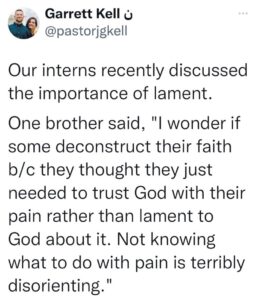
I’ve been through some stuff in my life, but I don’t ever recall a time when I’ve just wanted to pack it all in and jump ship. I scrolled through my twitter feed the other day and came across this share from a pastor I found quite enlightening:

That’s good. And painfully true.

Jacob is a case study in not dealing well with your hurt. You can’t tell me that his solemnity and despair didn’t rub off on his children. I imagine Judah or Simeon wondered aloud from time to time if they’d ever be more than a painful burr in their dad’s soul. Perhaps Reuben felt the scorn of being Leah’s son and that was all he could ever bring to the table.

But then there was a famine in the land. (Pay close attention to Gen 43:14)

It changed everything.

lessons learned

There came a day when Jacob got some news: his boy was alive! I’ve imagined how awesome it would be if I woke up tomorrow morning to see Graham at the foot of our bed! To realize it had all been a very bad dream. When I read of Jacob’s exhilaration, I feel that deep in my core.

Jacob had enjoyed Joseph for seventeen years in Hebron (Gen 37:2), and now he would get to enjoy Joseph for seventeen years in Egypt (Gen 47:28).

At 130 years of age Jacob made peace with his pain. In a long blessing over Joseph he invoked the name El Shaddai at the start and finished with Elohim at the close. Happy is the life that begins and ends with God!

Long before David called God his Faithful Shepherd, Jacob beat him to it. Jacob was the first person in Scripture to say that God “has been my shepherd all my life.” That sounds like a man at peace.

“I am about to die, BUT GOD…”

“But God.”

May this be your confession by his mercy and grace.

Allow me this one final splurge. Before you click away, I’d like to share the song whose lyric inspired the title of this post. Sandy chose this song as part of worship for Graham’s funeral. Yes, I said that. Funeral worship. We’ll see him again. Maybe not here, but when our lament has finished its course.

Amen.


the grand canyon and heaven too

Most of you know I was blessed to draw a line through a big item on my bucket list last year. There we were, Sandy and I, road trippin’ with two best friends, Alan and Kelli, across the southern U.S. Target: Grand Canyon.

I could do a huge photo dump of some of our grandest shared memories, but I’ll spare you that. Instead, I’ll leave you with two or three snapshots that practically tell the whole epic story.

I’ve been told by veteran visitors of the GC that the funnest part is to go with someone who has never been before. Then just stand back as they approach the rim and watch their expression. I was the one being watched that day and I’m pretty sure I followed the first-timer script.

But that’s enough about me. Let’s talk about this guy:

I probably took over a hundred photos during those eight or so hours at the southern rim. There are better shots than this, but this one is a sermon in itself.

This dude walked out on nature’s platform and, quite eloquently, turned it into a pulpit. He was an orator facing an Audience of One; I just so happened to be in the wings, eavesdropping.

As I watched, he stood there a few moments, hands in pockets, taking it all in. He may have sighed, I don’t know (I didn’t have my long lens with me). Keeping my finger on the trigger, I spied through the camera’s viewfinder thinking it made a pretty good photo on its own.

I snapped off a couple shots.

Then, slowly, he pulled one hand out of his pocket and raised a lone finger toward the sky. His face turned upward and looked where he was pointing. Like so:

I didn’t see him again the rest of the day. But I have to tell you, his actions out there in the cold sunshine, atop the canyon, moved me to the core. I got chills. The photo still does it to me.

It was a miracle we got to see the Grand Canyon at all. It had snowed to beat the band the day before — all day long. Visibility, zero. Wind gusts, treacherous. The roads to the canyon were impassable; it wasn’t until the very early morning hours they were reopened. This was the only day we could visit; the next day we would set out on our long return drive to Georgia.

Think of what we would’ve missed. Yes, the Grand Canyon. Of course, that. But we would’ve also missed a guy out on a ledge at the Grand Canyon experiencing God in the moment.

There was another guy at the Grand Canyon that day. He, too, was lifting a hand skyward but in his upraised hand was … a cell phone.

Dude was crazy. Far out on an outcropping of rock firing off selfies from all angles, he kept backing up, not paying attention to his six. There was a harrowing moment when I thought the Canyon might claim another life.

Guy #1 was pointing at the heavens that day, yielding worship to the Almighty Creator. Around the same time, Guy #2 was focusing on himself, playing fast and loose with gravity. There’s a sermon in there if you care to try.

Scroll back up to Guy #1 and see how small he is in the frame. He’s miniaturized by his surroundings. What is man that thou art mindful of him? indeed. Amid a selfie-obsessed generation, be Guy #1; he knows who he is and whose he is.

To that end, he permutates into an arrow, pointing away from himself, and directs his whole being heavenward. If we could see into the other realm we might witness the heavens opened and a whole host of beings ascending and descending, glorifying God and praising.

We are all starved for the glory of God, not self. No one goes to the Grand Canyon to increase self-esteem. Why do we go? Because there is greater healing for the soul in beholding splendor than there is in beholding self.

— John Piper

Here’s an idea: why not pause right now and lift a finger into the air and aim your praise at the Savior. Offer up humble thanks that he’s put you where he wants you, in frame, where you can testify to an eavesdropping world that Jesus isn’t just part of the Story, he’s the whole Point of the Story.

Selah, beloved. Oh, and here’s one final photo from that day at the canyon: