a savior who has time

When the wine ran out, Jesus’s mother told him, “They don’t have any wine.”
“What has this concern of yours to do with me, woman? ” Jesus asked. “My hour has not yet come.”

John 2:3,4


[5 minutes]

For Jesus, His “Hour” was the thing He held most sacred. It could not be trifled with; it couldn’t be waved off or pushed aside; he refused to be distracted from it. It was most expedient. His Hour was the work of His Heavenly Father through him to accomplish God’s will from the beginning. His Hour was His appointment with the Cross for the redemption of lost humanity.

At the wedding celebration in Cana Jesus wasn’t caught in a moment of fleshly irritation. No. There was no sin in his response to his mother no matter how much we try to run cover for Him. “Well, Jesus wasn’t really being disrespectful, there’s technical nuance in the original language that we don’t see in ours, etc.” While true, Jesus showed no ambiguity in exposing his inner motivation to His mom. For our Savior, the Hour of His death was everything. No surrender; no capitulation.

I was honored to share at my dad’s funeral seven years ago. Sharing from John 12:23 (And Jesus answered them, “The hour has come for the Son of Man to be glorified.”), I remembered something my dad said a day before he died. He had been rushed to the hospital with a heart episode and we thought his hour had come. But no. Dad rallied and recovered quickly and, only a few hours later, was resting comfortably in his hospital bed. Crisis averted.

“You had us all scared Dad,” I said. He flashed his signature boyish smile at me. All of 88 years old, he still looked like a much younger man.

“Did you feel ready if, you know, it was your time?” I asked haltingly, yet knowing the answer.

His soft blue eyes were shiny. “Every day I look up at the sky and spot a cloud. I wonder if my Savior will step out on that cloud and come for me. And I always tell him, I’m ready, Lord.”

A few hours later, Jesus stepped out on a cloud and said, “Let’s go, Tom.”

That last conversation with my dad means everything to me. Knowing my dad could have died before I got to him, yet given those extra hours with him, is a precious gift I hold dear.

Death comes for us all. We all have an Hour. That Hour is sacred, binding. There’s no avoiding it. For the believer in Jesus, we leave it in God’s hands and celebrate the days we have until then.

Jesus may have been at a wedding party, but he saw the Cross standing ominously in the background. Still, He was present and merciful and gracious and cared enough to keep a good party going. Isn’t He wonderful?

Tim Keller thoughtfully addressed the inner tension Christ must have felt in that moment:

When Jesus makes his enigmatic statement it’s as if he were looking far away, past his mother and past the bride and groom, and past the whole wedding scene. He’s seeing something else. He’s thinking, ‘Yes, I can bring festival joy to this world; I can cleanse humankind from its guilt and shame. I have come into the world to bring joy, but, oh, Mother. I’m going to have to die to do it.’

– Tim Keller, Encounters With Jesus

Even so, Jesus performs the miracle. How amazing! Yes, he faces a Cross, but he’s also in the company of people who are sad, worried, and frantic. The Gospel of Mark tells of a time Jesus healed a paralyzed man. When he encountered the pitiful man, he dealt with the worst problem in his life: his sin. “Your sins are forgiven you,” Jesus told the man. And then, because of the man’s physical condition, he showed compassion and said, “Rise from your mat and walk!”

In the upper room, following his resurrection, Jesus encountered Thomas. Thomas needed to feel the wounds in Jesus in order to see that he was really alive and not just some ghost or figment or hallucination. When Jesus entered the room, he knew immediately. This is really Jesus, my Savior, my Master! Even still, Jesus invited Thomas to touch him.

Jesus has time for us.

He takes time for us.

He makes time for us.

Jesus sat amidst all the joy of the wedding feast sipping the coming sorrow so that today you and I who believe in him can sit amidst all this world’s sorrow sipping the coming joy.

– Dr. Edmund Clowney

Don’t miss it. The “Hour” Jesus spoke of was His biggest assignment. Bigger than our life events or schedules or plans. And yet he kept the party going.

Master, carest Thou not that we perish? He stills the waves because of course He does. Not because we demand He do it, but because He wills it for us.

How can I pay my bills, Lord? He points out the birds of the air and the flowers of the field. Don’t you see, Child? You think I don’t have time for you, too?

Put yourself in the Savior’s sandals. Facing a Cross of execution as the Substitute for all humanity for all time, bearing all sin and its curse, and then someone — his mother! — tugs at His sleeve and says “We need more wine.”

And Jesus is liable to say, “You see those stone water jars? Bring them to Me.”

Selah, beloved.

going out weeping, coming home rejoicing

[4 minutes]

They weep as they go to plant their seed,
but they sing as they return with the harvest.

Psalm 126:6

The Bible isn’t a guidebook, it is a life book. It’s not a collection of principles to live by, but life-giving truth to rest in.

With refreshing transparency, Andrée Seu Peterson confessed her once weak-kneed approach to scripture during a particularly painful season of grief. While “grousing” she read from another writer who leaned hard into the Word of God in her own similar season of trial.

In her book Won’t Let You Go Unless You Bless Me, Andrée Seu said she was more prone to “pursue minimum Christianity: saved by the blood, but entitled to grouse.” Patti McCarthy Broderick, however, believed when the Bible said ‘suffering produces character and character hope,’ it means that suffering produces character and character, hope.’*

Andrée Seu:

I, on the other hand, have interposed a baroque system of hermeneutics between the Bible and my life. I have seminary training. Unlike simple people who obey the Bible because they don’t realize how complicated it is, I find ambiguity in every verse. I don’t obey scripture, I discuss it.

She and Broderick had both heard the same statistics and psychological findings regarding the ‘natural’ course of grief and the amount of time needed to ‘process’ it. “I went with the statistics and gave myself permission to be as bad as I wanted to be. She, more simple-minded, files the following report: ‘So I chose instead to bank my life on scripture being true, and I was not going to let even well-meaning Christians talk me out of it’… 

Of Broderick, Andrée Seu said, “She took the Bible as practical…She made a conscious choice to trust in God, to take his word as truth, to see opportunity, and to wear his praises publicly on her lips. And she did not find him disappointing.”

It’s necessary to draw a distinction here between distrustful whining and trusting God even as we grieve. Some sorrows run so deep they may take years to heal. But at the heart of Psalm 126 is a promise that will never disappoint.

jerald

I still recall my friend Jerald’s beautiful exposition of this verse. Jerald served as my right hand man for several years when I was pastor in Douglasville, Georgia. I remember his teaching as if it was yesterday.

Picture it: God directs a farmer to take the precious seed, the last seed in the barn, and plant it in the dry soil of his field. It hasn’t rained for weeks.


What? Waste my seed? Why would I do that? How will my family survive?


See him as he kneels in the dust, taking the last of the seed and putting it into the dry ground. He’s risking everything on God’s coming through for his starving family. Tears fill his eyes as he surrenders to the soil, praying with uncertainty. He looks up at the sky. No clouds. He writes his sweaty brow. The seed does no good in his hands, so he presses it into the hard-packed earth.


The next week he hears thunder. He rushes outside and sees dark clouds filling the sky! Torrents of rain wash down on the farmer’s fields. The ground is suddenly bathed in precious streams of living water, as valuable to him as if he discovered gold.


He had wept when he planted the last of the seed but now he rejoices because he knows the Almighty has heard his cries and has seen his sacrifice. The farmer now laughs as he stands under the showers with arms raised to the sky…

I sat by Jerald’s hospice bed one Sunday morning when he quietly slipped off into eternity. Marie, his wife (and one of my regular readers!), joined me in singing as many verses as we could remember of Leaning On The Everlasting Arms as we kept vigil. Somewhere in the middle of the hymn, Jerald left this earthen sod.

In in his lifetime Jerald wept much because of cancer, but Marie and I were witnesses to the exact moment when her husband heard God’s gentle thunder inviting him Home. He took flight from his sick bed to where the fields of grace are always green, always growing, always lush with crops. I believe Jerald was laughing when he saw Jesus.

those who dream

Beloved, one day your soul’s deepest cries will be heard and you will be as one of those who dream about reaching the crest of the last hill after a long wilderness journey. Every thorn and desert, each and every stream of bitter water, and all the giants who towered over you and made you feel weak and unprotected, they will all be behind you, drowned in a sea of forgetfulness.

Oh, but beloved, it’s not a dream. It’s a promise for us too, not just for an ancient people who were just like us. Trust the Almighty Tear-Wiper. You will not find Him disappointing.

Those who sow in tears
shall reap with shouts of joy!

Psalm 126:5

One final word: this promise is not merely for those who cry in this life, but for those who are willing to sow their seed — trusting, believing, hoping — in the midst of their tears. They will be the ones dancing in the rain.

Selah, beloved.


*from her book He Said, “Press”: Hearing God Through Grief by Patti McCarthy Broderick

the best of times, the worst of times: bethlehem and ramah

[5 minutes]

Happy New Year!

It is customary for many in our faith community to approach the new year with — in football lingo — a spiritual ‘fresh set of downs.’ So what’s one of the first plays we run? Right. We advance with a new Bible reading plan, right? My goal in 2025 is to tackle the New Testament along with the Psalms. Okay, enough with the football jargon.

So [opening my Bible], Matthew it is.

Matthew’s opening scenes are familiar for obvious reasons. My Advent meditations covered these passages and I quickly find myself here once again. I also spoke at a local church’s Christmas banquet using the same birth narrative as found in the first gospel. You may have read a version of it recently (“Keeping Jesus Out In Front“). I know this passage pretty well.

But, as is often the case for students of the Book, something can jump off the page that you’ve never seen before. You know what I’m talking about. That is what happened to me this morning.

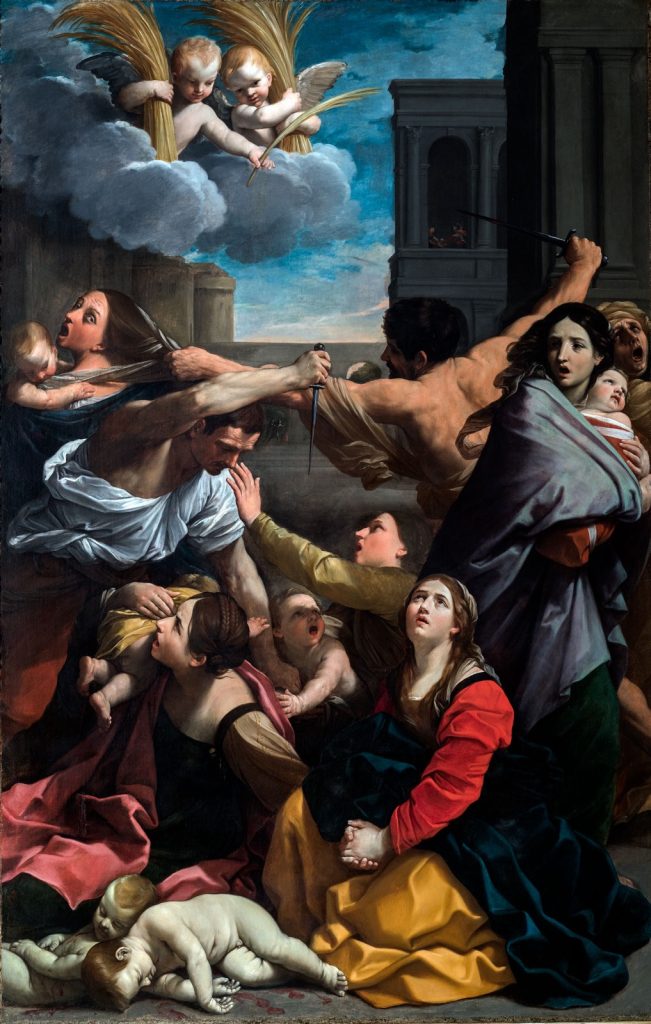
Then Herod, when he saw that he had been tricked by the wise men, became furious, and he sent and killed all the male children in Bethlehem and in all that region who were two years old or under, according to the time that he had ascertained from the wise men.

Matthew 2:16

Then was fulfilled what was spoken by the prophet Jeremiah:
“A voice was heard in Ramah,
weeping and loud lamentation,
Rachel weeping for her children;
she refused to be comforted, because they are no more.”

Matthew 2:17-18

In the same carol as “glad tidings of comfort and joy” is this tragic verse of inconsolable grief and sorrow.

How do you reconcile “good news of great joy” with “weeping in Ramah” …in the same breath?

Not even ten verses earlier, Matthew goes out of his way to stack superlatives in describing the mood of the Magi when they found themselves on the right track to find Baby Jesus. The rejoiced exceedingly with great joy! The wise men were so deliriously happy they couldn’t contain themselves. High fives, back slaps, whoops and hollers commenced!

But things looked a whole lot different in Ramah and other surrounding towns.

Herod was furious. The Magi had agreed to bring him the baby king straightaway, but they changed the script on him and kept the child’s identity and location a state secret. Hotheaded Herod was beside himself.

Who is this baby???

He would show them. Herod ordered a genocide of all the baby boys in the region and suddenly Judea’s Silent Night, Holy Night turned into terror. Like Egypt during the plague of darkness and death, only wails and loud weeping were heard across the land.

Okay. I didn’t like where this was going, but the Holy Spirit made me look. Here’s what I wrote in my Bible journal:

God will permit the deaths of innocents as he carries the story of redemption forward. There is weeping in Ramah though there be good news elsewhere.

Guido Reni’s Massacre of the Innocents

It was the best of times, it was the worst of times indeed. You can’t visit Bethlehem without hearing the wails of Ramah. That’s just how it is in this sad, tragic, very broken world.

Yesterday, in New Orleans, thousands were gathered on Bourbon Street to ring in the new year and enjoy the atmosphere around college football playoff game. Then, frenzy. Moments before a white pickup truck tore through a crowd of people, the streets were teeming with festive joy and frivolity. Seconds later, the sound of screams and sirens filled the night. Fifteen dead, dozens injured.

So what do we do with that paragraph I wrote? God permits the deaths of innocents, etc. How do we frame those words to people who are in shock over such a senseless act of terror? People who are likely to cancel you straight up for trying to pull the God-is-still-sovereign card.

I confess I want to keep my mouth shut. Just bury my nose in a book and don’t address it. But can we? There is the matter of timing, of course. Maybe don’t bring up Jimmy Carter’s political blunders on the day he died? There’s also the matter of courtesy. Waiting to be invited into the discussion instead of barging in and pontificating.

For the purposes of this post, I am speaking of an event that happened 2000 years ago not something that happened yesterday. The truth still remains, however. God does permit evil to bare its fangs now and then, but only in keeping with two incontrovertible rules:

  • God must win in spite of how everything looks right now.
  • the devil and his kingdom must be destroyed because it has been declared so from the beginning, and God can’t lie.

This world is broken and mercilessly mean, yes, but remember: God is broken-hearted by it; and he is the ONLY one with the power to change things.

Ramah is real. Rachel weeping for her children is our lot in this life. Evil people will do evil things and, I believe, 2025 is going to be filled with more evil and more weeping than in years past. Ramah is hard. Ramah is real.

But so is Bethlehem. “Jesus Joy” is real also.

Herod was the devil in Ramah, to be sure. But let’s not miss the bigger Story: Jesus still got born, shepherds told the news, souls got saved, the Church was born, Christ is exalted, the devil and his demons will burn in the lake of fire forever, and our King from heaven will return to dwell with us. And so shall we forever be with the Lord…in the eternal best of times. Weeping may last through the night, but the Man of Joy gets the final say.

Selah, beloved.