Father’s Day From A Prodigal’s Perspective

Today I propose we do a little what if-ing. Let’s “what-if?” the story that contains the prodigal son. It pretty much leaves us with some open-ended questions, I know.

Did Dad ever want to wring the son’s neck? Ever?

Where was Mom in all this?

What happened six weeks or six months later?

Did the kid suffer a relapse?

Questions.

So…let’s pretend.

Imagine if Father’s Day fell a week following the prodigal son’s return. No, check that. Let’s pretend it occurred about six or seven months later. On that morning, the father—let’s call him Chanan (Hebrew for gracious)—awakens from a dreamless sleep and rubs his eyes so as to roust them from their hours of inertia. It is still dark, but an oil lamp casts a coppery glow inside the master’s bedroom, and he looks at the pleasing, sleeping form of his wife—oh, may as well: Chana. Hannah. Grace. Continue reading Father’s Day From A Prodigal’s Perspective
Fire and Joy

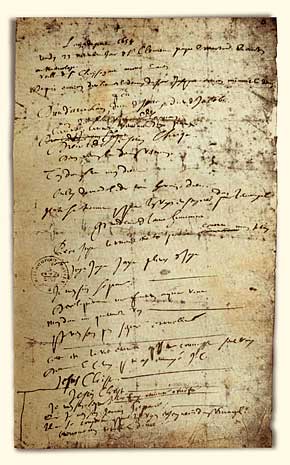
The following manuscript was found sewn inside a dead man’s clothes. The owner of the document had a long history of depressions and had just barely escaped death in a harrowing carriage accident. While alive, his existence was a study in hardship: awful, wracking  pain from a disease ravaged his bowels, legs and feet. So bad was his circulation, he wore stockings soaked in brandy so his feet could stay warm. One month after his brush with death, Blaise Pascal encountered God in what seems to be a Damascus Road way.

This is how he described it:

The year of grace 1654,

Monday, 23 November, feast of St. Clement, pope and martyr, and others in the martyrology.

Vigil of St. Chrysogonus, martyr, and others.

From about half past ten at night until about half past midnight,

FIRE.

GOD of Abraham, GOD of Isaac, GOD of Jacob

not of the philosophers and of the learned.

Certitude. Certitude. Feeling. Joy. Peace.

GOD of Jesus Christ.

My God and your God.

Your GOD will be my God.

Forgetfulness of the world and of everything, except GOD.

He is only found by the ways taught in the Gospel.

Grandeur of the human soul.

Righteous Father, the world has not known you, but I have known you.

Joy, joy, joy, tears of joy.

I have departed from him:

They have forsaken me, the fount of living water.

My God, will you leave me?

Let me not be separated from him forever.

This is eternal life, that they know you, the one true God, and the one that you sent, Jesus Christ.

Jesus Christ.

Jesus Christ.

I left him; I fled him, renounced, crucified.

Let me never be separated from him.

He is only kept securely by the ways taught in the Gospel:

Renunciation, total and sweet.

Complete submission to Jesus Christ and to my director.

Eternally in joy for a day’s exercise on the earth.

May I not forget your words. Amen.

A Door Called Aldersgate

I get John Wesley. Before he became the guy who said, “I look upon all the world as my parish”* he preferred his parochial, amicable studies and libraries rather than the great halls. He was a cave-dweller. Ministerially, he was a good Oxfordite, a proper Anglican priest, who toed the party line and desired things be done decently and with order. He had some OCD in him, I’d wager. In short, he went with the program.

I do like my cave, but, granted, that last bit is quite unlike me. I have Baptistic roots but there are doors closed to me because of my ‘aberrant’ theology, and, likewise, I have not found a home among their polar opposites (I’m too Baptist I’m told). Ah, well, such is life. My wife quipped a few years ago that if I were the type of person to “play the game”, I would be set for life with meetings and denominational appointments. She followed that up by saying, “I respect you more because you don’t.”

She so completes me.

John-surnamed-Wesley was a fussy dresser, I’m told, always neat and fashionable without being conspicuous, starched to the gills and spotless. Hands soft and manicured, Wesley’s skin was probably sallowed from dwelling indoors by candle’s glow. Continue reading A Door Called Aldersgate