the hidden goodness of God

Dickens penned one of the greatest opening lines in a novel with “It was the best of times, it was the worst of times…”

It takes a whole other level of creativity to find the best of times in the worst of times; that’s something only the Author of Life can write. I’ve been through some terrible and dark times but with each has come a major plot twist: good from bad, healing from ruin, life from death.

A particularly dark time brought me into the jaws of death in 2009. None of my doctors could locate the cause of infection that was taking my life. Every day the news got more grim; every day I fell more deeply into darkness. I won’t belabor you with the entire nasty business but I will tell you this: today I look back on that time with reverence and a deeper revelation into the healing love of God.

So when David makes wild claims like “It is good for me that I was afflicted…” I don’t wince; I say to myself, “I totally get that.”
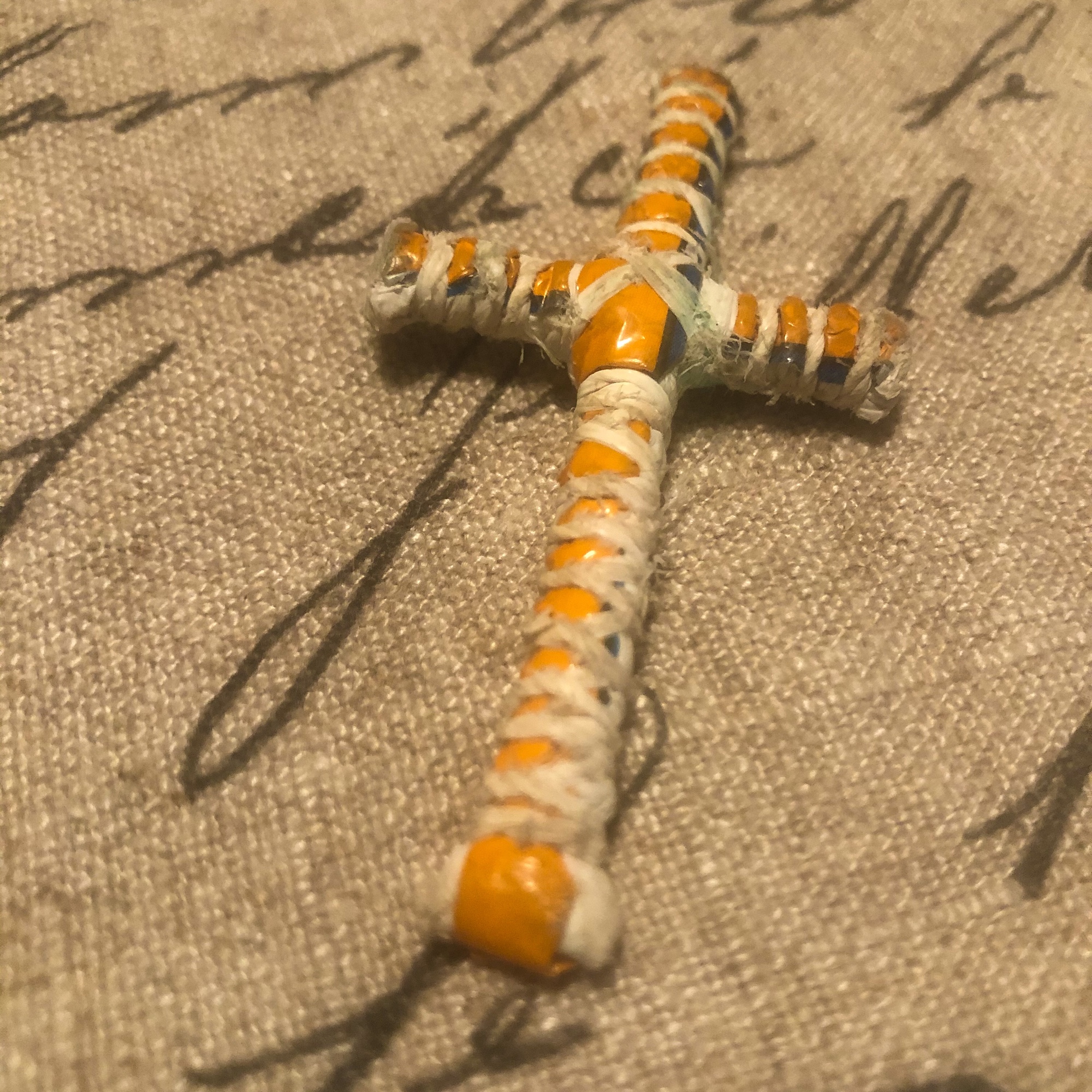
Years ago, our son made this cross out of garbage bags while in prison; there’s truly a parable in it.

The longest chapter in the Bible is Psalm 119 and covers the entire vista of life in God from A-Z. Each section begins with a succeeding letter of the Hebrew alphabet and the accompanying verses expand on the theme. If you move your eyes down to the ninth paragraph (vs65-72) you’ll find composer David reflecting on the greatest lesson he ever learned about trials and afflictions.
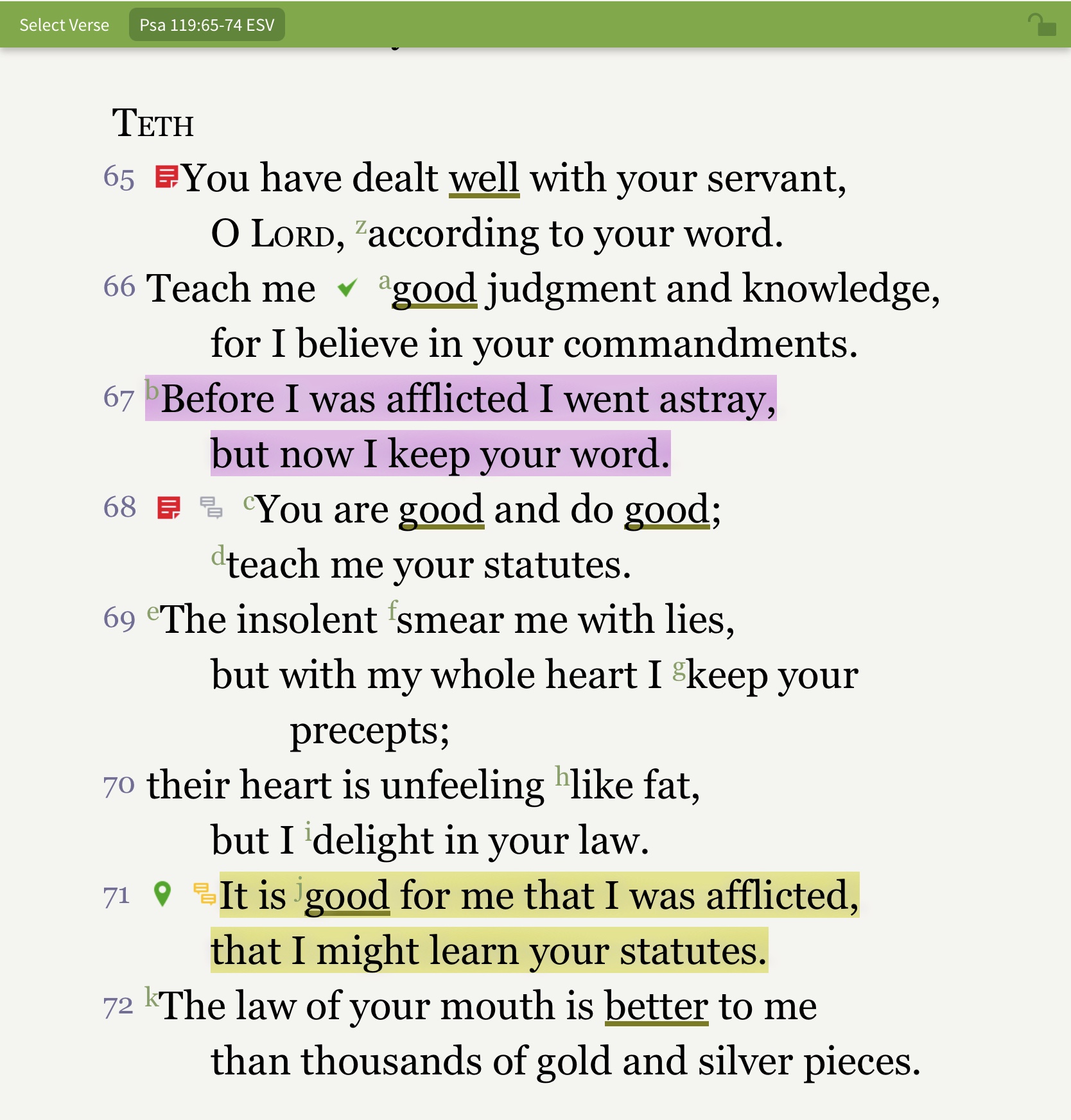
The 9th letter in the poem, TETH (‘tayt’), means essentially “the hidden goodness of God.” Take a look at the image just below: some have seen in the shape of the letter a pregnant belly, others a full pot. The ‘good’ within can only be seen at delivery or when one removes the lid.

Hebrew letter “Tet”

Now take another look at the passage above and locate the underlined words. Each time it’s the Hebrew word, “Tov.”

“Tov” (“well”, “good”, “better”) is found six times, hidden in those eight verses. Its basic meaning is ‘good’ but it’s fuller definition has to do with something that is “well suited” for its purpose; something “well wrought” and “well crafted.” It’s a word found in the vocabulary of an artist.


🔹It’s a fruit of the Spirit (“goodness”)

🔹We first see it throughout the creation story (“God created….and it was good”)

🔹Satan wanted to erase all “good” from creation, plunging it all into darkness and chaos; he wanted the opposite of ‘tov’: he wanted despair and hopelessness

🔹God has preserved this aspect of creation by never removing ‘Tov’; even as Satan is busily stacking bricks to build his empire, rays of ‘tov’ spread over the earth…to the evil one’s great consternation

Satan assumed grief would be the end of us. He thought affliction and trial would cause us to curse God. He never, ever expected good to come from any of it.


The devil wanted to erase “good” for good. Big mistake. God’s good cannot be erased; this is still our Father’s world, and we can find good in our suffering.

My dad was known for having a wonderful singing voice. When called on to give a solo at church he would sometimes sing “The Love of God.” I remember hearing him give the backstory about one of the verses being found on the walls of a cell, put there by an inmate at an insane asylum:

Could we with ink the ocean fill,
and were the skies of parchment made;
were every stalk on earth a quill,
and every man a scribe by trade:
to write the love of God above
would drain the ocean dry,
nor could the scroll contain the whole
though stretched from the sky to sky.

It’s crazy to think how we can see the love of God inside walls of despair pressing in on us. It seems counterintuitive. How do you sing about the love of God from a hospital bed? How can you see the goodness of God at the graveside of your child or spouse?

After my accident in 1981 I spent time at Shepherd spinal center in Atlanta doing rehab. One day the staff psychologist called my parents into his office and said he didn’t think I was handling my disability well at all. He felt I was living in denial. I was (his assessment) “too happy.”


I can tell you that I am not the hero in any of my stories. It’s not about how strong or well-balanced I am. It’s all about the goodness of God.


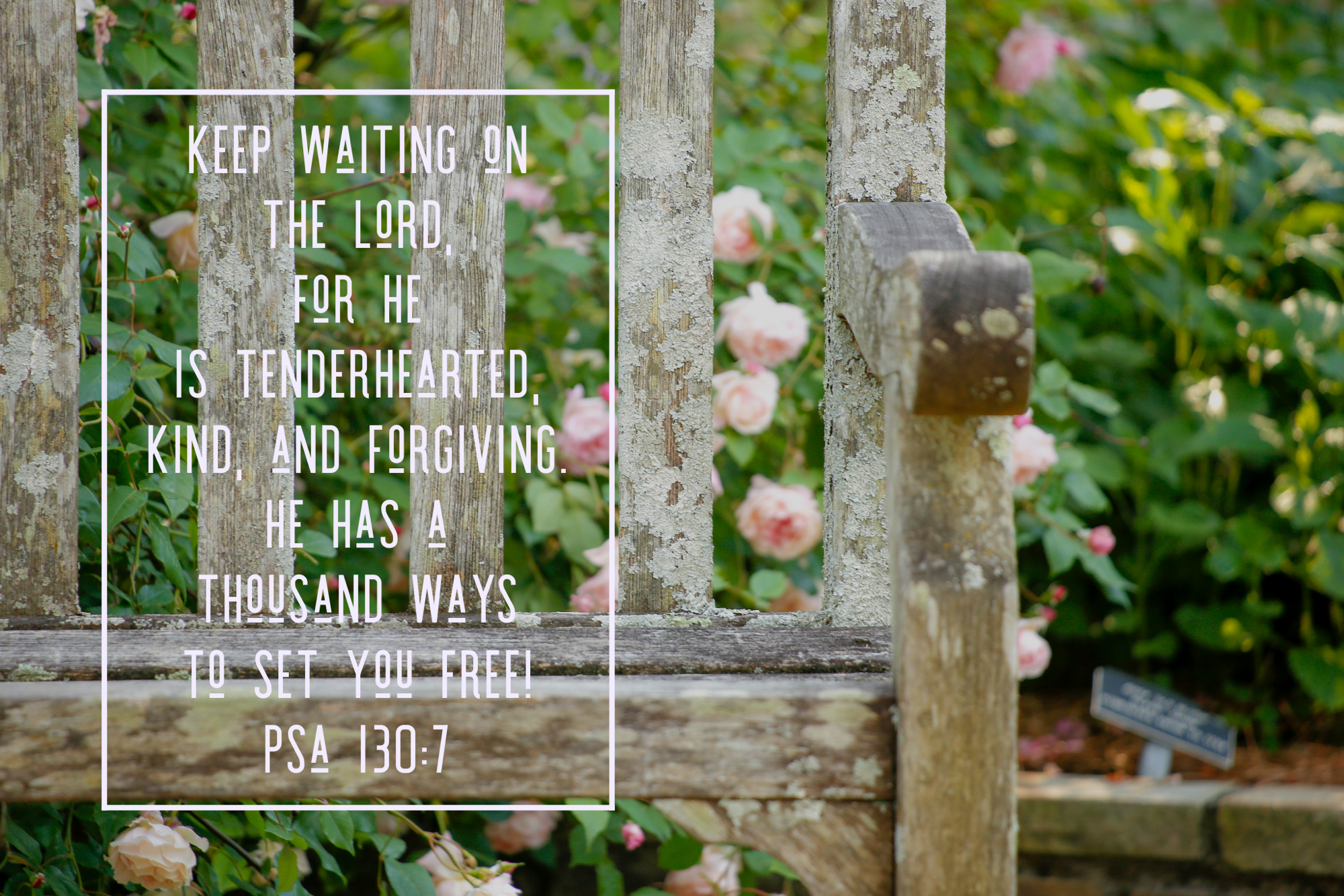
One of the pilgrim psalms tells us God has a “thousand ways to set you free!” (Psa 130:7). When you begin to learn how much God loves to rescue us, you learn, even in the throes of great trial, to wait for him to show up. Because he will.

“The anvil, the fire, and the hammer, are the making of us…I have found that there is a sweetness in bitterness not to be found in honey; a safety with Christ in a storm which may be lost in a calm. It is good for me that I have been afflicted.” – Charles Spurgeon

“Good” affliction

It’s good for me that I was afflicted, that I might learn your statutes. (Psa 119:71)

“Good. for. me.”

“Good” has the place of emphasis. Everything else is window dressing. This passage is the Old Testament parallel to Romans 8:18-28. We know that Paul was a Hebrew scholar and in his training as a Pharisee memorized the Old Testament Scriptures. I think it’s very likely he was calling to remembrance these verses in Psalms when he was writing his Magnus opus in Romans!

So it begs the question: how can we call grief and affliction “good”?

A number of years ago, I was sitting by the graveside of my son, just talking with him about my disability and how good God has been to me throughout my affliction. It was actually on the 33rd anniversary of my accident and I just started jotting down some things. I wish I had time to share them all with you here (there’s a whole bunch more), but let’s just look at a few that tell us why trials and troubles and heartache can be called “good” in the plan of God.

▪️Faithfully enduring trials invites us into deeper intimacy with the Father

▪️It is not in suffering itself that brings glory but our voluntary, joyful acceptance of it

▪️Broken people release the aroma of Christ’s love, healing and mercy

▪️God only allows suffering when He is intent on birthing something new out of it

▪️There’s no greater evangelical “tool” than for the unsaved to encounter a broken vessel that lets the Light of Christ shine into the darkness!

▪️The afflictions of this lifetime will determine the affluence of my eternity and the pains I endure here will reciprocate to pleasures compounded daily for eternity

▪️Until faith has been tested in fire it cannot be trusted in life

▪️God is more focused on my character than my comfort – but not at the expense of His being my Comforter!

▪️Joyfully embracing brokenness leads to patience, gratitude and infectious hope

I pray you find the best of things in the worst of times. May the hidden goodness of God change your story and leave you… stunned.

But in a good way.

Selah, beloved.


weak-shaming

I can’t walk.

It’s not a temporary condition. It doesn’t only afflict me on certain days. It’s lifelong. If my overhead lift in the bedroom loses power I have to wait for it to recharge just so I can perform the simple task of getting into bed. If the ramp on my van quits working I’m stuck inside until somebody comes by to help (hopefully someone who understands basic mechanics).

There are days my paralysis gets the best of me. A good cry usually gets me back to center. The Good Lord knows and I feel seen.

I’m weak. It’s my lot in life. Don’t cry for me, Argentina, it’s all good. One of the reasons I know so is because there’s a verse in the Bible about me.

Look at your situation when you were called, brothers and sisters! By ordinary human standards not many were wise, not many were powerful, not many were from the upper class. But God chose what the world considers foolish to shame the wise. God chose what the world considers weak to shame the strong.1

Don’t let my pastor hear this, but while he was preaching this morning I dug into the text he was expositing (Gospel of Mark, chapter 2, verse 13, yes I was listening) from my Bible app. I came across this beautiful nugget of a story from The Preacher’s Commentary:

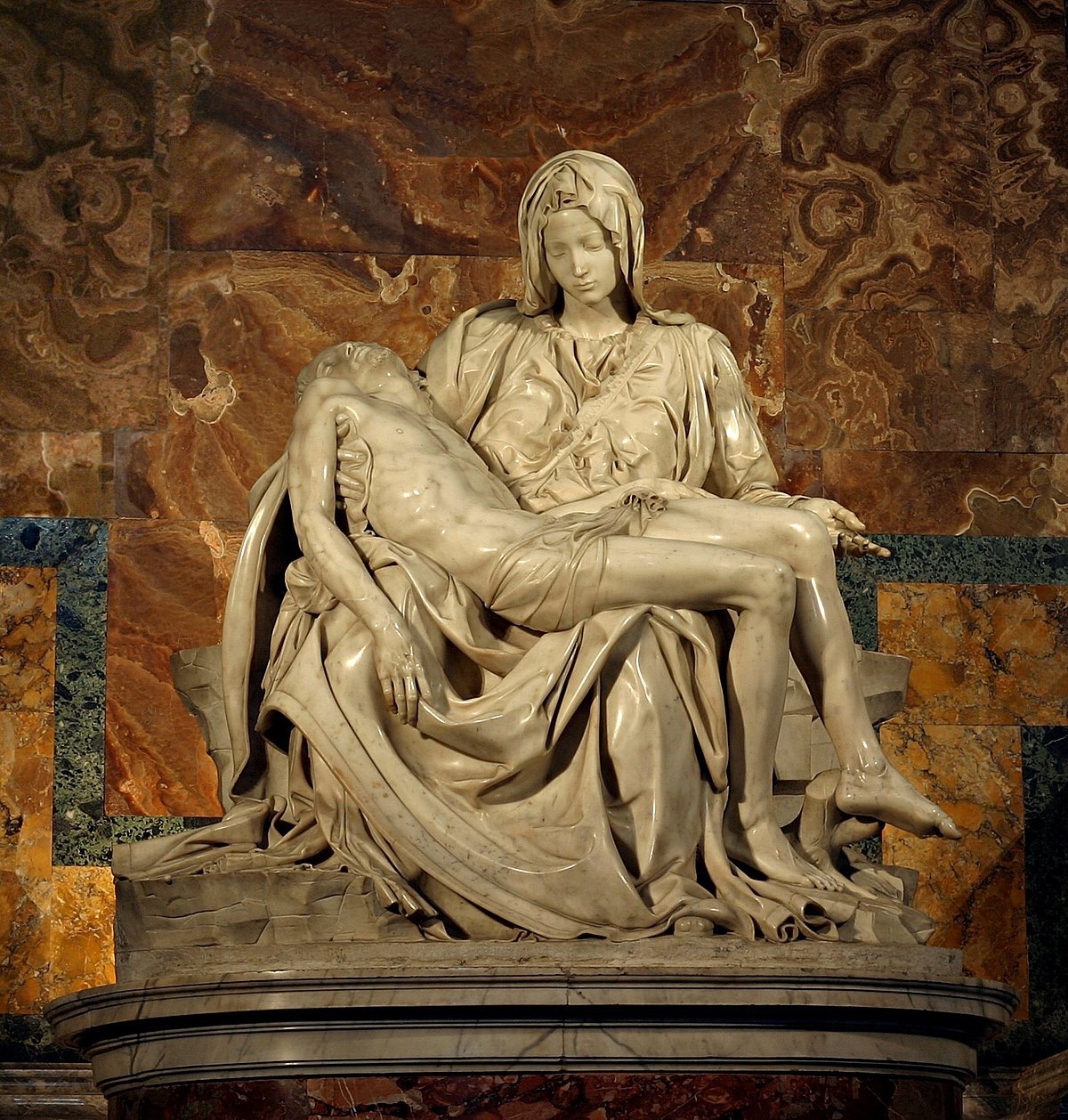
“To see Michelangelo’s Pietà—the sculpture depicting Mary holding her son, Jesus, after He was taken down from the Cross—is an overwhelming experience. Yet, the legend behind the stone is an inspiration in itself. Early in his career, Michelangelo was too poor to buy the marble for his sculpting. He had to pick his way through the rejected or ruined stones of other sculptors. As he eyed the marble, he said that he could see the figure inside waiting to be released by his chisel. Dragging it home, he freed the figures of Mary and Jesus that he envisioned and thus produced one of the miracles of artistic creation—from a reject.”2

Paul, the apostle, knew something about weakness. But he also knew something about God‘s workmanship. He said we rejects and castoffs are really God’s “masterpiece,” his artwork…his poem.3

Here’s N. T. Wright to add some flavor:

Those who are grasped by grace in the gospel and who bear witness to that in their loyal belief in the one God, focused on Jesus, are not merely beneficiaries, recipients of God’s mercy; they are also agents. They are poems in which God is addressing his world, and, as poems are designed to do, they break open existing ways of looking at things and spark the mind to imagine a different way to be human.


“A different way to be human.”

My, my, my. Sign me up because the world’s way of being fully human is turning into an inbred mess! There’s no rhyme or reason to humankind left to itself.

Are you feeling pretty weak about yourself today? Yeah, I bet you are. Losing the same battles over and over again, bumbling and fumbling and stumbling your way through life. Overlooked, unappreciated, dismissed. You’re mild-mannered Clark Kent in a superhero world. Nobody sees who you are on your way to becoming.

Newsflash, God specializes in weak-shaming.

First, he goes into the junkpile and finds the most unlikely materials and says, “I’m going to make something beautiful.” Next, he takes his chisel and chips away all the hard edges and smooths and grinds out all the rough spots. It takes some doing, but he gets us there.

All the patrons of the ages will see it and know they’re witnessing a miracle. They are hushed by the pure poetry of sight in graceful curves and righteous detail. The glory of the Artist shines through and they can’t be in the same room with all that glory; they know they don’t belong there. They bow and take their exit.

If I could tell you that you are one of the lyrics in God’s Epic Poem or a statue in his gallery you’d be happy as a pig in mud. Well, you are, right along with all us other weak sauce saints. Right now its all rough draft, but I know the publishing date is set and the unveiling is scheduled and your scars and embarrassments and deficiencies will make sense on That Day. There’s rhyme and reason for it all. Just you wait and see.

I can’t wait.

———————————————————————

1 1 Corinthians 1:26-27, Common English Bible

2 The Preacher’s Commentary, Dr. Stuart Briscoe, New Testament, Mark 2, Ministry of Hope

3 The Greek word for workmanship in Ephesians 2:10 is poiema.

Timothy Keller asks “Do you know what it means that you are God’s workmanship? What is art? Art is beautiful, art is valuable, and art is an expression of the inner being of the maker, of the artist. Imagine what that means. You’re beautiful, you’re valuable, and you’re an expression of the very inner being of the Artist, the divine Artist, God Himself. You see, when Jesus gave Himself on the Cross, He didn’t say, “I’m going to die just so you know I love you.” He said, “I’m going to die, I’m going to bleed, for your splendor. I’m going to re-create you into something beautiful. I will turn you into something splendid, magnificent. I’m the Artist; you’re the art. I’m the Painter; you’re the canvas. I’m the Sculptor; you’re the marble. You don’t look like much there in the quarry, but I can see. Oh, I can see!” Jesus is an Artist!” And you beloved are His crowning achievement, His masterpiece! (Precept Austin)

mercy from a thousand directions

©️ Scott Mitchell

Moody’s my guy. I grew up reading his sermons, learning about his life, quoting him, reading stories about him. D.L. is my categorical “can’t wait to meet him when I get to heaven” people.

One of my favorite anecdotes was when Mr. Moody had an encounter with the Lord far too wonderful for words. Older saints would call it the “baptism of the Holy Spirit” or a “deeper experience of faith.” To describe that New York City event he borrowed an illustration from his childhood. Young Moody’s job for the family was to fetch water when the well ran dry. Now as an adult living on that same property, he remembered back when he had to carry pails of water to and from that spring. He got smart and laid pipes from the source to the house and just let the water come to him!

I was all the time tugging and carrying water. But now I have a river that carries me.

Moody said the rivers of heaven deluged him with the manifold love of God. It felt like tides and waves of mercy coming from every direction, so much so he begged God to make it stop!

‘Ah, what a day! I cannot describe it, I seldom refer to it, it is almost too sacred an experience to name. Paul had an experience of which he never spoke for fourteen years. I can only say God revealed himself to me, and I had such an experience of his love that I had to ask him to stay his hand.’”

Now that’s some mercy!

Moses got a jolly good dose of it when he asked for a vision and God gave him a VIP seat to the greatest show on earth. His request is not for more fireworks, thunder, blood, wind, locusts, armies, manna, or burning bushes. He wanted something more personal, so God did a really cool thing: he said “Do you really want to see me, Moses? I can’t do that because it would kill you; the weight of it would crush you.”

“However, this is what I’ll do… I’ll send a tidal wave of a thousand mercies at you ALL AT ONCE, the likes of which you’ll never, ever forget.”

Oh yes, some of that, please.

I imagine in eternity during one of our chats with Jesus, he will take us back to a moment on earth when we were going to work or headed to the mall. He’ll describe that day to a tee and tell us there were maybe four or five different times we could have been injured or worse but he dispatched angels of mercy to protect us. I like to think about stuff like that.

For with the Lord there is steadfast love, and with him is plentiful redemption. Psalm 130:7, ESV

Why don’t we hear this psalm quoted more often? I cannot recall the last time I heard/used this verse as a text in a sermon. It’s powerful. It’s delightful. What a promise!

My only low-key gripe with the Passion translation (photo at the top) is why did it stop at 1000? Why not 10,000… (hmm, sounds like a song Matt Redman should write) Or 1 trillion? I get that it’s poetic, and I quickly back away from my soft criticism. Truth told, I love how its lyrical gentility sits on my tongue:

“He has a thousand ways to set you free!”

Of course we all know he has way more than a thousand mercies at any given moment. I like how John Piper puts it: “God is always doing 10,000 things in your life, and you may be aware of three of them.”

With God are “plentiful redemption[s].” Beloved saint, worry not; you have not, nor will you ever, use up your quota of rescues at the hand of the Father! He longs to show you mercy…

the LORD longs to be gracious to you;

therefore he will rise up to show you compassion.

For the Lord is a God of justice.

Blessed are all who wait for him! (Isaiah 30:18)

A word. There are times when God’s mercies do not come in the form of hugs and rainbows, but rather in the form of chastisement or adversity. I would hardly be loath to tell you how God has saved me from myself many times by taking me through deep waters.

I told my son one time, “as long as you are looking for a way out rather than the way home, you’ll always be a prodigal.” There are times when we will not see the Lord’s banner of victory in our life until we wave the white flag of surrender.

Mr. Spurgeon has something to say about this severe mercy:

Take this in the very starting, that whatever thy trouble, or thine affliction, there cannot be anything punitive in it, thou must never say-“Now God is punishing me for my sin.” Thou hast fallen from thy steadfastness when thou talkest so. God cannot do that. He has once for all done it. “The chastisement of our peace was upon HIM, and by HIS stripes we are healed.” He is chastising thee, not punishing thee; he is correcting thee in measure, he is not smiting thee in wrath. There is no hot displeasure in his heart. Even though his brow may be ruffled, there is no anger in his breast; even though his eye may have closed upon thee, he hates thee not, he loves thee still. He is not wroth with his heritage, for he seeth no sin in Jacob, neither iniquity-in Israel, considered in the person of Christ. It is simply because he loves you, because ye are sons, that he therefore chastises you.1

Yes, a thousand times yes, God is fully willing to send a stranger to fix your tire on a rainy night when the highway is so busy you cannot get out of your automobile because of your disability. You can be jolly well certain God has you on his radar when you’re on your sickbed and the devil is terrifying you with fevered dreams of despair. He’ll also use your sickbed to find his Beautiful Face in the dark.

Start making a list of the times when you see God‘s mercies come to you, in big and small ways. Before you know it your list might grow to a thousand. Or more.


1 Charles H. Spurgeon, Chastisement, https://www.spurgeon.org/resource-library/sermons/chastisement/