Anywhere you find an anemic church, the problem can easily be traced. The issue is certainly not with Jesus, or his Word, or our mission statements. When Jesus said “I will build My church…and the gates of hell shall not prevail against it“ he meant exactly what he said. Peter said some pretty cool stuff in that exchange, but the church isn’t built on him. The church is built on My.
We gotta get the pronouns right. Weak churches have switched the pronouns from “His” church to “our” church. They love their ‘us-four-and-no-more’ little kingdoms or their mega-fancy Sunday events.
Wherever the church operates as His, flying under his banner, you can rest assured mountains are being moved, exiles are finding a home, bondages are being broken, devils are sent into pigs, the poor are being prioritized, the last are first, the first are last, nets are dropping, the gospel is thriving, and Christ is all and in all.
To be “His” Church requires ongoing repentance, faith, and being led by the Spirit. To say that “Jesus is Lord” is to say in the same breath “I am not.” It requires absolute reliance upon and unashamed allegiance to Christ. In essence, “not about me” becomes “all about You, Jesus.” Pronouns.
A powerless church has a nasty flesh-eating disease. Cancer, too-long undetected, has metastasized throughout the system and the body slowly dies.
The late Francis Schaeffer explains:
The central problem of our age is not liberalism or modernism, nor the old Roman Catholicism or the new Roman Catholicism, nor the threat of communism, nor even the threat of rationalism and the monolithic consensus which surrounds us. All these are dangerous but not the primary threat.
The real problem is this:
the church of the Lord Jesus Christ, individually or corporately, tending to do the Lord’s work in the power of the flesh rather than of the Spirit.
The central problem is always in the midst of the people of God, not in the circumstances surrounding them.1
Good News
The gospel won’t allow us just to leave that hanging there, as if there were no hope, no remedy. ‘Twould be easy to harp all day about all the wrongs in the church, but we cannot ignore the fascinating picture of the end-time Church.
Paul said she’s still His church and he takes responsibility to bathe her and iron her garments and heal her disease-ravaged body. Our bridegroom Lord is not finished with his bride. Right now she’s “prone to wander,” but his love in the end makes her stay.
There is coming a day when we will see her high up in the bridal chamber “making herself ready” for eternal matrimony with the Lover of her soul. Her destiny is enfolded into Him.
O to grace how great a debtor daily I’m constrained to be!
Let thy goodness like a fetter, bind my wandering heart to thee
Prone to wander Lord I feel it, prone to leave the God I love
Here’s my heart, O take and seal it, seal it for thy courts above!2
Gospel grammar is important. This is our hope: He is Lord and we are made for him. Selah, beloved
1 Francis A. Schaeffer, No Little People (Wheaton, 2003), 66.
2 Come Thou Fount of Every Blessing, Robert Robinson, 1758
Dickens penned one of the greatest opening lines in a novel with “It was the best of times, it was the worst of times…”
It takes a whole other level of creativity to find the best of times in the worst of times; that’s something only the Author of Life can write. I’ve been through some terrible and dark times but with each has come a major plot twist: good from bad, healing from ruin, life from death.
A particularly dark time brought me into the jaws of death in 2009. None of my doctors could locate the cause of infection that was taking my life. Every day the news got more grim; every day I fell more deeply into darkness. I won’t belabor you with the entire nasty business but I will tell you this: today I look back on that time with reverence and a deeper revelation into the healing love of God.
So when David makes wild claims like “It is good for me that I was afflicted…” I don’t wince; I say to myself, “I totally get that.”
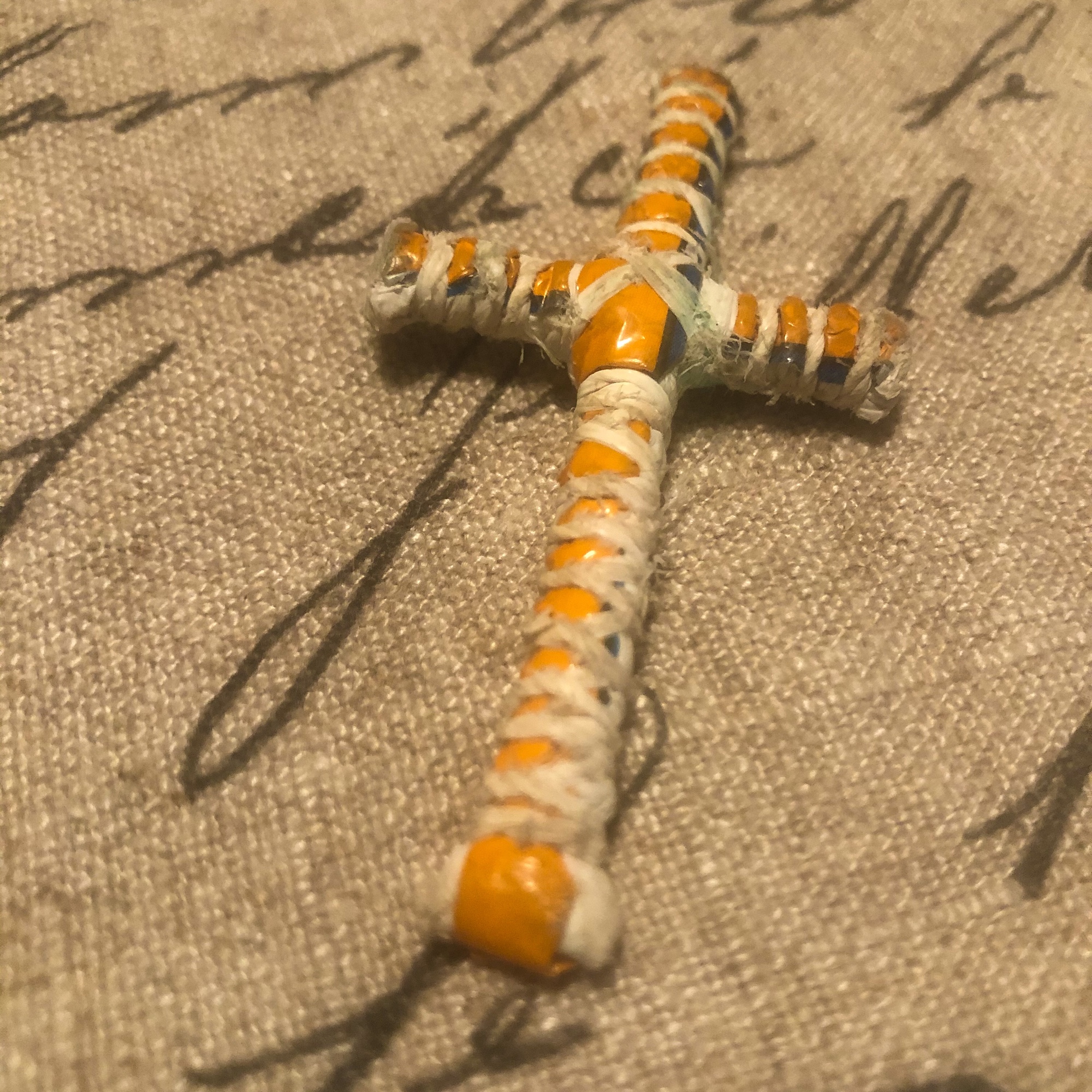
Years ago, our son made this cross out of garbage bags while in prison; there’s truly a parable in it.
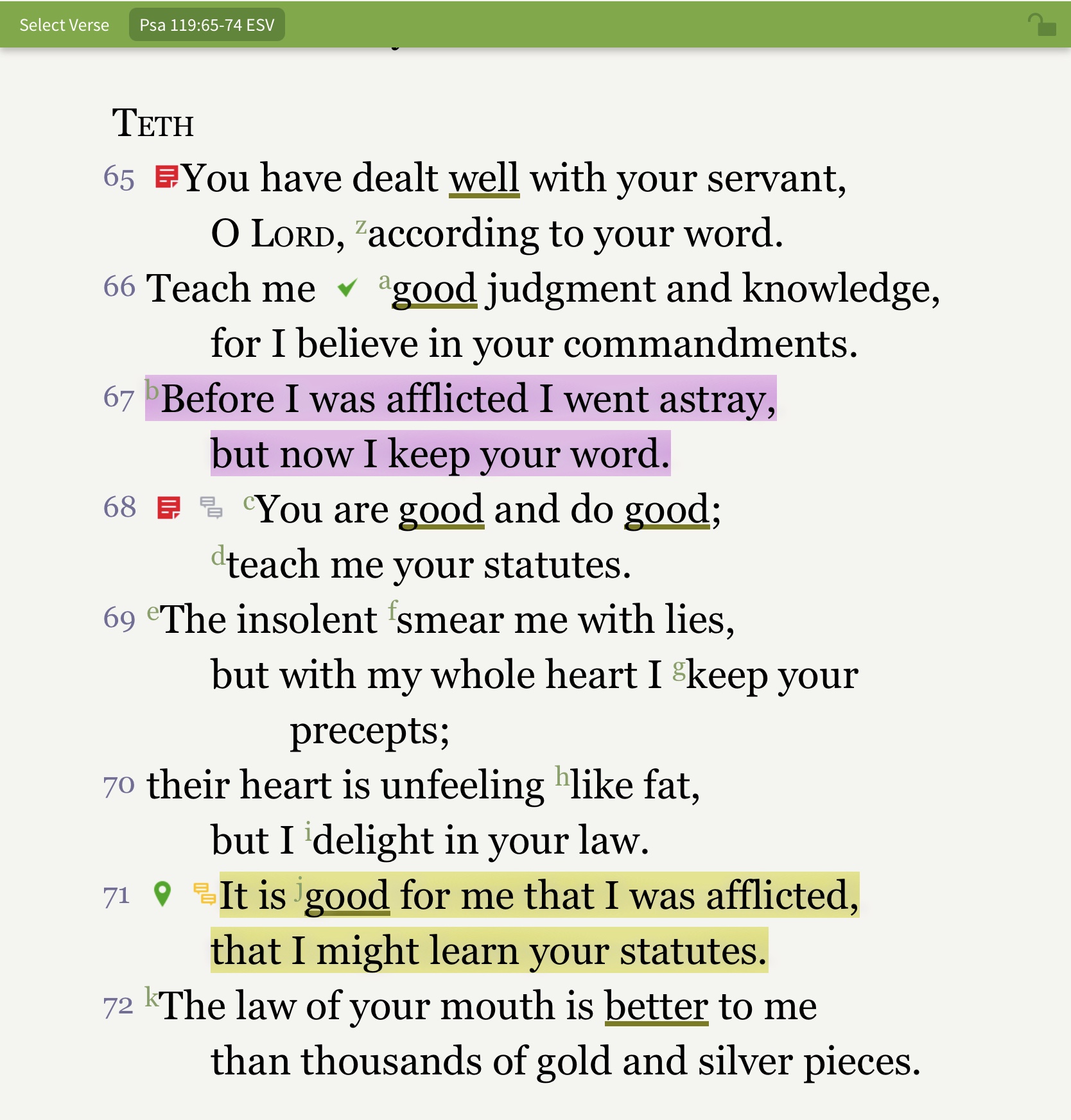
The longest chapter in the Bible is Psalm 119 and covers the entire vista of life in God from A-Z. Each section begins with a succeeding letter of the Hebrew alphabet and the accompanying verses expand on the theme. If you move your eyes down to the ninth paragraph (vs65-72) you’ll find composer David reflecting on the greatest lesson he ever learned about trials and afflictions.
The 9th letter in the poem, TETH (‘tayt’), means essentially “the hidden goodness of God.” Take a look at the image just below: some have seen in the shape of the letter a pregnant belly, others a full pot. The ‘good’ within can only be seen at delivery or when one removes the lid.
Hebrew letter “Tet”
Now take another look at the passage above and locate the underlined words. Each time it’s the Hebrew word, “Tov.”
“Tov” (“well”, “good”, “better”) is found six times, hidden in those eight verses. Its basic meaning is ‘good’ but it’s fuller definition has to do with something that is “well suited” for its purpose; something “well wrought” and “well crafted.” It’s a word found in the vocabulary of an artist.
🔹It’s a fruit of the Spirit (“goodness”)
🔹We first see it throughout the creation story (“God created….and it was good”)
🔹Satan wanted to erase all “good” from creation, plunging it all into darkness and chaos; he wanted the opposite of ‘tov’: he wanted despair and hopelessness
🔹God has preserved this aspect of creation by never removing ‘Tov’; even as Satan is busily stacking bricks to build his empire, rays of ‘tov’ spread over the earth…to the evil one’s great consternation
Satan assumed grief would be the end of us. He thought affliction and trial would cause us to curse God. He never, ever expected good to come from any of it.
The devil wanted to erase “good” for good. Big mistake. God’s good cannot be erased; this is still our Father’s world, and we can find good in our suffering.
My dad was known for having a wonderful singing voice. When called on to give a solo at church he would sometimes sing “The Love of God.” I remember hearing him give the backstory about one of the verses being found on the walls of a cell, put there by an inmate at an insane asylum:
Could we with ink the ocean fill, and were the skies of parchment made; were every stalk on earth a quill, and every man a scribe by trade: to write the love of God above would drain the ocean dry, nor could the scroll contain the whole though stretched from the sky to sky.
It’s crazy to think how we can see the love of God insidewalls of despair pressing in on us. It seems counterintuitive. How do you sing about the love of God from a hospital bed? How can you see the goodness of God at the graveside of your child or spouse?
After my accident in 1981 I spent time at Shepherd spinal center in Atlanta doing rehab. One day the staff psychologist called my parents into his office and said he didn’t think I was handling my disability well at all. He felt I was living in denial. I was (his assessment) “too happy.”
I can tell you that I am not the hero in any of my stories. It’s not about how strong or well-balanced I am. It’s all about the goodness of God.
One of the pilgrim psalms tells us God has a “thousand ways to set you free!” (Psa 130:7). When you begin to learn how much God loves to rescue us, you learn, even in the throes of great trial, to wait for him to show up. Because he will.
“The anvil, the fire, and the hammer, are the making of us…I have found that there is a sweetness in bitterness not to be found in honey; a safety with Christ in a storm which may be lost in a calm. It is good for me that I have been afflicted.” – Charles Spurgeon
“Good” affliction
It’s good for me that I was afflicted, that I might learn your statutes. (Psa 119:71)
“Good. for. me.”
“Good” has the place of emphasis. Everything else is window dressing. This passage is the Old Testament parallel to Romans 8:18-28. We know that Paul was a Hebrew scholar and in his training as a Pharisee memorized the Old Testament Scriptures. I think it’s very likely he was calling to remembrance these verses in Psalms when he was writing his Magnus opus in Romans!
So it begs the question: how can we call grief and affliction “good”?
A number of years ago, I was sitting by the graveside of my son, just talking with him about my disability and how good God has been to me throughout my affliction. It was actually on the 33rd anniversary of my accident and I just started jotting down some things. I wish I had time to share them all with you here (there’s a whole bunch more), but let’s just look at a few that tell us why trials and troubles and heartache can be called “good” in the plan of God.
▪️Faithfully enduring trials invites us into deeper intimacy with the Father
▪️It is not in suffering itself that brings glory but our voluntary, joyful acceptance of it
▪️Broken people release the aroma of Christ’s love, healing and mercy
▪️God only allows suffering when He is intent on birthing something new out of it
▪️There’s no greater evangelical “tool” than for the unsaved to encounter a broken vessel that lets the Light of Christ shine into the darkness!
▪️The afflictions of this lifetime will determine the affluence of my eternity and the pains I endure here will reciprocate to pleasures compounded daily for eternity
▪️Until faith has been tested in fire it cannot be trusted in life
▪️God is more focused on my character than my comfort – but not at the expense of His being my Comforter!
▪️Joyfully embracing brokenness leads to patience, gratitude and infectious hope
I pray you find the best of things in the worst of times. May the hidden goodness of God change your story and leave you… stunned.
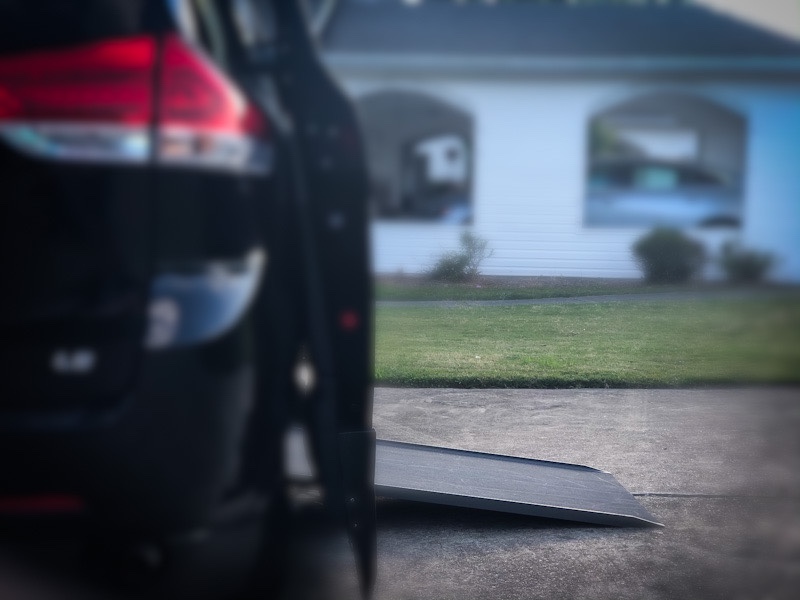
It’s not a temporary condition. It doesn’t only afflict me on certain days. It’s lifelong. If my overhead lift in the bedroom loses power I have to wait for it to recharge just so I can perform the simple task of getting into bed. If the ramp on my van quits working I’m stuck inside until somebody comes by to help (hopefully someone who understands basic mechanics).
There are days my paralysis gets the best of me. A good cry usually gets me back to center. The Good Lord knows and I feel seen.
I’m weak. It’s my lot in life. Don’t cry for me, Argentina, it’s all good. One of the reasons I know so is because there’s a verse in the Bible about me.
Look at your situation when you were called, brothers and sisters! By ordinary human standards not many were wise, not many were powerful, not many were from the upper class. But God chose what the world considers foolish to shame the wise. God chose what the world considers weak to shame the strong.1
Don’t let my pastor hear this, but while he was preaching this morning I dug into the text he was expositing (Gospel of Mark, chapter 2, verse 13, yes I was listening) from my Bible app. I came across this beautiful nugget of a story from The Preacher’s Commentary:
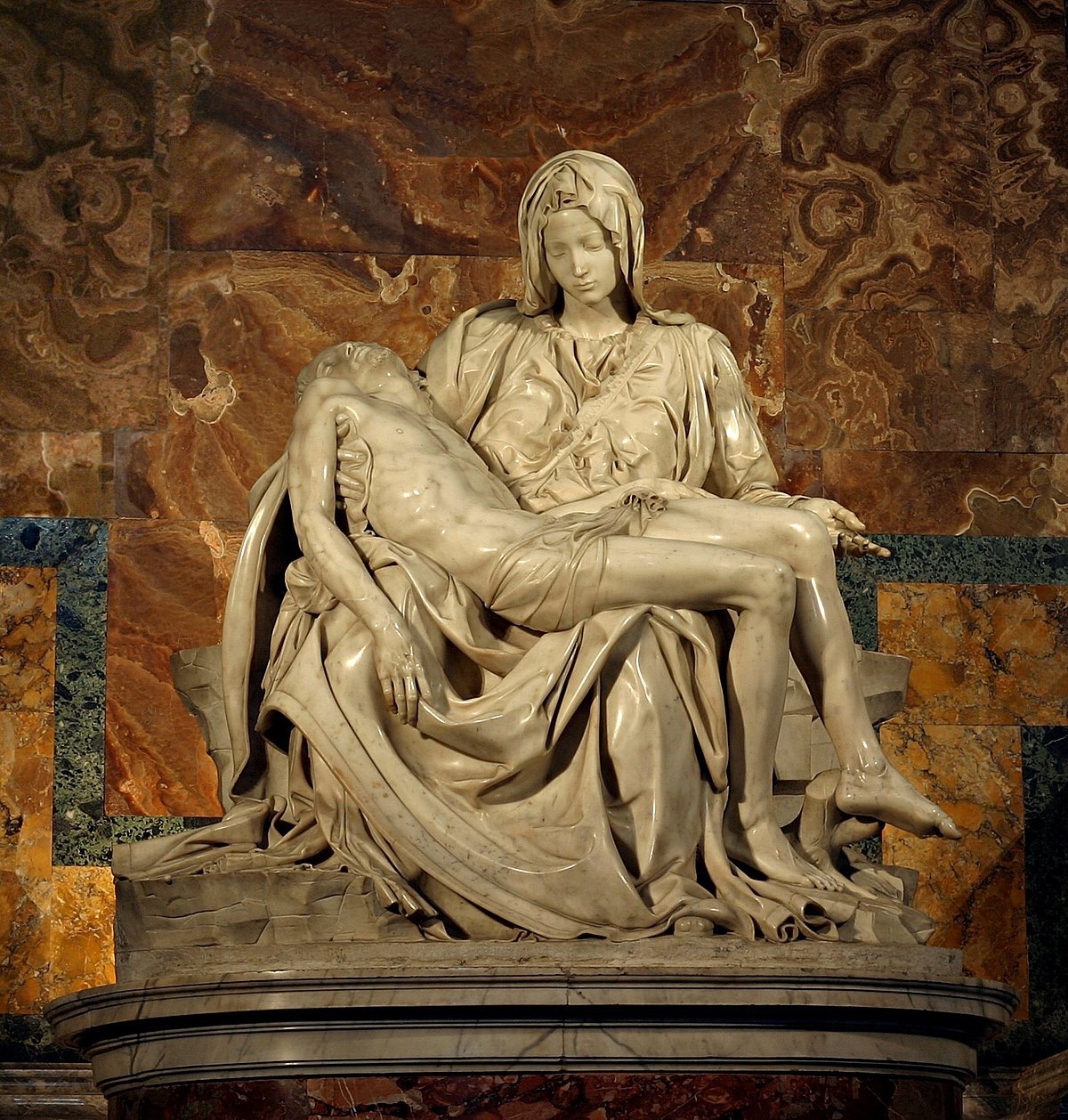
“To see Michelangelo’s Pietà—the sculpture depicting Mary holding her son, Jesus, after He was taken down from the Cross—is an overwhelming experience. Yet, the legend behind the stone is an inspiration in itself. Early in his career, Michelangelo was too poor to buy the marble for his sculpting. He had to pick his way through the rejected or ruined stones of other sculptors. As he eyed the marble, he said that he could see the figure inside waiting to be released by his chisel. Dragging it home, he freed the figures of Mary and Jesus that he envisioned and thus produced one of the miracles of artistic creation—from a reject.”2
Paul, the apostle, knew something about weakness. But he also knew something about God‘s workmanship. He said we rejects and castoffs are really God’s “masterpiece,” his artwork…his poem.3
Here’s N. T. Wright to add some flavor:
Those who are grasped by grace in the gospel and who bear witness to that in their loyal belief in the one God, focused on Jesus, are not merely beneficiaries, recipients of God’s mercy; they are also agents. They are poems in which God is addressing his world, and, as poems are designed to do, they break open existing ways of looking at things and spark the mind to imagine a different way to be human.
“A different way to be human.”
My, my, my. Sign me up because the world’s way of being fully human is turning into an inbred mess! There’s no rhyme or reason to humankind left to itself.
Are you feeling pretty weak about yourself today? Yeah, I bet you are. Losing the same battles over and over again, bumbling and fumbling and stumbling your way through life. Overlooked, unappreciated, dismissed. You’re mild-mannered Clark Kent in a superhero world. Nobody sees who you are on your way to becoming.
Newsflash, God specializes in weak-shaming.
First, he goes into the junkpile and finds the most unlikely materials and says, “I’m going to make something beautiful.” Next, he takes his chisel and chips away all the hard edges and smooths and grinds out all the rough spots. It takes some doing, but he gets us there.
All the patrons of the ages will see it and know they’re witnessing a miracle. They are hushed by the pure poetry of sight in graceful curves and righteous detail. The glory of the Artist shines through and they can’t be in the same room with all that glory; they know they don’t belong there. They bow and take their exit.
If I could tell you that you are one of the lyrics in God’s Epic Poem or a statue in his gallery you’d be happy as a pig in mud. Well, you are, right along with all us other weak sauce saints. Right now its all rough draft, but I know the publishing date is set and the unveiling is scheduled and your scars and embarrassments and deficiencies will make sense on That Day. There’s rhyme and reason for it all. Just you wait and see.
I can’t wait.
———————————————————————
1 1 Corinthians 1:26-27, Common English Bible
2 The Preacher’s Commentary, Dr. Stuart Briscoe, New Testament, Mark 2, Ministry of Hope
3 The Greek word for workmanship in Ephesians 2:10 is poiema.
Timothy Keller asks “Do you know what it means that you are God’s workmanship? What is art? Art is beautiful, art is valuable, and art is an expression of the inner being of the maker, of the artist. Imagine what that means. You’re beautiful, you’re valuable, and you’re an expression of the very inner being of the Artist, the divine Artist, God Himself. You see, when Jesus gave Himself on the Cross, He didn’t say, “I’m going to die just so you know I love you.” He said, “I’m going to die, I’m going to bleed, for your splendor. I’m going to re-create you into something beautiful. I will turn you into something splendid, magnificent. I’m the Artist; you’re the art. I’m the Painter; you’re the canvas. I’m the Sculptor; you’re the marble. You don’t look like much there in the quarry, but I can see. Oh, I can see!” Jesus is an Artist!” And you beloved are His crowning achievement, His masterpiece! (Precept Austin)