“The two most important days in your life are the day you are born and the day you find out why.” – Mark Twain
Once upon a time a Sunday school teacher got a burden for a young man in his class and visited the young man at his shop. He told him the good news of the gospel of salvation and that young shoe salesman became one of the great pastors and evangelists of a generation, D.L. Moody.
Now I’m sure that Sunday school teacher accomplished many other things in his life but none more notable than walking into a shoe shop that day.
What an amazing “Why.”
There’s Martin Luther’s memorable “Here I stand, I can do no other” appeal before the Roman Catholic tribunal. Defacing cathedral doors with inflammatory messages might get you in trouble with religious folk but they may be just what is needed to ignite a reformation.
Six centuries later and we all can give thanks today he found his “why” and struck the first match.
At a pastor’s retreat one of the attendees noticed how a woman joyfully cleaned all the rooms each day. On the last day he found her in the bathroom scrubbing one of the toilets and thanked her. “How do you do such degrading work so happily?” he asked. “Oh no,” she relied with a noticeable spark, “I don’t have to do this, I get to do this!”
A beautiful “Why.”
For nearly 40 years I’ve watched my wife minister to me by doing things no wife should ever have to do for her husband. Not long ago I listened in on a phone conversation she was having with a family member. She told my wife, “One of the things I have watched you do over and over is to simply show up. To be there, whenever and wherever you’re needed.”
Her “Why” sings into eternity!
Let’s look at another.

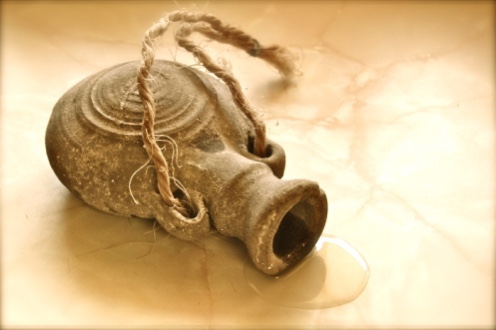
Mary, the sister of Lazarus, is found in several places in the New Testament but in three of the four gospels (Luke shares a different occasion, a different woman, but an uncannily similar act of worship) we find her demonstrating her most notable “Why” the day she walked into the room where Jesus was reclining and poured costly perfume on his feet.
[Read Mark 14:1-9]
Mary’s“beautiful work” was to prepare Messiah for his burial. This is a work belonging only to her. It was a one-of-a-kind act of service in which she endearingly rose to the occasion (or bowed, in her case).
The thought struck me: we can’t do Mary’s noble task of preparing Christ’s body for burial but we can prepare his body for his return (Heb 10:25).
Two Marys and Salome went to the tomb to anoint the body of Jesus (Mark 16:1), but they found they were too late. Their anointing was not necessary because Christ Jesus was alive. They didn’t need to do Mary’s “beautiful work” because that was a one-off. Instead, they were given a new mandate to pound the ground with the news of the Savior’s resurrection, and every generation of disciples since are compelled to share that same empty-tomb news… with the added good news that he is coming back!
worthy v. worthless
A word. Just because we do stuff “in Jesus name” doesn’t necessarily mean we’ll have it memorialized on a building or a park bench in the New Jerusalem. There are “beautiful works” and there are “disposable works.” The difference is the source that drives it. Beautiful works put self on its knees and the body of Christ in the place of honor. Disposable works reverse the emphasis. We can cut our neighbor’s lawn but the minute we subtly draw attention to it on social media (posing next to a push mower, gesturing wiping sweat from our faces but smiling like we just did something special) it’s destined for the brush pile. You do know it’s possible to do some pretty great things in Jesus name and those things be burned up and lost in the end (1 Cor 3:11-15), right?
beautiful waste
What Mark does with this beautiful tableau is nothing shy of genius. The anointing at Bethany was actually a week earlier but Mark drops it here because he wants the readers to see the contrast between selfless worship and self-driven religion.
You know how the room reacts to Mary’s “waste of resources.” The Twelve, led by Judas, turn it into a church business meeting and vote against the whole affair. It didn’t make sense to their sensual minds. Judas especially, driven by greed and devilry, thought the whole thing was stupid and consequently showed his true colors.
Where do we next see Judas? That’s right. In the very next paragraph. Mark sets him in the most unflattering light, akin to Iago’s treachery to Desdemona’s innocence. I imagine the good John Mark spitting into his inkwell and gritting his teeth before putting pen to parchment. Gothic overtones. All black, at night, evil intent.
Nothingness.
Waste.
Incidentally, the word “wasted” in verse four is the same word translated “perdition” in John 17:12 with regard to Judas. Mark exposed him as destined for hellfire. It’s a cautionary tale in ALL CAPS for us: any work, act of service, effort, duty, ministry, offering, cause, collaboration, whatever, motivated by greed, self-promotion, self-indulgence, or internal pride, is burnt up and worthless.
Bottom line: if our “Why” isn’t Jesus, there’s no life in it.
In the next post, we’ll explore more deeply the idea of such beautiful, selfless, Mary-scented, Son-approved, life-giving works to the body of Christ and for the glory of God. Judas and his ilk don’t figure into it like this one, so let’s just wash that bad taste from our mouths and focus on a broken jar of perfume and a house infused with a hint of heaven. Mark still has much to say on the matter, so I hope you’ll be back.
Selah, beloved. Until then.
[tipjarwp mode=”button” link_text=”Click here to buy me a coffee ☕️ Thank you!” open_style=”in_place”]