the best of times, the worst of times: bethlehem and ramah

[5 minutes]

Happy New Year!

It is customary for many in our faith community to approach the new year with — in football lingo — a spiritual ‘fresh set of downs.’ So what’s one of the first plays we run? Right. We advance with a new Bible reading plan, right? My goal in 2025 is to tackle the New Testament along with the Psalms. Okay, enough with the football jargon.

So [opening my Bible], Matthew it is.

Matthew’s opening scenes are familiar for obvious reasons. My Advent meditations covered these passages and I quickly find myself here once again. I also spoke at a local church’s Christmas banquet using the same birth narrative as found in the first gospel. You may have read a version of it recently (“Keeping Jesus Out In Front“). I know this passage pretty well.

But, as is often the case for students of the Book, something can jump off the page that you’ve never seen before. You know what I’m talking about. That is what happened to me this morning.

Then Herod, when he saw that he had been tricked by the wise men, became furious, and he sent and killed all the male children in Bethlehem and in all that region who were two years old or under, according to the time that he had ascertained from the wise men.

Matthew 2:16

Then was fulfilled what was spoken by the prophet Jeremiah:
“A voice was heard in Ramah,
weeping and loud lamentation,
Rachel weeping for her children;
she refused to be comforted, because they are no more.”

Matthew 2:17-18

In the same carol as “glad tidings of comfort and joy” is this tragic verse of inconsolable grief and sorrow.

How do you reconcile “good news of great joy” with “weeping in Ramah” …in the same breath?

Not even ten verses earlier, Matthew goes out of his way to stack superlatives in describing the mood of the Magi when they found themselves on the right track to find Baby Jesus. The rejoiced exceedingly with great joy! The wise men were so deliriously happy they couldn’t contain themselves. High fives, back slaps, whoops and hollers commenced!

But things looked a whole lot different in Ramah and other surrounding towns.

Herod was furious. The Magi had agreed to bring him the baby king straightaway, but they changed the script on him and kept the child’s identity and location a state secret. Hotheaded Herod was beside himself.

Who is this baby???

He would show them. Herod ordered a genocide of all the baby boys in the region and suddenly Judea’s Silent Night, Holy Night turned into terror. Like Egypt during the plague of darkness and death, only wails and loud weeping were heard across the land.

Okay. I didn’t like where this was going, but the Holy Spirit made me look. Here’s what I wrote in my Bible journal:

God will permit the deaths of innocents as he carries the story of redemption forward. There is weeping in Ramah though there be good news elsewhere.
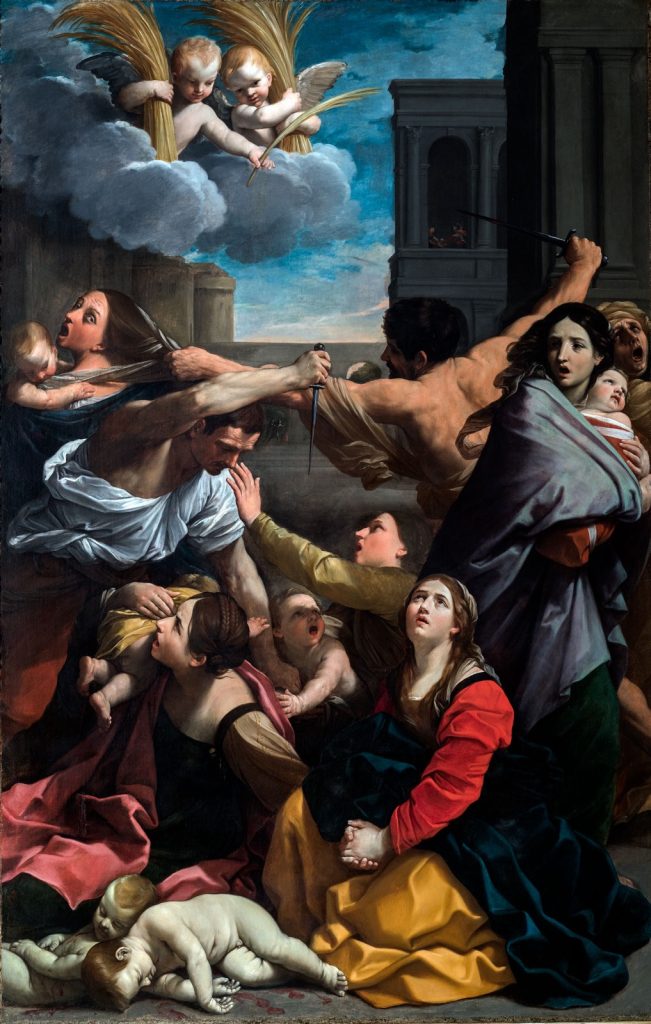
Guido Reni’s Massacre of the Innocents

It was the best of times, it was the worst of times indeed. You can’t visit Bethlehem without hearing the wails of Ramah. That’s just how it is in this sad, tragic, very broken world.

Yesterday, in New Orleans, thousands were gathered on Bourbon Street to ring in the new year and enjoy the atmosphere around college football playoff game. Then, frenzy. Moments before a white pickup truck tore through a crowd of people, the streets were teeming with festive joy and frivolity. Seconds later, the sound of screams and sirens filled the night. Fifteen dead, dozens injured.

So what do we do with that paragraph I wrote? God permits the deaths of innocents, etc. How do we frame those words to people who are in shock over such a senseless act of terror? People who are likely to cancel you straight up for trying to pull the God-is-still-sovereign card.

I confess I want to keep my mouth shut. Just bury my nose in a book and don’t address it. But can we? There is the matter of timing, of course. Maybe don’t bring up Jimmy Carter’s political blunders on the day he died? There’s also the matter of courtesy. Waiting to be invited into the discussion instead of barging in and pontificating.

For the purposes of this post, I am speaking of an event that happened 2000 years ago not something that happened yesterday. The truth still remains, however. God does permit evil to bare its fangs now and then, but only in keeping with two incontrovertible rules:

  • God must win in spite of how everything looks right now.
  • the devil and his kingdom must be destroyed because it has been declared so from the beginning, and God can’t lie.

This world is broken and mercilessly mean, yes, but remember: God is broken-hearted by it; and he is the ONLY one with the power to change things.

Ramah is real. Rachel weeping for her children is our lot in this life. Evil people will do evil things and, I believe, 2025 is going to be filled with more evil and more weeping than in years past. Ramah is hard. Ramah is real.

But so is Bethlehem. “Jesus Joy” is real also.

Herod was the devil in Ramah, to be sure. But let’s not miss the bigger Story: Jesus still got born, shepherds told the news, souls got saved, the Church was born, Christ is exalted, the devil and his demons will burn in the lake of fire forever, and our King from heaven will return to dwell with us. And so shall we forever be with the Lord…in the eternal best of times. Weeping may last through the night, but the Man of Joy gets the final say.

Selah, beloved.

words that say ‘advent’ to me…and a bit of other exciting news

Each year, Sandy chooses a word or phrase that serves as a theme for our holiday season. This year’s word is “merry.” In years’ past, she has displayed “gather” as well as “joy” and “merry and bright” on dishes, pillows, and mementos around the house. One year we basked in “comfort and joy.” I love this tradition. These catchwords and catchphrases are short, relatable, and, yes…incarnational.

The world (much of it, at least) outside our humble little cottage also brands the season by trading greetings that are brought out and dusted off this time of year:

“Merry Christmas.”

“Season’s greetings.”

“Happy holidays.”

”Joyeux Nöel.”

Accordingly, this Holy Advent, I have been struck by the generosity and wonder of another pair of words:

“My people.”

Comfort, comfort my people,”
says your God.

Isaiah 40:1


God, the Eternal, Wholly Other, Transcendent, Invisible, Uncreated, Ageless, Divine Creator and Ruler wants it published near and far that He is not too proud to invoke possessive pronouns when referring to us.

My tribe.

My kind of folk.

My home.

When you love someone, don’t you want to be around them? Spend as much time with them as you possibly can? One of the all-time favorite feel-good Christmas standards is the song “I’ll be home for Christmas.” We swoon to that song because it reminds us of people we want near, those whom we love and miss and cannot wait to see.

The nativity story leaves a prominent trail of breadcrumbs that point to just how much God wants to be near us. The Lord appealed to Joseph through his dreams. Angel Gabriel brought big news to a poorly adolescent girl. A holy choir of angels appeared in the visible sky before an audience of lowly shepherds. The Magi were given a very specific roadmap to visit the infant Messiah. God is personable, reachable, and knowable.

The word that startled the slumbering world on that first Christmas was “Emmanuel.” God with us. You can’t get away from the theme…it’s shot all through the nativity story and beyond. (I mean, must we look any further than a Messiah on a cross who looks at His best friend and tells John to take care of His mama when He’s gone?) And that’s how the Almighty Father has planned it. From Mary’s dramatic assent to offering the womb that would carry the Babe of Bethlehem to His taking on human flesh and being swaddled in earthly vestments, the divine imprint upon humankind has taken hold.


As it also says in Hosea,
I will call Not My People, My People,
and she who is Unloved, Beloved.
And it will be in the place where they were told,
you are not my people,
there they will be called sons of the living God.

Romans 9:25,26


The Lord could have called us “subjects” or “bots” or “playthings.” Pets. We could be nothing more than experiments or throwaways to His almightiness. If we didn’t know better, He might be inclined to turn His magnifying glass on our pathetic beingness and take sadistic pleasure in burning us to cinder like ants. But no.

A God who weeps with us, sings over us (like Mary undoubtedly did as she cradled the Christ Child), who covers us with His wings, keeps His promises to us, prays for us, and speaks to us in our dialect, is the God revealed to us in the scriptures. He’s a people Person.

So, this Advent, may God’s “My people” hit you like it hits me and stir inside you the merriment that you are God’s kind of people, proven in the incarnation and His abiding Presence within.

If I may, I’d love to share with you some exciting news. As I intimated in the last post (over five months ago), I have been working on a manuscript, Though He Fall, that has been, technically, over 40 years in the works. I’m pleased to let you know it will be ready to order in the next few days (paperback version only for now). Keep your eye on my blog site for a follow-up post soon which will detail the when and where of the book and how you can order.

Thank you, beloved. You each have been an invaluable part of my journey, and I’m so happy I could share my news with you first. You are my tribe, my people.

Merry Christmas, people of God!

what started out as a barn

Do you not know that you are God’s temple and that God’s Spirit dwells in you?

1 Corinthians 3:16

Christmas is nearly upon us. We can be certain we will be treated to all forms of ‘baby Jesus in a stable’ scenes and meditations (mine included). While a barn may have housed the babe of Bethlehem, it will not do to accommodate a reigning King.

That’s you and me, friend. We are God’s house. For better or for worse, Jesus makes his abode in us.

The cave or lean-to in which Jesus was born gives a certain charm to the incarnation narrative but is quickly discarded for a house when the Magi show up.


Here’s a question: does our life say ‘barn’ or ‘temple’? Maybe we think we’ve got a dream house going on when really we’re just unstable structures built on sand.


Early on the tabernacle of God was a mobile tent. It sufficed for a time, but it really bothered David.

“Here I am inside a cathedral, while God is out there in a cardboard box!” he groused. David intended to do something about it, but God gently withstood him. We know the reason why, of course, but I think that story reveals something about how we approach life.

Put simply, we aren’t meant for this world. We are called to something more permanent, ever more glorious. Like David, we should be bothered. There should be in us a “holy restlessness” until God gets all that he rightly owns. Us. His temples.

In one gospel story, Peter and his boys had just watched a rich young ruler foolishly walk away from Christ, unwilling to liquidate his assets for the kingdom. What just happened, they wondered.

The disciples couldn’t believe what they were hearing, but Jesus kept on: “You can’t imagine how difficult. I’d say it’s easier for a camel to go through a needle’s eye than for the rich to get into God’s kingdom.”
That set the disciples back on their heels. “Then who has any chance at all?” they asked.

Mark 10:24-26, The Message

The disciples were dumbstruck. They’d been brainwashed to believe since birth that the rich and powerful were fast-tracked into God’s kingdom. Jesus upended that heresy by exposing the hypocrisy of the religious elite. That those (air-quote) other guys (end air-quote) wouldn’t gain entry they understood.

But this guy wasn’t a hypocrite. He wasn’t combative. He was sincere, respectful, even desperate. I mean, he actually ran up to Jesus and fell to his knees! If that’s not an altar call I don’t know what is.

Only he went away lost, owned by his wealth. Eugene Peterson helpfully writes, “His possessions were his millstone strangling the very life from his soul – that is why Jesus touched on the topic of what he owned. ‘It’s killing you man, it’s owning you!’”

The young aristocrat preferred his bigger barn portfolio to the Savior of the world.

Characteristically, Peter just had to inject himself into the uncomfortable silence.

See, we have left everything and followed you.

Mark 10:28, ESV

Except…

…much of what Peter and the others thought to be important was not really so, and that what they thought to be of no importance was often of great significance before God.”

Dallas Willard, The Divine Conspiracy, p. 121

If you’re out here just doing stuff to get reimbursed, rewarded, or recognized — even in the name of Jesus — forget it. That stuff’s just gonna get burned up.

Praise God, we know how the disciples’ story ends. Their faith in — and obedience to — Christ made their lives a fit habitation for King Jesus. They certainly did their share of slumming from time to time, but in the end they were temples.

One day we shall thank God we built with enduring material. It is so easy to let up here and there and work in a little wood or stubble, but blessed is the man (and woman) who will not substitute even the good for the best.

—Vance Havner

Jaroslav Pelikan, Yale scholar and historian of religion, observed:

Jesus of Nazareth has been the dominant figure in the history of western culture for almost twenty centuries. If it were possible, with some sort of super magnet, to pull up out of that history every scrap of metal bearing at least a trace of his name, how much would be left?

—Quoted from The Divine Conspiracy, Dallas Willard, p. 12

Setting aside the meta narrative of human history for a second, let’s address it on a more cellular level:

how much of ‘Jesus’ will be left in us when the fire purges from us everything that is not him?

That’s really the question. Are our respective ‘inns’ so crowded all we can offer Jesus is a mucked-out stable? Is he worthy of more?

As I’m writing this, I’m listening to the pounding of hammers on the other side of the house. For the past 251 days (yes I’m counting!) we’ve been temporarily lodging in a converted garage without a single window. All that pounding and sawing and drilling is sweet music to our ears; it means we will be moving into a spacious suite of rooms with plenty of windows through which the Florida sun can shine all the live long day!

You might say our living situation is a metaphor. I don’t want my life to be a garage without windows. I want to be a wide-open, well-lit, fully-accessible house for my Jesus.

Selah, beloved. Until next time.


[tipjarwp mode=”button” link_text=”Click here to buy me a coffee ☕️ Thank you!” open_style=”in_place”]