Therefore a man shall leave his father and his mother and hold fast to his wife, and they shall become one flesh. And the man and his wife were both naked and were not ashamed.
Genesis 2:24-25
We’re still in the ‘love-obsessed’ month of February, so this episode of the Pasture’s Podcast will focus on three healthy images of marital bliss.
I love all three, but I especially love what the 3rd image displays and says!
(Hint, hint)
>>>It means you gotta listen!<<<
Hey it’s only 25 minutes short. You’ve got that much time to invest in a pretty crucial subject, doncha?
Whether married, getting married, or dreaming of marriage, this episode is for you.
If you are married or engaged, I’d like you to consider listening together with your significant other and talking about it when it’s finished.
My Sandy, improving the coastline scenery of Scotland last year.
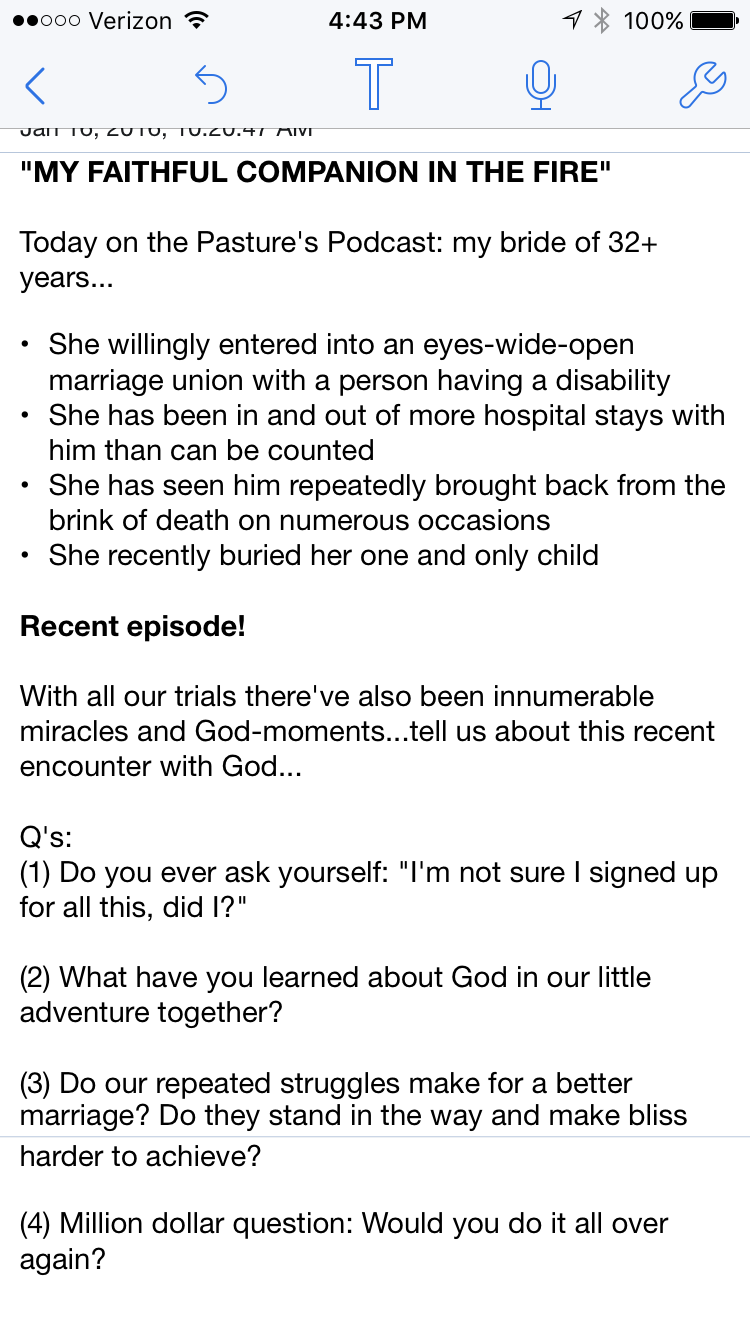
For my 21st podcast I’ve invited the love of my life, my bride, Sandy, to join me and share why she’s been my “Faithful Companion in the Fire” for over 3 decades.
If finding a wife is “a good thing” (Prov 18:22) I’ve easily scored an amazing thing.
Proverbs 31:29
Many women have done excellently, but you surpass them all.”
Quite.
I think, after listening, you’ll understand why I run out of superlatives when I speak of her. What a gift!
Joseph named his older son Manasseh, for he said, “God has made me forget all my troubles and everyone in my father’s family.” Joseph named his second son Ephraim, for he said, “God has made me fruitful in this land of my grief.”
First off, let’s recognize the great white whale in the room.
Life is unfairly hard.
{Agreed.}
Yet God is deliberately good and kind.
There’s a well-known story in the Written Word that goes like this: a younger son is lost in a far country and father dutifully waits for his return. At long last when the day of reunion comes, father falls on his long-lost son’s neck and weeps for joy after which a grand family party ensues.
You know the tune.
Or at least you think you do.
This particular plot is found in the Old Testament not the New. It’s about Joseph, who, by character and demeanor, is a far cry from that other young son who actually chose the far country.
Let’s briefly recap Joseph’s story in the light of that famous chestnut ‘bad things happen to good people’ as it easily applies here.
Young Joseph has a quality his sibling brothers do not share and their father recognizes it and dresses him in a special robe. The Hebrew doesn’t have to mean multi-colored, it can mean long-sleeved. At any rate, it was fit for a prince among tribesmen, and the brothers hated him for it; that, and those self-serving made-up dreams.
They concoct a scheme to kill him off, but Judah steps in and, ostensibly out of some measure of mercy for the lad, edits the storyline to look like a killing when, in actuality, they sell off their brother to a migratory tribe. The final nail involved dipping the blasted coat in animal blood and – Oscar-worthily – presenting it most forlornly to their inconsolable father.
Meanwhile, Joseph, after being sold yet again, lands on his feet by the sheer grace of God. He gets a gig managing the household of the head-dude of Pharaoh’s security detail!
Now, if I’m writing the story, I’m going to exact poetic justice right away. I’m going to have Joseph quickly rising through the ranks and becoming da man in Egypt. His brothers would be sorry, especially when Emperor Joe sent an insertion team into Canaan-land to extract his siblings and throw them at the foot of his throne of justice.
But that’s just me.
We know that God holds the pen, however, and He’s got some things to redeem out of Joseph before He can move on with His ultimate plan.
God doesn’t want Joseph to even toy with the ideas of retribution and payback. He can’t have His man gloating or dismissive. He needs him to be His savior even to the very ones who despised him!
That’s how God writes it.
Joseph’s very cush world gets upended when the boss’s wife cries “rape!” after her repeated (re: daily) attempts to seduce the teenage boy go unrequited, and he suddenly becomes the target of the adage hell hath no fury like a woman scorned.
Hello hell-hole prison.
Forthirteen long, dark, harrowing years.
Forsaken? Forgotten? For what?
▶️ The good son.
▶️ The trusted employee.
▶️ The innocent charge.
You’d think he’d emerge from prison poisoned by bitterness with bloodlustful payback on his mind. Or, at the very least, go to his grave with unyielding unforgiveness brewing his tempest in a teapot. And you’d guess wrong.
Case in point (and I’m skipping over a lot of really cool poetic justice here): Joseph, sentence miraculously commuted, settles into life, settles down with a beautiful bride, and starts a family. Life’s good.
He is given two sons, and the very naming of them speaks volumes of his understanding how life is supposed to work when trust trumps blame and compliance bests complaint.
Joseph insists his firstborn be called “folly forgotten” and his second, “fruitful hardship”. Imagine! James M. Boice points out the order had to be thus for
“no one can really be fruitful until the past is forgotten in the proper sense. If we are living in the past, whether that is the past of unconfessed sin, hurts, suffering, or even old blessings, we will never be completely fruitful in the present. We must let the past be the past, forgetting it, and go on with God.”
It’s the name of the second-born (Ephraim) I’d like to comment on because it’s so my own story.
In each decade since my early 20’s I’ve faced death in one way or another. Some decades brought me to the brink more than once.
Most recently I was spirited from my home in the middle of the night by EMT’s who couldn’t find vital signs. I was septic, dehydrated, losing vision, and barely responsive. Later I’d be told I got to the ER in barely enough time or we’d be looking at a far different outcome. I didn’t ask what that meant but I have a good idea.
I’m in my mid-fifties and this is the third time in this half-decade God’s miraculously preserved my life, I can only presume, for more ‘preservation of life.’1 There are still some assignments ahead for me.
As a 21-year old I prayed, “Lord, put me in a fire and don’t ever let up.” As such, suffering has been the mark of my life – AND I WOULDNT CHANGE A THING. Through many dangers, toils, and snares, I’ve found a depth of intimacy with Christ I wouldn’t have found otherwise.
Like Joseph, I want the product of my life to tell the story that I’m doubly blessed and fruitful from all my afflictions, and God has been doubly kind to allow me the privilege of suffering for His glory and name.
This is my story, this is my song, praising my Savior all my life long:
Praise God for loss.
Praise God for the fire.
Praise God for heart-brokenness.
Praise God for weakness.
Praise God for humility.
Praise God for the tough times.
Praise God for the sweetness of the fruit that grows from the soil of hardship.
If any of this sounds weird, it’s only because I’m trying to live up to my name. You can call me Ephraim.